
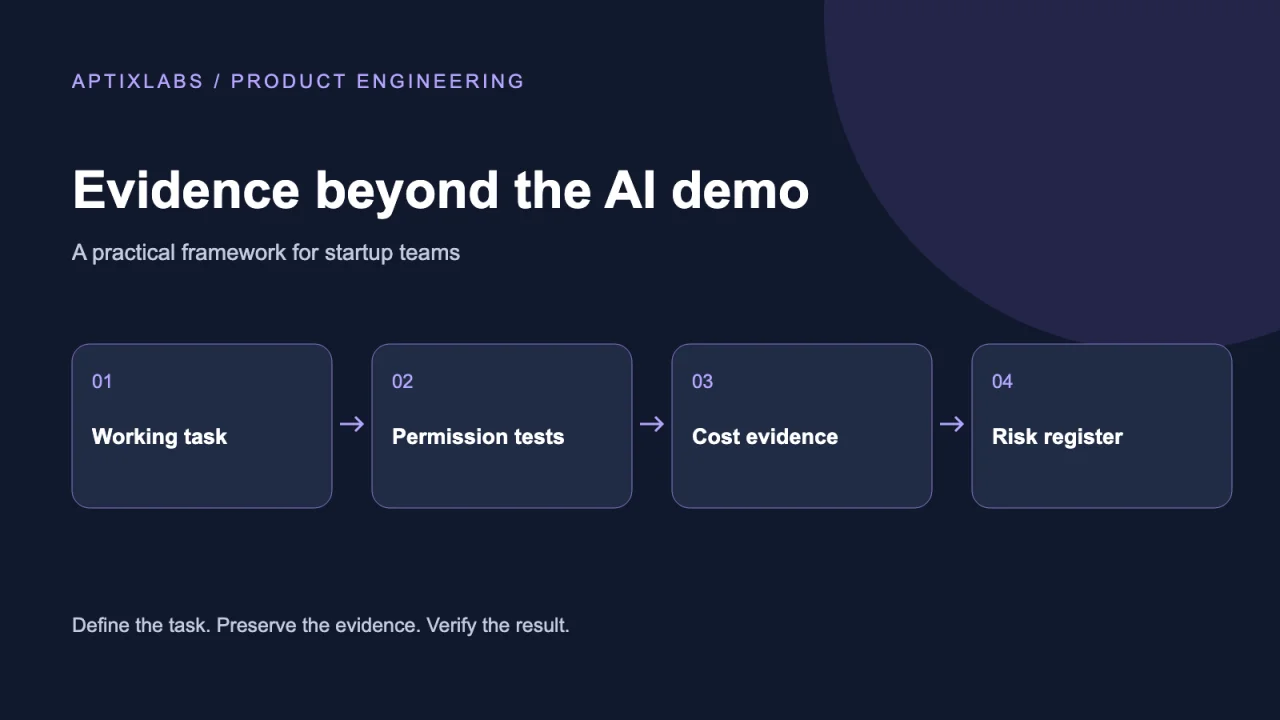
For an AI startup, technical due diligence should establish what the product reliably does, which parts depend on outside providers and what evidence supports the operating assumptions. A polished demo is useful, but a founder also needs a traceable task, permission tests, a cost model and an honest account of unfinished work.
Why the AI label is not enough
Carta's Q1 2026 report, published in May, says more than 60% of the venture capital raised by companies on Carta that quarter went to AI companies. That is a dated observation about Carta's dataset, not the whole market, a forecast or evidence that adding AI will improve a particular startup's funding prospects.
Our engineering inference is narrower: when AI is prominent in a pitch, the team should be able to explain the product behind the label. The checklist below is a preparation tool for founders and technical reviewers, not investment advice or a promise of financing.
Begin with one inspectable task
Pick a representative user request and preserve a reproducible trace from input to saved result. Identify the account, permission checks, model calls, product operations and failure response. Use synthetic or properly redacted examples instead of putting customer health records into an investor data room.
UltraFit360 offers a useful engineering example. Its reviewed MCP wrapper carries verified identity and scopes into tool dispatch, and its coach registry distinguishes different tool behaviours. Those concrete mechanisms can be explained and tested. Their existence alone does not prove a security certification, a customer outcome or investment readiness.
Separate implemented, deployed and validated
Maintain a feature ledger with three distinct questions. Is the code implemented? Is that version deployed for the intended users? Has its behaviour been validated against an acceptance criterion? A source review can answer the first while leaving the other two open.
This distinction is particularly important for AI fitness products. A native pose-detection helper may support photo alignment without supporting exercise-form correction. A calculated recovery score may be available in the interface without being clinically validated. A precise description is more defensible than a slide that bundles those claims together.
Make the operating model inspectable
For one representative workflow, estimate model usage, tool calls, storage, delivery and human review separately. State the assumptions and the date of any vendor prices. Include retries and unsuccessful attempts: a model call that does not complete the task still costs something.
A useful worksheet is: cost per completed task equals the total measured cost of all attempts, plus allocated review cost, divided by completed tasks over the same period. This is a proposed measurement approach, not an UltraFit360 cost result. Do not substitute a hypothetical worksheet for actual operational evidence.
A compact technical evidence room
- Product: a reproducible task, acceptance criteria and the current feature ledger.
- Architecture: a diagram of the app, backend, storage and third-party dependencies, with named owners.
- Reliability: denied-access cases, retry behaviour, failure handling and the unresolved risk register.
- Economics: dated usage assumptions, measured cost where available and sensitivity to more retries or longer interactions.
- Data: consent boundaries, retention and deletion behaviour, with unresolved legal or compliance questions assigned to qualified reviewers.
- Delivery: deployment history, rollback procedure and a short account of what remains manual.
Use the gaps to set the next milestone
A missing artifact is a useful planning signal. If the product has a compelling demo but no denied-access tests, the next milestone may be authorization evidence. If the model works but nobody measures review time, the next milestone may be a workflow baseline.
Founders can use this preparation before a financing conversation or a paid pilot. The practical outcome is the same: a clearer statement of what exists, what has been demonstrated and what still requires work. AptixLabs can help translate that statement into an implementation and evaluation plan.
Sources and next steps
Carta: State of Private Markets, Q1 2026
Discuss a related implementation with AptixLabs
Does an AI feature guarantee investor interest?
No. Funding reports describe particular datasets and periods. A startup still needs to demonstrate its own product, customer need and operating evidence.