
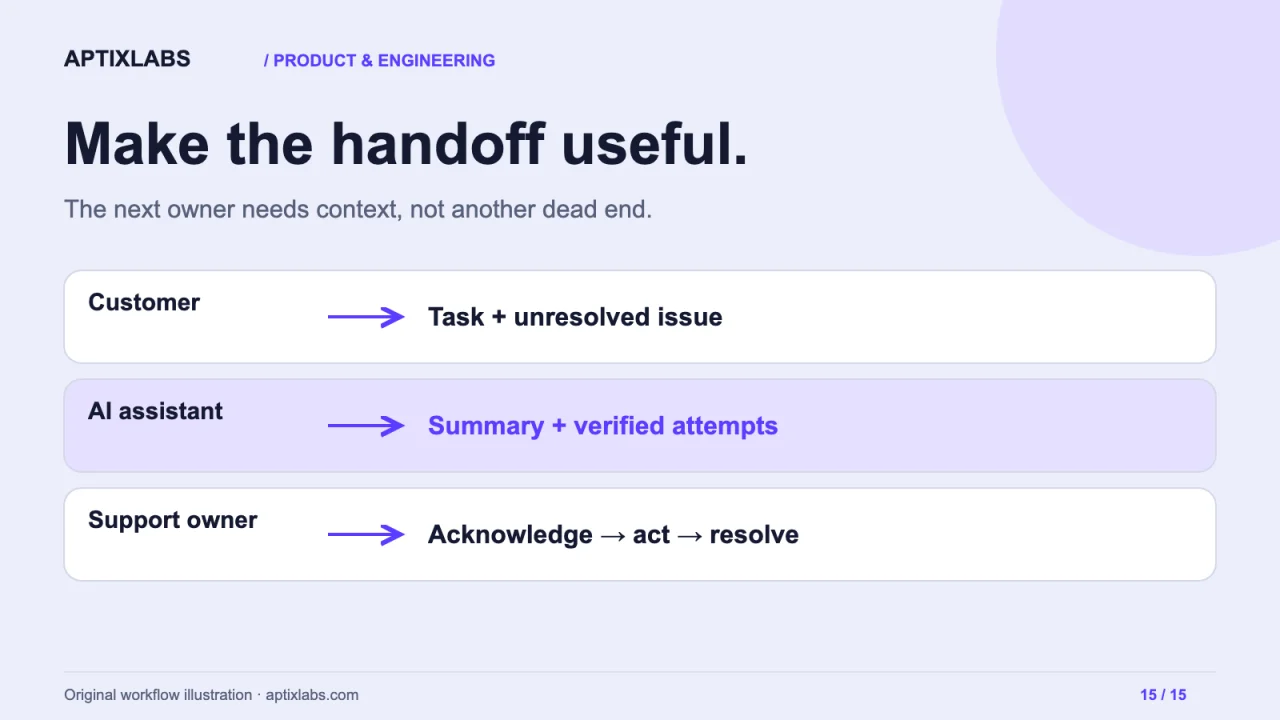
An AI support agent that cannot solve a problem should leave the customer closer to help. That means creating a useful handoff, naming the next owner and preserving context. “Contact support” after a long conversation is not a complete escalation flow, especially if the customer must repeat every detail.
Define handoff triggers before the pilot
Some triggers are explicit: the customer asks for a person or a requested action is outside the assistant's permissions. Others depend on the workflow, such as repeated failed attempts, conflicting account information or an issue requiring a billing decision. Treat confidence scores cautiously; a fluent answer can still be wrong.
Separate support from health advice. In a fitness product, an assistant can help with a missing workout log or a sync setting, while a report about pain or an emergency requires a different response policy. Do not route sensitive disclosures through an ordinary troubleshooting script without deciding how they should be handled.
Build an escalation packet
| Field | Useful content | Exclude by default |
|---|---|---|
| Customer task | What the person tried to accomplish | Unsupported assumptions about intent |
| Account context | Verified account and affected feature | Unrelated private records |
| Attempts | Steps already tried and their results | An unfiltered internal debug dump |
| Evidence | Relevant error or operation identifiers | Passwords, tokens and secret values |
| Requested outcome | The action needing human review | A promise the support team has not accepted |
| Routing | Queue, priority reason and case status | An invented response deadline |
Let the customer review a concise summary when appropriate. Preserve a link to the original conversation for authorised staff, but do not make the full transcript the only description. A summary should distinguish what the customer reported from what the system verified.
Make ownership visible
Creating a ticket and assigning an owner are separate steps. Define the queue responsible for unassigned cases, what happens outside support hours and how failed ticket creation is surfaced. Tell the customer whether the request was saved, assigned or waiting. Do not say a person has been notified until the relevant delivery outcome supports that claim.
Intercom's Fin documentation describes handoff to an inbox, email or another support tool. Those destinations illustrate the integration choices; a product team still needs its own ownership, availability and status-message rules.
Reference: Intercom's AI conversation handoff documentation
Evaluate resolution rather than silence
A customer leaving the conversation is not proof of success. In a pilot, examine whether the intended task was completed, whether a person had to repeat work and whether the case reopened. Track the delay between the handoff request and human acknowledgement separately from the agent's response latency.
Use a small set of realistic cases with known expected outcomes. Include a solved settings question, an unavailable integration, a permission failure, an incorrect first answer and a direct request for a person. Review the handoff packet and the receiving team's ability to act, not merely the generated response.
Related: evaluating tool-using AI agents
Start with one support workflow
UltraFit360's app and coach portal provide concrete product contexts for account, plan and check-in questions. This article does not claim an automated support-resolution rate for them. For a new support assistant, AptixLabs can scope one workflow, the permitted tools and its human exit path. Expand after the team can explain both the solved cases and the failures.
When should an AI support agent hand over to a person?
Define triggers for explicit human requests, actions outside its authority, unresolved attempts and issues requiring human judgement. The policy should reflect the product and support team’s responsibilities.
Is ticket creation proof that a support handoff succeeded?
No. Verify that the case reached the intended queue, has a clear owner or assignment process, and gives the customer an accurate status. Track acknowledgement and eventual resolution separately.