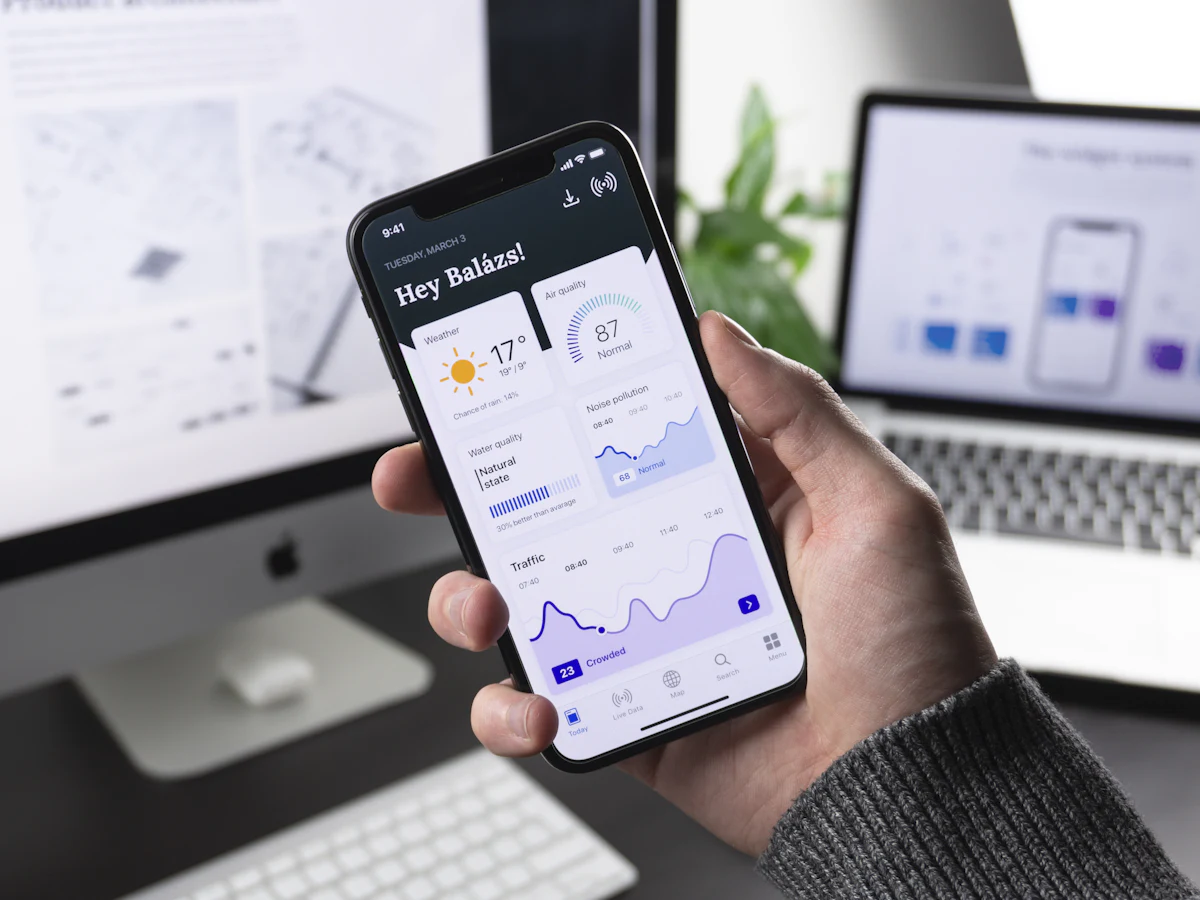
UltraFit360 is the studio's flagship product — a consumer fitness app that ships from a single React Native codebase to both iOS and Android. After six months in market it sits at 5,000+ Android installs, 700+ iOS installs, and a 4.8★ App Store rating.
Why React Native
A two-engineer team can't maintain two native codebases. React Native gives us 95% shared code with native escape hatches for the parts that matter — HealthKit and Health Connect bridges, WatchConnectivity for live workout sessions, and platform-specific bottom-sheet behaviour.
How real-time works
Firestore is the heartbeat. Workouts, programmes and progress documents stream to the device via onSnapshot listeners. When a user finishes a set on their watch and it writes to Firestore via the phone, the same record streams to the coach's open dashboard within 100–300 milliseconds. There's no WebSocket server. Firestore is the message bus.
Audio coaching at runtime
Voice coaching uses ElevenLabs streaming voices generated on demand from a coach's text script. The same coach voice can cover thousands of new workouts without re-recording. Latency-sensitive paths use the streaming endpoint; longer-form audio is generated ahead of time and cached in Cloud Storage.
What we monitor
- Firebase Crashlytics for crash-free session rate (target: 99.5%+)
- Firebase Performance for cold-start time and screen-render time
- Custom Firestore traces for sync latency on key user actions
- App Store and Play Store review velocity and rating drift
The hardest 5% nobody warns you about
Shipping the happy path of a fitness app is quick. The time goes into the edge cases: a workout interrupted by a phone call, a watch that disconnects mid-set, a user who changes timezones on a flight, a programme edited by a coach while the member is halfway through it. Each is rare individually and inevitable across thousands of users. We budget explicitly for this tail, because it is exactly what shows up in one-star reviews.
What we would do differently
- Instrument retention from day one — we added cohort analytics later than we should have, and flying blind on week-one drop-off cost us iterations
- Ship the offline story before the social story — connectivity failures hurt trust faster than a missing leaderboard
- Treat the App Store listing as part of the product — screenshots and the first screen move installs more than a feature does
None of these are framework problems. They are product-judgment problems, and they are the reason hiring a team that has already shipped a fitness app beats hiring one that is about to learn on yours.