
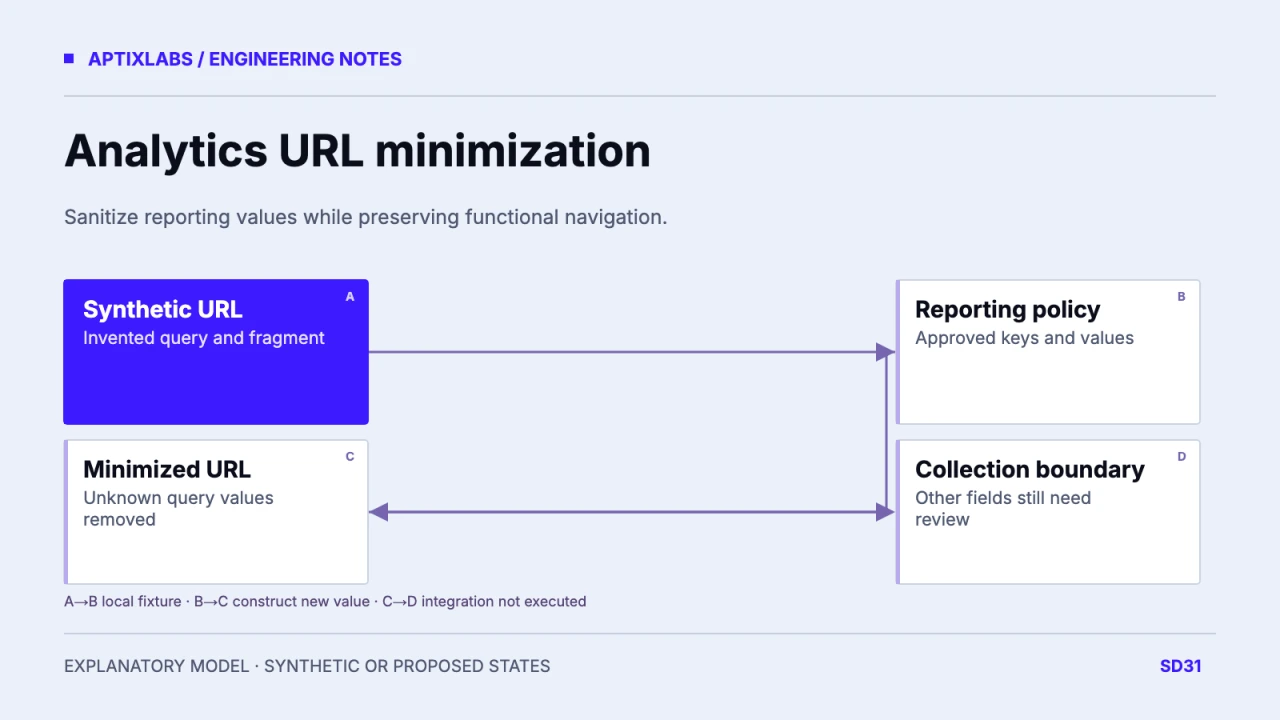
Audit analytics URL fields independently from custom event allowlists. Build a minimized reporting URL before collection, and verify automatic page views, referrers and client navigation as well as manually emitted events.
Inventory every source of page location
List initial page views, router changes, enhanced measurement, tag-manager variables, custom wrappers and server-side ingestion paths. A safe set of custom contact fields does not constrain a separately collected page_location. The inspected repository illustrates that distinction: its contact attribution validates known content identifiers, while page-view handling supplies the browser location through a different path. That is a source observation, not evidence that any actual private value was collected. Evaluate the configured runtime and collected payloads with invented data before making a claim about exposure or remediation.
Define permitted keys and values
Choose which query fields are needed for a real reporting decision. An allowlisted key can still carry arbitrary private text, so review the value domain too. Google’s web-stream data-redaction feature supports email-pattern and configured query-parameter redaction, with documented limits. It is a useful layer, not a substitute for avoiding private data in URLs. Do not place names, tokens or messages into campaign fields. Define a reporting route policy as well: removing query strings does not sanitize a private identifier embedded in the path, and fragments can contain sensitive state even when omitted from HTTP requests.
| Synthetic input | Reporting output |
|---|---|
| email + token + lang=en + fragment | Only lang=en retained |
| utm_source=demo@example.test + lang=ar | Only lang=ar retained |
| utm_source=linkedin + email | Only approved source retained |
| Private identifier in path | Outside this fixture; normalize separately |
Inspect the executed synthetic sanitizer
The isolated local fixture constructs a new reporting URL from origin and path, then accepts only lang values en/ar and utm_source values linkedin/newsletter. It strips fragments and all other query keys. An invented URL containing email and token becomes https://example.test/contact?lang=en. A private-looking value placed inside utm_source is also removed because it is outside the approved value set. The saved result contains synthetic inputs only. This validates a narrow query policy, not a complete production privacy layer: path normalization, origin restrictions and every collection route still need their own contract.
const clean = new URL(url.origin + url.pathname);
if (["en", "ar"].includes(url.searchParams.get("lang"))) {
  clean.searchParams.set("lang", url.searchParams.get("lang"));
}
// Narrow query example: add route normalization and audit all collectors.
Keep functional navigation separate from reporting
Do not blindly rewrite the actual browser URL to match the analytics representation. Functional parameters may be needed for confirmation, routing or cross-domain measurement, and changing them can break the task. Construct a minimized value for reporting at the collection boundary instead. Review page_referrer, link destinations and automatic fields under the same policy, and prevent automatic page views from firing earlier with a raw URL if the integration requires explicit collection. The exact configuration depends on the installed tag path. A helper function alone cannot prove that another tag or SDK uses it.
Verify initial load and navigation with invented values
Use a clean browser session and synthetic query fields for both a direct load and an in-app route change. Inspect outgoing requests, debug output and any export sample permitted by the account. Check refresh, back navigation and denied-consent behavior. Do not send real private data merely to see whether redaction works. Keep before-and-after payload examples with the policy version. The local fixture did not contact Google Analytics and no production configuration was changed. A complete release needs evidence from the actual collection paths and a review of paths, titles and referrers too.
GA4 leads versus form attempts
Bring the collection inventory and approved URL policy to scope verification of the reporting boundary.
B2B SaaS development: scope and acceptance
Does a custom-event allowlist sanitize page_location?
Not automatically. Audit page URL collection and automatically supplied fields as separate paths.
Should the sanitizer delete all functional browser parameters?
Construct a minimized reporting value separately. Preserve required navigation and linker behavior under its own contract.