
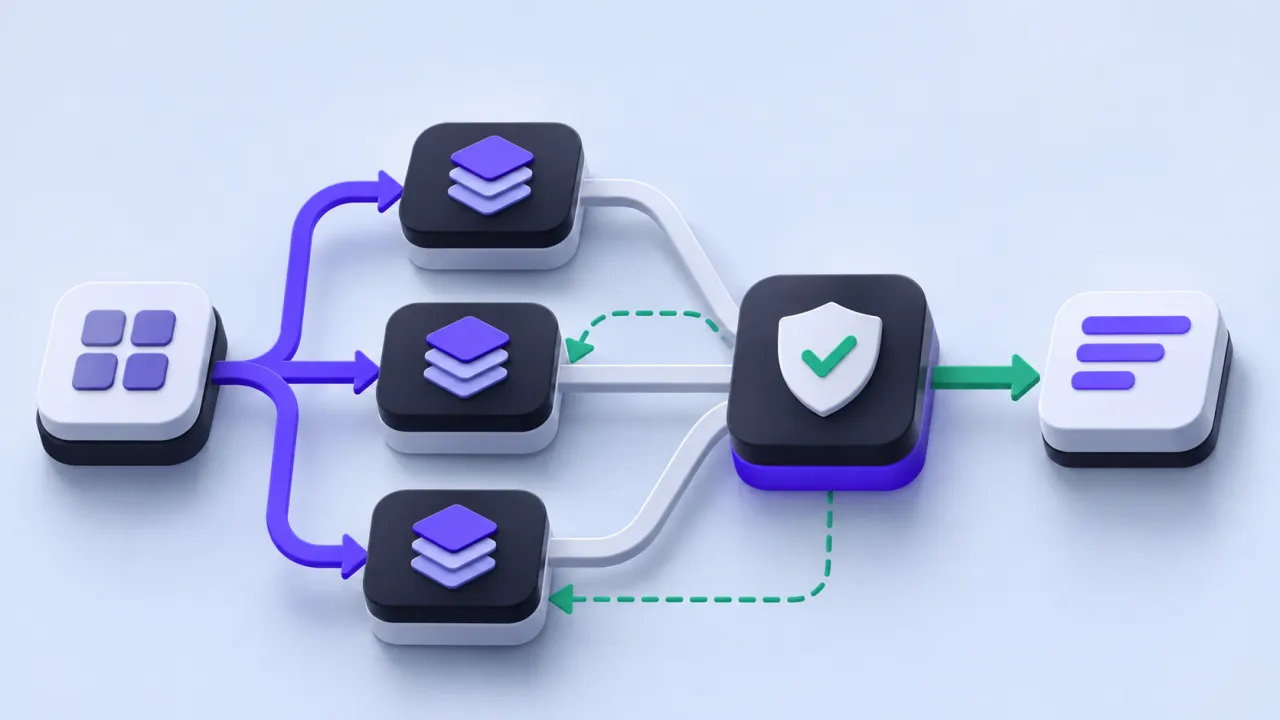
Fallback routing is useful only if the fallback can satisfy the same task contract. A cheaper or faster model may have different tool support, output behavior or context limits. Production routing should be driven by a defined failure condition and an evaluation set, not an assumption that any available model is interchangeable.
The contract to define first
Separate availability fallback from quality routing. An unavailable provider can trigger a compatible alternative, while a difficult task may require a different route before execution. Record which model served the request and validate outputs identically. Keep tool-side authorization unchanged, and do not replay a completed external action merely because a second model generated a new plan.
A worked scenario
For a synthetic workout summary, both routes must preserve dates, units and missing-data labels. A fallback that produces fluent prose but fabricates a recovery value fails the contract. Compare completion quality and cost per accepted result, including retries and escalations.
An implementation and review sequence
- Define explicit routing triggers and compatible capabilities
- Build a shared task and output evaluation set
- Track accepted results by route and provider
Failure cases worth testing
| Condition or input | Expected behavior |
|---|---|
| Primary provider is unavailable | Only a compatible route is selected |
| Fallback returns a different schema | Validation catches the mismatch |
| A previous tool write already succeeded | The fallback does not execute it again |
Download the illustrative acceptance checklist (JSON)
Tradeoffs and limits
Fallback adds configuration and testing overhead. A narrower product that admits temporary unavailability may be preferable to an untested chain of providers for sensitive workflows.
Use the result to make a decision
The practical output is straightforward: compare timeout and quality fallbacks on a labelled synthetic evaluation set. Keep the assumptions with the artifact so a product owner, implementer or prospective partner can review the same decision. A useful handoff states the supported scope, the evidence collected and the remaining dependency instead of treating a successful demonstration as proof of every operating condition.
Continue with related implementation detail
Related guide: Budget AI features per completed task.
AI chat streaming that survives reconnects
AI agent retry and timeout design
References and current platform requirements
MCP specification and tool contracts
Google Cloud: AI security and safety for MCP
Platform capabilities, programme terms and access conditions can change. Check the linked primary references against the version and account you actually use; the patterns above do not establish a provider approval, certification or universal compatibility guarantee.
Discuss the workflow
Bring one workflow, its systems, and the actions requiring human approval.
Explore the relevant AptixLabs service
How should a fallback model be evaluated?
Fallback routing is useful only if the fallback can satisfy the same task contract. Fallback adds configuration and testing overhead.
Which failure cases should be included in the review?
Include these explicit cases: Primary provider is unavailable: only a compatible route is selected; Fallback returns a different schema: validation catches the mismatch; A previous tool write already succeeded: the fallback does not execute it again.