
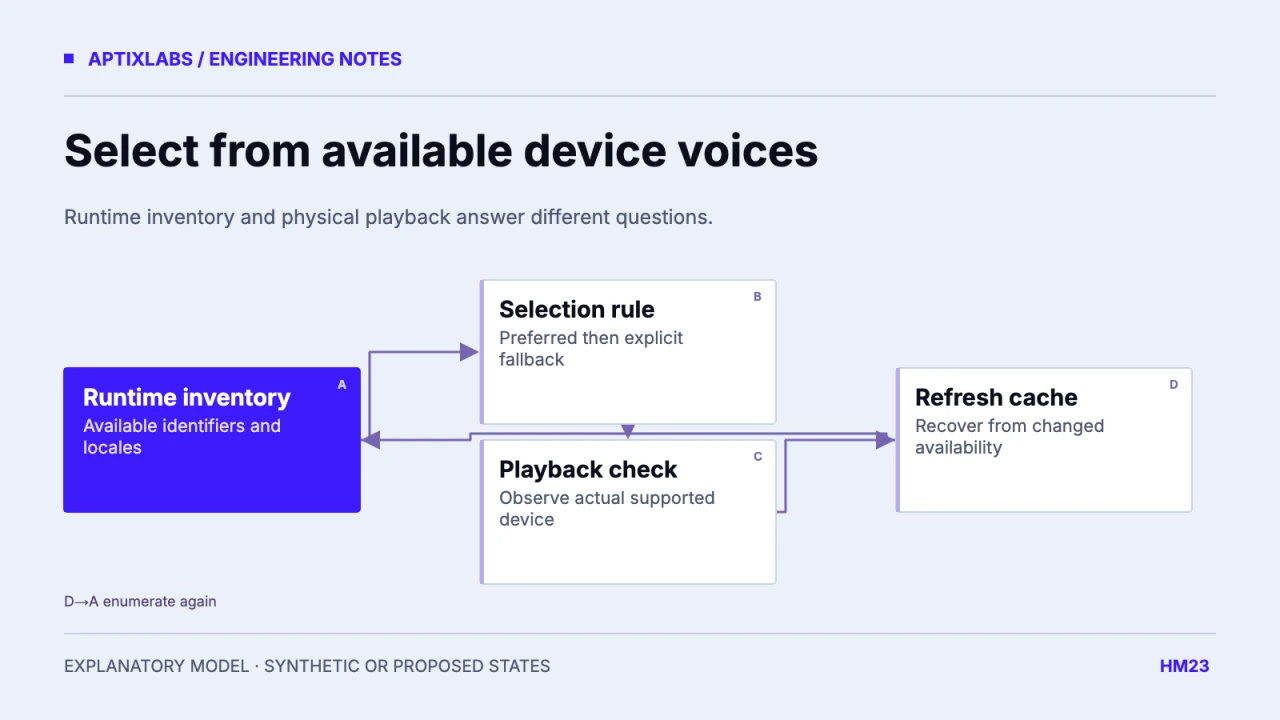
A React Native TTS feature should enumerate available voices and select a supported identifier at runtime. Do not promise an offline voice merely because one development phone speaks successfully. Voice engines, installed resources, locale support and platform settings can differ between supported devices.
Prerequisites are the actual Expo Speech version, target locales, supported platforms and a text fallback. Keep the requested locale, selected voice identifier and observed playback result separately. A successful enumeration is useful evidence about available choices at that moment; it is not a guarantee of future playback or offline operation.
Select from the actual runtime list
Expo documents getAvailableVoicesAsync and voice identifiers returned by that call, noting that availability depends on the device. Use that runtime inventory rather than hardcoding one identifier found on a test phone. Treat display names as presentation and identifiers as platform-specific selections.
Expo: runtime voice enumeration and identifiers
| Available fictional inventory | Requested choice | Proposed outcome |
|---|---|---|
| Preferred voice and locale match | Preferred identifier | Select it |
| Locale match, preferred ID absent | Preferred identifier | Choose an available locale fallback |
| Only another supported locale | Requested locale | Apply explicit language fallback or text |
| No usable voice or enumeration failure | Any voice | Keep text and report voice unavailable |
The identifiers are fictional; the table is not an executed device inventory. A fallback should preserve language intelligibility before a subjective preference for voice quality. Avoid selecting the first arbitrary voice merely to avoid an empty result. If the requested language is unsupported, communicate the limitation in the interface.
Cache a choice without making it permanent
The reviewed UltraFit360 voice helper enumerates voices, selects per platform and caches an identifier or null while sharing an in-flight selection promise. That is a useful source pattern for avoiding repeated enumeration. A process-long cache can also retain a failed or outdated choice after voice resources change, so define when it should be refreshed.
Consider refreshing after an explicit retry, relevant settings change or a playback error that indicates the selection is no longer usable. Avoid re-enumerating on every render. Preserve the difference between “enumeration failed” and “enumeration succeeded with no suitable voice,” because they lead to different diagnostics and recovery copy.
Test offline as a separate capability
Use airplane mode or another controlled offline condition on a physical test device, then start a cue that was not already being spoken. Record the engine, selected voice, locale, OS, build and result. Repeat after installing or removing voice resources where the supported platform allows it. Do not claim a downloaded or network-backed voice behaves like every other voice.
A selection algorithm can be tested with a synthetic list, but only device playback can establish that combination’s observed offline behavior. If a feature needs guaranteed offline instructions, define the supported asset or engine strategy and its acceptance evidence instead of treating runtime enumeration as the guarantee.
Keep a failed voice from blocking the task
Show the instruction text and a useful retry or settings route when speech cannot start. Keep cancellation responsive and prevent a failed cue from remaining permanently “speaking.” Voice availability belongs alongside playback state, not inside an unexplained spinner that hides the workout action.
No real-device voice inventory or offline playback was executed here. The article supplies a proposed fallback matrix grounded in the reviewed selection helper. Before release, retain the supported-device results and inspect their actual audible output with the intended language content. A source comment about voice quality or universal presence is not substitute evidence.
Keep pronunciation review separate from voice availability. A voice can be present and audible while reading exercise abbreviations or numbers poorly for the intended audience. Use a short fictional cue set with representative units, punctuation and exercise names. Review the audible result in each supported language and retain text alternatives. Do not describe a voice as better simply because its metadata says enhanced; quality selection is a product preference that still needs evaluation of the actual content.
Bring the supported devices, installed SDK versions and a reproducible lifecycle or UI failure to scope a mobile engineering assessment.
Explore react native development
Can a React Native app assume its preferred TTS voice is available offline?
No. Enumerate runtime voices, select an available identifier and verify offline behavior on each supported device and engine combination.
Does a returned voice identifier prove offline playback works?
No. Offline behavior needs a separate physical-device test for the selected engine and voice.