
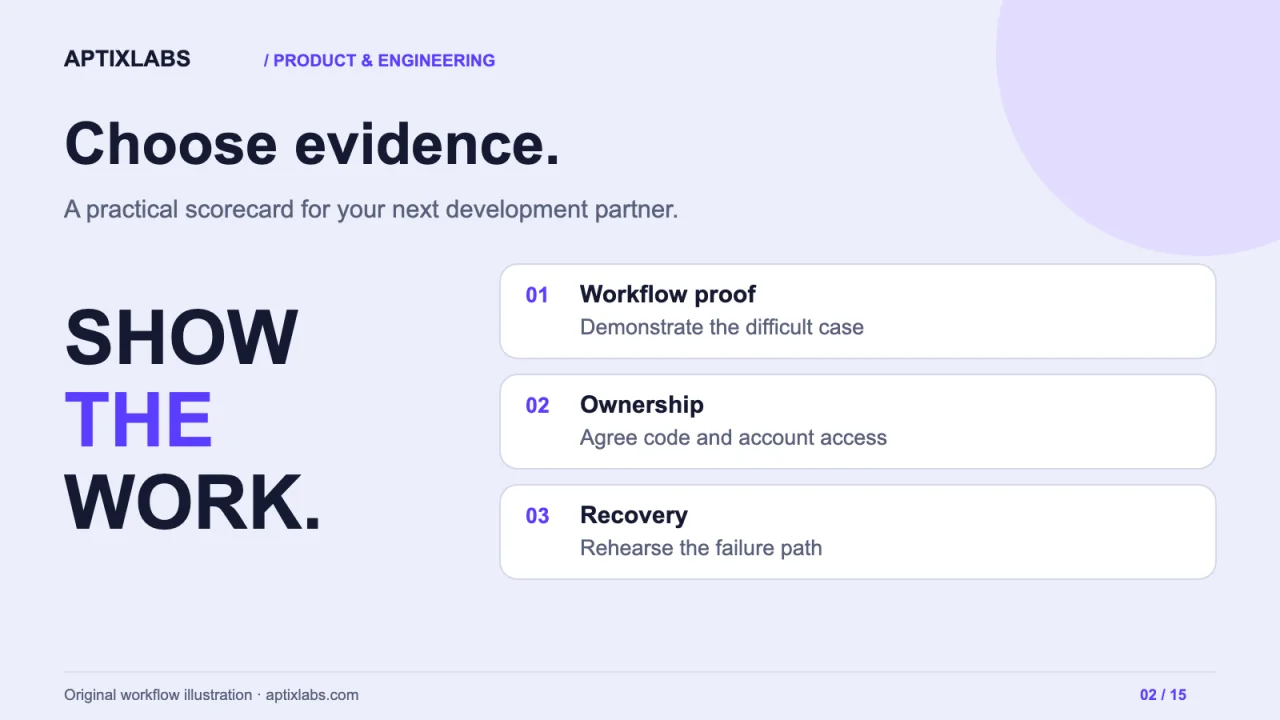
A SaaS development partner should be able to explain how a customer task becomes a working, operated product. Attractive screenshots help you assess design taste. They do not show whether permissions work, deployments can be repeated or someone will recover a failed integration. Evaluate those responsibilities before making a long commitment.
Send a brief that reveals the difficult part
A useful request for proposal fits around one customer, one workflow and the main constraints. Describe what the customer does today, what the first release must change and which existing systems it must connect to. Include a sample record with confidential details removed. State launch constraints and explain which are fixed versus negotiable.
Ask each supplier to identify uncertainty in the brief. An honest question about missing data or an integration dependency is useful evidence of understanding. A proposal that repeats every requested feature without explaining sequencing or risk gives you little basis for comparison.
- Audience and buyer: who uses the product, who approves it and who pays.
- First workflow: starting state, user actions and acceptable final state.
- Existing assets: code, designs, data, infrastructure and vendor accounts.
- Boundaries: excluded features, required platforms and access restrictions.
- Delivery evidence: demonstrations, tests, handover and support expectations.
Ask for a small acceptance demonstration
Consider a hypothetical workspace invitation flow. An administrator invites a colleague; the colleague joins the intended workspace; a user from another organisation cannot read its records. Ask the team to explain how it would verify the negative case as well as the happy path. A paid discovery or feasibility engagement can make that explanation concrete without pretending the entire product is already specified.
The evaluation should respect the supplier's time and intellectual property. Agree the scope, fee, ownership and permitted use of any demonstration. Avoid requesting unpaid production work from several teams and comparing the polish of what they could afford to give away.
| Decision | Useful evidence | Weak substitute |
|---|---|---|
| Product understanding | Workflow with exceptions and exclusions | A copied feature list |
| Engineering quality | Walkthrough of boundaries and failure recovery | A framework logo wall |
| Delivery reliability | Named milestones and acceptance criteria | An unexplained launch date |
| Ownership | Repository, deployment and handover terms | A verbal promise of access |
| Support | Responsibility and escalation agreement | “We will take care of it” |
Read the handover terms early
Clarify who controls production accounts, source repositories, domains and third-party subscriptions. Define how secrets are transferred or rotated, how someone else can deploy and what documentation describes background jobs and backups. A handover should be demonstrable: a second authorised person follows the runbook and completes the agreed operation.
Also distinguish a defect from a new request. Agree how each is recorded and prioritised, and what support is included after acceptance. This avoids turning every product decision into a disagreement about the original estimate.
Look for a visible working method
thoughtbot publishes a business-development process built around understanding outcomes and qualifying fit. That transparency is worth looking for in any supplier, although its specific engagement model is not a universal rule. Ask a prospective partner to explain its own method with examples and trade-offs.
Reference: thoughtbot's business-development playbook
AptixLabs can show implementation context from UltraFit360's mobile app, coach portal and backend. Treat it as a reference to discuss relevant decisions, not proof that your project has identical requirements. Bring a workflow and the biggest unknown; the next useful step is an agreed scope and evidence plan, not a generic promise to build everything.
What should a SaaS development RFP contain?
Include the target user, first complete workflow, existing systems, constraints, exclusions and acceptance evidence. Ask suppliers to identify assumptions and dependencies explicitly.
How can I assess a development agency without a large commitment?
Use a mutually agreed discovery or feasibility scope with a clear deliverable, fee and ownership terms. Evaluate the reasoning and demonstrable result rather than requiring unpaid production work.