
B2B SaaS development for connected customer workflows
We help product teams turn a customer workflow into a working SaaS application. Start with the people, records and integrations involved; agree the first complete journey, ownership and evidence before expanding the roadmap.
Start a conversationWhat's included
- Workflow discovery and a scoped first-release plan
- Web applications and connected mobile experiences
- Backend APIs, data models and account boundaries
- Customer onboarding, imports and integration workflows
- Billing, identity and AI feasibility assessment
- Acceptance checks, release preparation and handover planning
Begin with a complete customer task
An invitation, an imported record and a completed action reveal more than a dashboard mockup alone. We map who performs the task, which records change, what access is required and how failure is handled. That becomes a reviewable first milestone with explicit exclusions, so the estimate describes a product you can accept.
Connect the interface to the operating model
A client app, an administrator portal and a background worker need a shared understanding of identity, ownership and state. We define those boundaries around your workflow, including what happens when a member leaves or an integration becomes unavailable. Web versus mobile is a requirements decision; not every first release needs both.
An implementation reference from UltraFit360
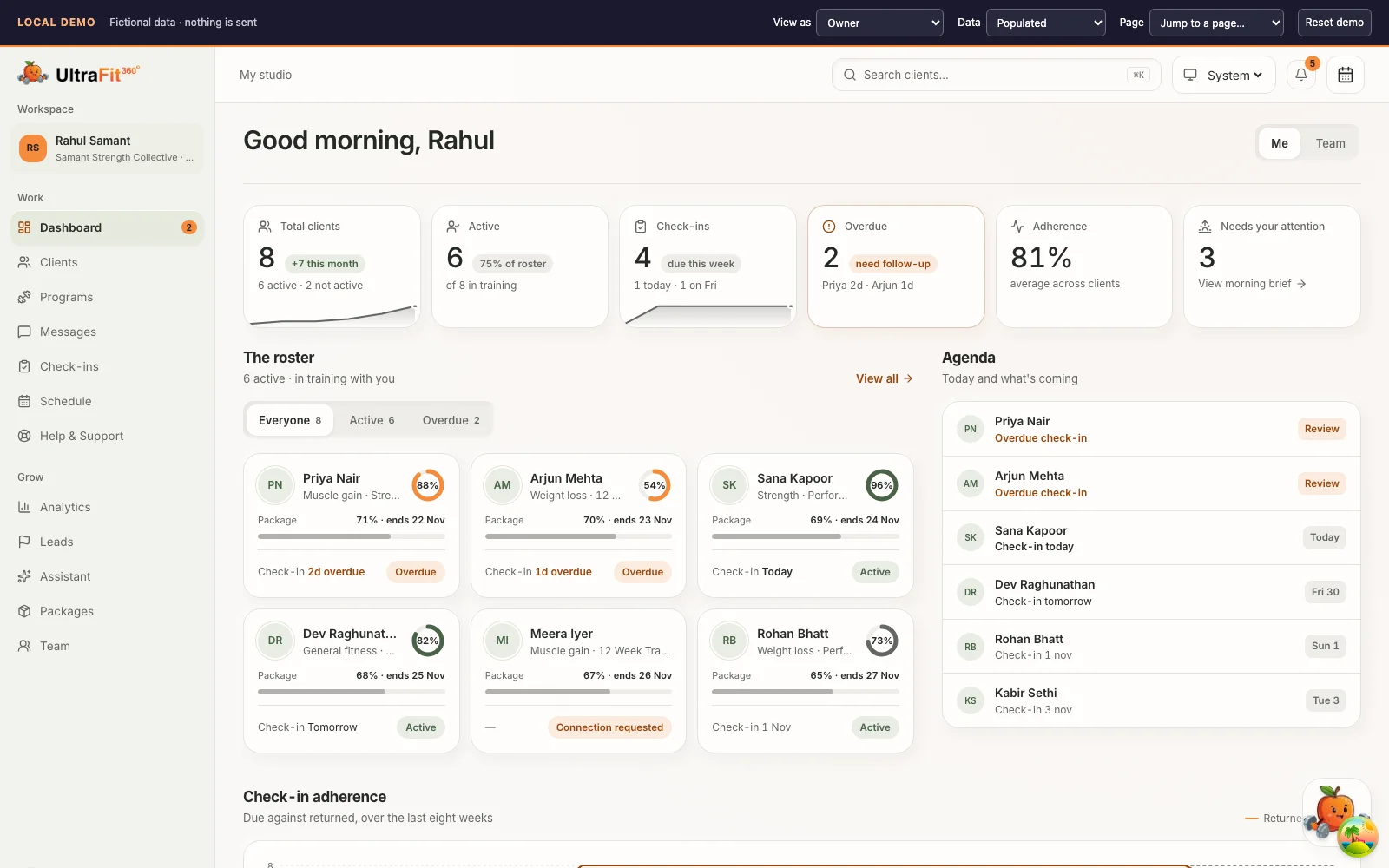
AptixLabs builds UltraFit360: an Expo and React Native client app, a coach web portal and backend workflows using FastAPI, PostgreSQL and Firebase Auth. Its code provides concrete examples of account context, programs, check-ins and connected interfaces. We use that evidence to discuss relevant decisions without presenting it as a claim about your delivery time, customer results or every enterprise feature.
Treat important integrations as separate work packages
Billing needs an agreed unit and reconciliation path. Enterprise identity needs a lifecycle and access-removal tests. AI tools need scoped permissions and verifiable outcomes. We identify required vendor access, existing components and unknowns before committing to implementation. When feasibility is uncertain, a bounded investigation can produce evidence for the wider estimate.
Compare quotes through assumptions and acceptance
Bring existing designs, redacted sample data, required platforms and a launch constraint. We separate the first release from later features and discuss which responsibilities belong to your team. A proposal should name assumptions, dependencies, acceptance evidence and change handling. Ongoing infrastructure, support and maintenance are distinct from initial development and should have named owners.
Prepare for operation and handover
The engagement can include source code, deployment instructions, data and API documentation, integration runbooks and agreed verification evidence. Repository and infrastructure ownership, support responsibilities and any continuing service are defined in the scope. We discuss the actual recovery and release tasks someone must perform after launch rather than treating a deployed URL as the end of product ownership.
Frequently asked
Can you work on an existing SaaS product?
We can assess an existing codebase and workflow before proposing a scope. Share the current stack, ownership arrangements, known issues and the first outcome you need. The assessment determines dependencies and appropriate acceptance checks.
How do you estimate a B2B SaaS project?
We use agreed workflows, supported platforms, integrations and operating requirements. Estimates state assumptions and exclusions; uncertain dependencies may need a feasibility milestone before a larger commitment.
Do you guarantee a fixed launch date or business result?
Delivery commitments depend on an agreed scope, dependencies and responsibilities. Customer adoption, revenue and search rankings are separate outcomes that cannot be guaranteed by the development work alone.
Let's scope it.
Tell us your first user workflow, existing systems and launch constraints. We’ll define the scope, dependencies and acceptance criteria before proposing delivery milestones.