
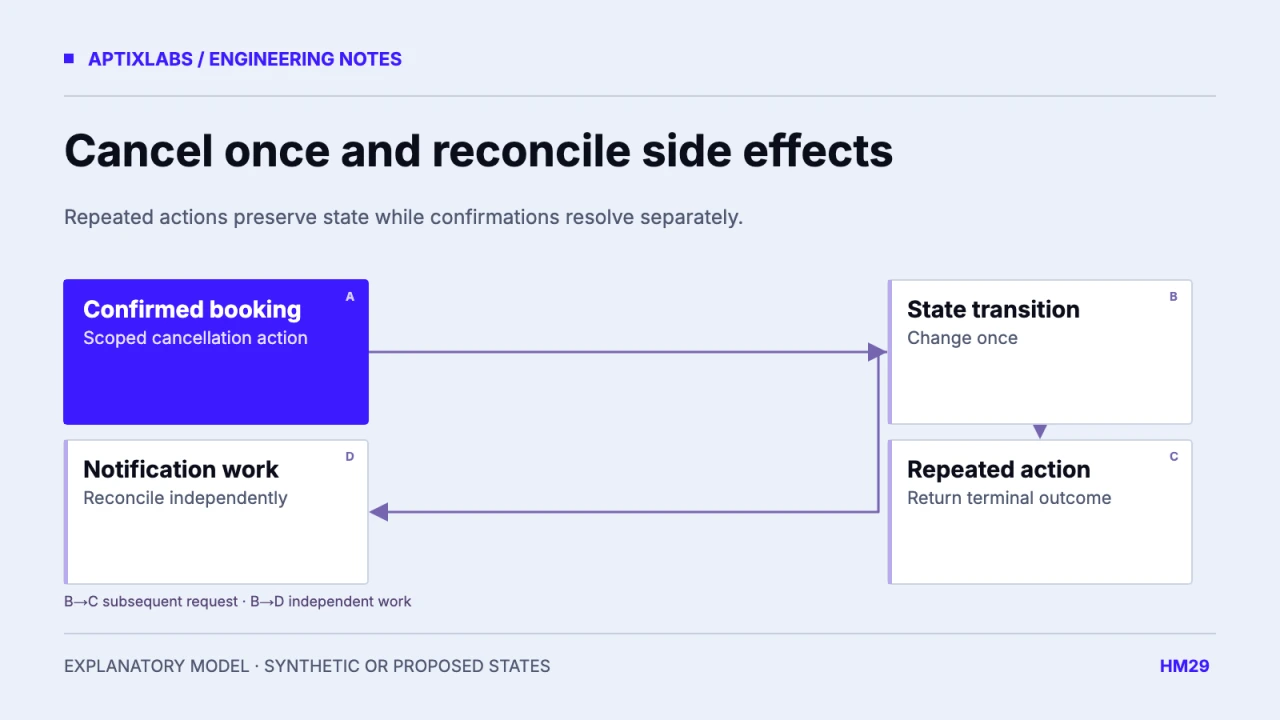
A cancellation is safe to retry when repeating the same authorized action preserves the booking’s terminal state without creating a second logical cancellation. Bind the action to the intended booking and distinguish an already-cancelled booking from an unknown reference. Track notifications separately from the state transition.
Prerequisites are stable booking identity, a defined authorization mechanism, explicit cancellation states and a side-effect policy. Cancellation releases or changes an existing appointment. Rescheduling creates a new time relationship and needs its own transaction and recovery design; it should not be implied by a cancel endpoint.
Update only the intended current state
The reviewed UltraFit360 prospect-cancellation path updates confirmed bookings identified by a cancellation token. When no transition occurs, it checks whether the token is known and returns success for an existing booking while unknown tokens return not found. This is source-level evidence of a repeated-request path, not an executed end-to-end test.
Proposed transition contract:
confirmed + valid action → cancelled
cancelled + repeated same action → cancelled
unknown action reference → not found
// The visible state remains tied to the original booking.
Treat an action link as a scoped capability, distinct from a general sign-in credential. Keep it out of public logs and screenshots. The UI should identify the relevant appointment after an authorized lookup without exposing unrelated booking details. A cancellation reason is optional context, not a new identity for every retry.
A timeout does not mean the state change failed
| Event | Booking state | What remains uncertain |
|---|---|---|
| First cancellation commits | Cancelled | Client has not received response |
| Connection times out | Cancelled | Client does not know result |
| Same action retried | Cancelled | Response confirms terminal state |
| Notification delivery pending | Cancelled | Receipt or confirmation still unresolved |
The trace is proposed and was not executed against the API. Its useful distinction is that booking state and message delivery can disagree temporarily. A retry should reconcile the original operation rather than invent another booking or restore confirmed state because a toast was not shown.
Make notification work durable and deduplicated
In the reviewed source, cancellation notification enqueue attempts happen after the state update and have separate error handling. That pattern does not establish transactional outbox durability or exactly-once delivery. A state change can succeed while a follow-up notification remains unresolved, so evaluate the actual queue and reconciliation contract.
A proposed outbox can key logical work by booking, transition and recipient purpose. Retrying a worker should not create another logical confirmation, although downstream delivery may still require provider-specific deduplication and receipts. Avoid claiming exactly-once messaging from an idempotent database update alone.
Keep provider lifecycle examples in context
CoachAccountable documents appointment cancellation separately from other appointment operations. That is a first-party lifecycle reference, not a statement that its endpoint or permission model matches UltraFit360. Verify the actual provider contract before proposing a cross-system cancellation adapter.
CoachAccountable: appointment lifecycle API reference
Acceptance should cover malformed or unknown references, a repeated cancellation, cancellation after another authorized actor changed the booking and a response lost after commit. Confirm which terminal states are intentionally treated as success. Test side effects with synthetic recipients or a local fake queue, never real customer notifications.
No cancellation API or notification worker was executed for this article. The deliverable is a state-and-side-effect worksheet for a release test. A successful result should explain the booking state, whether the slot is available again and which confirmations are still pending, without promising a rescheduling workflow that has not been implemented.
Specify whether a repeated request may change the original cancellation reason. If the first accepted action stored one explanation and a retry carries a different value, decide whether it is an amendment or merely a replay. Keep the transition’s accepted timestamp separate from later delivery attempts. This preserves a coherent booking history and prevents a network retry from appearing to be a new user decision. Test the chosen policy with fictional reasons and inspect the final accepted record.
Bring one client-to-coach workflow, current data contract and acceptance constraint to discuss a bounded fitness product build or integration pilot.
Explore health fitness app development
What makes a booking cancellation safe to retry?
Bind it to the intended booking and make the state transition repeatable. Track confirmation side effects separately so retries do not imply they were delivered.
Does an idempotent cancellation guarantee exactly-once email?
No. The booking transition and notification side effects need separate durability and deduplication evidence.