
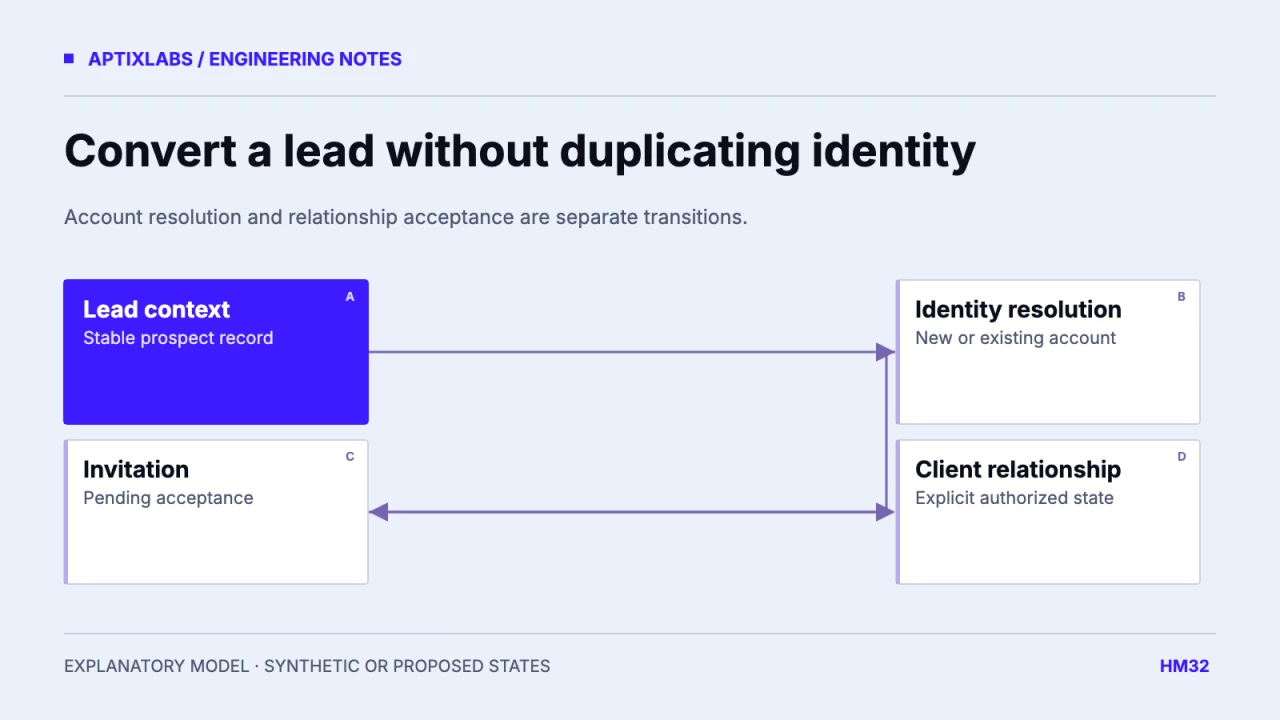
Converting a lead should preserve context without duplicating a person or implying that they accepted a coaching relationship. Resolve identity, create or link the intended account under an authorized workflow, and track invitation and relationship states separately from the CRM label converted.
Prerequisites are stable lead and account identifiers, an organization boundary, assignment rules and a definition of what conversion means. An email address is useful matching context, but a display-name or email similarity is not sufficient evidence to merge accounts or transfer private records automatically.
Name the objects in the handoff
| Object | Purpose | What it does not prove |
|---|---|---|
| Lead | Prospect context and contact preference | An app account exists |
| Account | Authenticated person identity | A coach relationship is accepted |
| Invitation | Offer of a specific relationship | The person accepted it |
| Client relationship | Authorized assignment and status | Every lead note should be copied |
In a synthetic example, a prospect already has an application account under the intended verified identity. Conversion should link through the supported account workflow rather than creating a second person. The existing account may still need to accept the coach relationship; authentication alone does not settle that consent or access boundary.
Preserve useful context with explicit field mapping
Map lead source, stated goal, preferred contact method and relevant notes to the destination only when authorized and necessary. Decide which operational notes remain CRM-only. A salesperson’s internal note should not silently appear in a client-visible profile simply because both systems have a text field named notes.
The reviewed UltraFit360 lead model includes new, contacted, converted and archived statuses, plus contact and context fields. That source observation establishes a CRM state vocabulary. It does not establish an automatic account merger, client creation transaction or invitation acceptance workflow. This guide proposes those missing contract decisions for assessment.
Make a repeat request converge on the same handoff
Illustrative conversion result:
{
  "leadId": "fictional-lead-7",
  "conversionId": "fictional-conversion-7",
  "accountState": "existing_account_link_pending",
  "relationshipState": "invitation_pending"
}
The JSON is proposed, not an existing API response. A stable conversion operation lets a retry return the same outcome rather than issuing another invitation or creating another client. Use server-side uniqueness and relationship checks appropriate to the actual model. Retain a clear correction path for a mistaken match.
If conversion includes asynchronous work, show which parts are complete. A CRM status may be converted while onboarding remains pending. A coach roster should not describe that person as an active client unless the relationship contract supports it. Keep the source lead identity for support and reconciliation.
Use provider examples only for the behavior they show
Coachway’s first-party lead feature describes capturing and converting leads. It provides product-context evidence that handoff is a distinct workflow, not a specification for this application’s schema or access model. Verify any proposed provider integration independently.
Coachway: lead capture and conversion feature
Acceptance should cover a new account, an existing account, two leads for one person, a repeated conversion, an expired invitation and a coach reassignment during onboarding. Confirm which context appears to the client and which roles can read it. No conversion API or real account was changed for this guide.
No verified fictional local handoff UI was available, so the researched screenshot becomes an explanatory object-state diagram. The concrete commissioning artifact is the identity and field map, with a replay trace and explicit pending states. That can be reviewed before anyone promises a one-click migration from prospect to active client.
Define what unconvert means before offering it. Archiving a lead after conversion should not silently remove an accepted client relationship or delete an existing application account. Reversing a mistaken handoff needs a scoped correction with current access checks and an audit of copied context. Test that operation against a fictional person with earlier app history. The expected outcome should preserve unrelated account records while correcting the coach relationship and CRM status under the agreed ownership policy.
Propose a bounded UltraFit360-related integration pilot with the partner system, intended users, data rights, owners and acceptance criteria; availability must be verified.
Explore health fitness app development
Does changing a lead status to converted create a client relationship?
Not necessarily. Identity resolution, invitation acceptance and coach assignment are separate transitions that need an explicit conversion contract.
Can an existing app account be added to a coach automatically?
Only under the product’s explicit authorized relationship workflow. Account existence alone does not establish acceptance.