
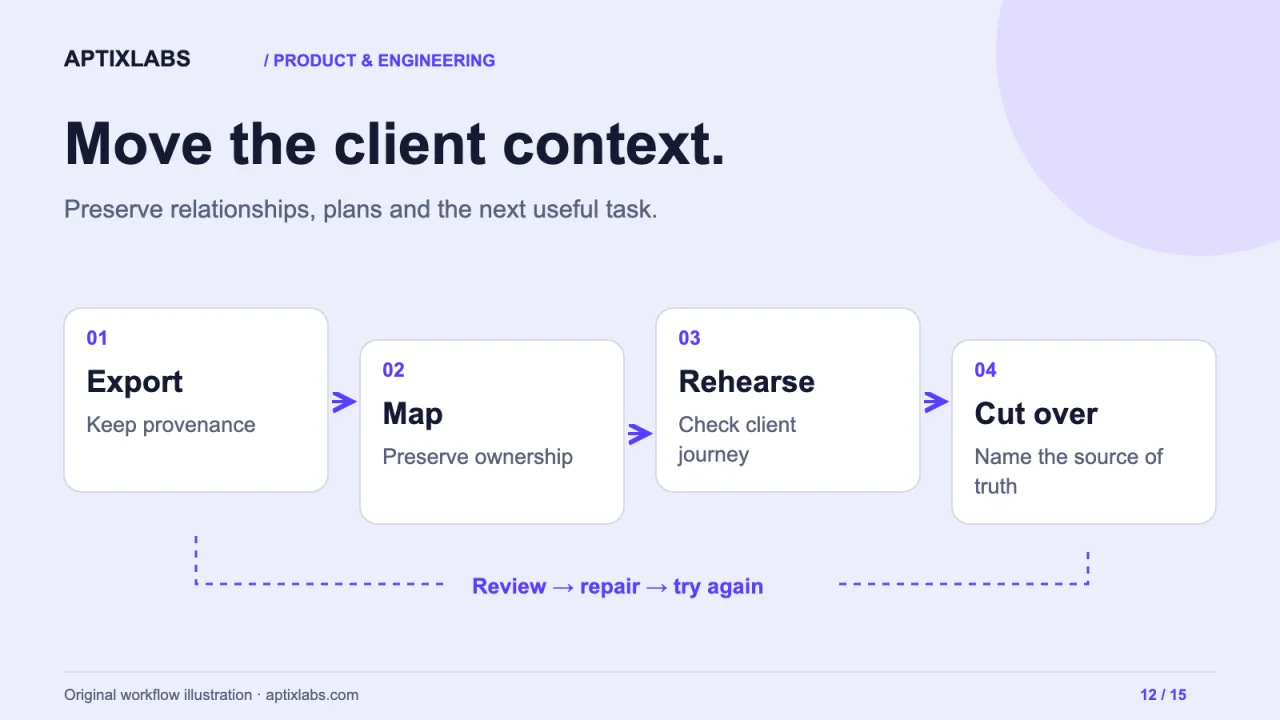
Moving a coaching business is not just importing a list of names. A client has an assigned coach, an active plan, recorded progress and expectations about where the next check-in happens. A migration succeeds when that context survives and both people know which system is authoritative after the switch.
Inventory the relationships before the fields
List the records you need to retain: client identity, coach assignment, current program, relevant history and communication preferences. Separate required operational context from material you are not authorised to move. Review the source platform's export options and your rights to use the data before treating every visible screen as transferable.
Use stable source identifiers where available. Display names are not reliable keys; two clients can share a name and one person can change an email address. Preserve provenance so a coach can understand where a record came from and when it was last updated.
| Source context | Destination decision | Verification |
|---|---|---|
| Client and coach IDs | Identity and ownership mapping | Correct coach sees the correct client |
| Active program | Supported plan representation | Client can find the next assigned task |
| Historical activity | Import, archive or retain separately | Dates, units and source are understandable |
| Check-ins and notes | Scope and access policy | Private material reaches only authorised roles |
| Messages and attachments | Export feasibility and retention | Unsupported content is disclosed before cutover |
Rehearse with representative records
Use a small authorised sample that includes the awkward cases: a transferred client, an incomplete plan, different units and missing dates. Compare source and destination with the coach who understands the records. Counting imported rows is useful, but it does not prove that relationships or meaning survived.
If a destination cannot represent a field, decide whether to transform it, archive it or leave it in a retained source export. Explain that decision to the business owner. Avoid silently flattening a structured program into text and calling it a complete migration.
Choose the cutover rule
Pick when edits stop in the old system and where new work begins. A long period of unrestricted editing in both platforms creates reconciliation work. If parallel operation is necessary, define which records can change in each system and who resolves conflicts.
Prepare a reversal or pause plan based on what can actually be restored. Keep an authorised source export and document unresolved items. Do not promise instant rollback after clients have created new records in the destination; that data needs a plan too.
Communicate the client's next action
Tell clients where to sign in, whether they need a new invitation and where their current plan appears. Provide a support route for account mismatch or missing context. Keep the message focused on the next useful task rather than the business's software procurement story.
UltraFit360's coach workspace includes client records, programs, meal plans, messages and check-ins. Those interfaces show why a migration needs relationship-level acceptance checks. This article does not claim that an automated importer exists for every coaching platform; source formats and supported scope need assessment.
Explore the UltraFit360 coach portal
Open the live UltraFit360 Coach sign-in
Bring a sample export to the partnership discussion
For a possible UltraFit360 collaboration or a custom coaching product, AptixLabs can review a redacted field map and the critical client journey. Agree who handles data preparation, permission checks, training and support. A small rehearsal with a clear pass condition is a better first milestone than announcing a full migration before the source has been inspected.
Can all coaching history be moved automatically?
Not necessarily. Export availability, data rights and destination structure determine what can move. Map required records and disclose transformations or unsupported fields before committing to a migration.
What should be checked before a coaching-platform cutover?
Verify identity, coach assignments, active plans, relevant history and access boundaries with representative records. Agree an edit-freeze or conflict policy, client communication and recovery responsibilities.