
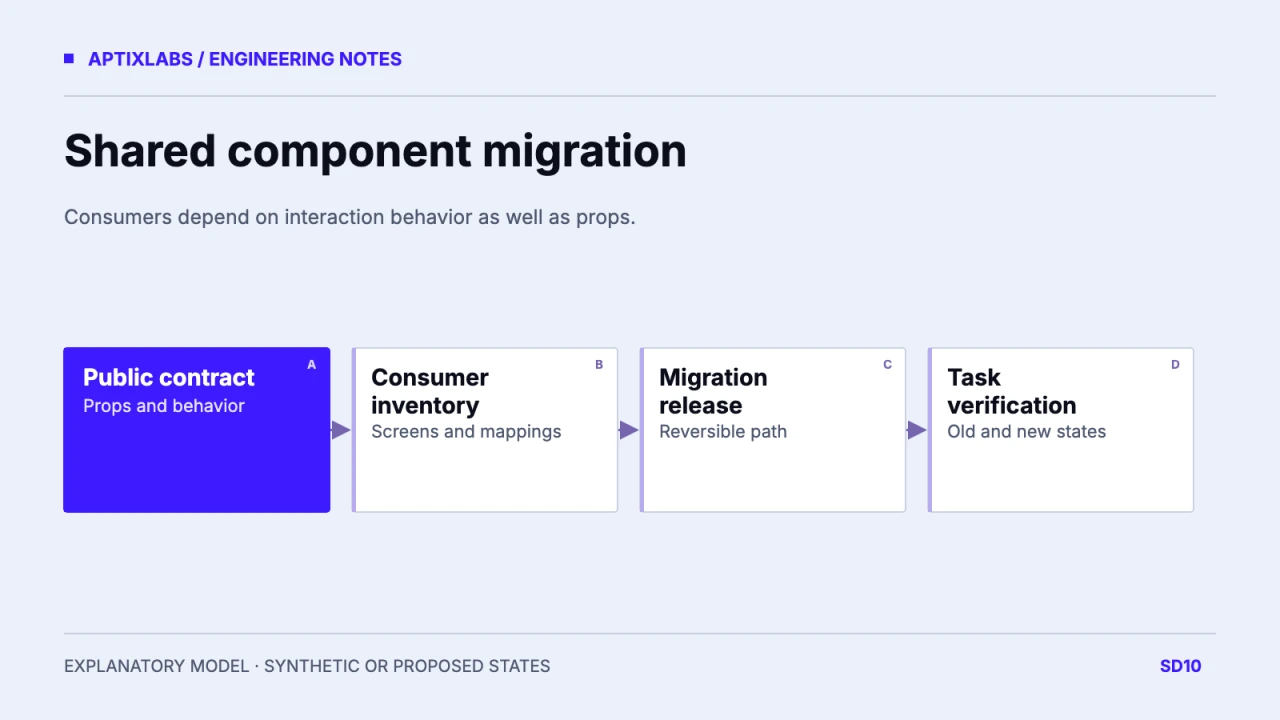
Version a shared component against its public props, token expectations and interaction behavior. A migration plan should identify affected consumers and design mappings, then explain how teams can move and roll back without guessing.
Define what consumers rely on
The component contract includes more than its TypeScript interface. Consumers may depend on keyboard behavior, focus return, accessible names, rendered roles, styling hooks and supported variants. List those expectations before classifying a change. Morningstar publishes a major, minor and patch versioning model; use your own library’s documented policy when determining a release. A visual tweak can still alter wrapping, target size or a critical interaction. Record the supported browser and framework versions with the change so a team does not confuse an unrelated environment upgrade with the component migration.
Classify the menu change by observable behavior
Consider a synthetic menu that previously wrapped a supplied trigger and now requires an explicit trigger slot. Some consumers may need a prop update; others may depend on the old focus-management behavior. Additive optional props can be compatible, while removing a required behavior can be breaking even if compilation succeeds. Token changes also need review when they alter meaning or remove a supported mode. Give the release a concrete before-and-after example and state which compatibility layer, if any, exists. Do not promise semantic-versioning safety solely from the version number.
| Consumer | Change | Evidence needed |
|---|---|---|
| Simple toolbar | New trigger slot | Open and dismiss task |
| Custom wrapper | Manual focus review | Focus-return trace |
| Design mapping | API example update | Correct component reference |
| Legacy screen | Temporary compatibility path | Rollback verified |
Inventory consumers and design mappings
Search the codebase for imports, wrappers and indirect usage, then map the results to screens and owners. Include examples, tests, documentation and Code Connect mappings where they exist. A component rename can leave a design mapping pointing to an obsolete API even after application imports compile. Categorize each consumer as unchanged, automatic migration, manual review or blocked. Keep the inventory narrow enough to complete. A spreadsheet with hundreds of unverified checked boxes is weaker than a known set of affected screens with a representative interaction trace.
// Illustrative API migration; adapt to the real library.
// Before: <Menu trigger={<Button>Actions</Button>} />
// After:  <Menu><Menu.Trigger asChild><Button>Actions</Button></Menu.Trigger></Menu>
Provide a reversible migration path
Release the new API alongside a documented deprecation window when your compatibility policy supports it. Show how one consumer changes, what old behavior is preserved and what needs explicit configuration. Avoid silently rewriting product-specific focus behavior during a mechanical prop migration. Keep a rollback route that includes code, package resolution and any associated design mapping. If the new behavior requires a data or configuration migration, treat that as a separate dependency. This synthetic menu example is a planning worksheet; no library release or consumer rewrite was executed for the article.
Verify the old and new task through transition
Compile representative consumers, then open the menu, navigate choices, dismiss it and confirm where focus returns. Test disabled and permission-restricted states as well as long labels and narrow layouts. Compare the task in the old supported release and the proposed new one, with any intentional differences recorded. The release note should link the migration example, affected variants and known limits. Assign a date and owner for removing deprecated support after consumers are verified. A source-compatible change can still require human review when it alters what users can do.
Figma Code Connect component mapping
Product design handoff specification
Bring the proposed component change and affected consumers to scope a reversible migration.
B2B SaaS development: scope and acceptance
Can a behavior-only change be breaking?
Yes. Consumers may rely on focus, keyboard or accessible-role behavior even when the props still compile.
Should every consumer receive a mechanical rewrite?
No. Inventory wrappers and custom interactions, then separate automatic changes from manual behavior review.