
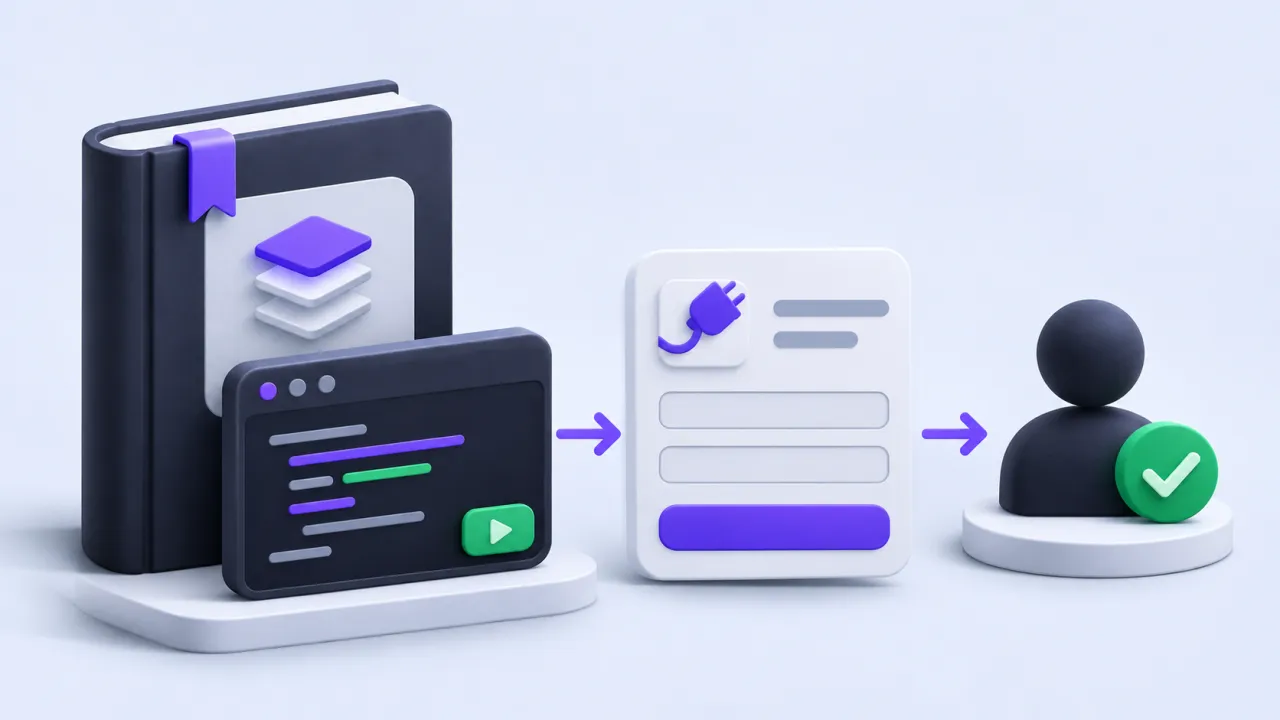
Developer documentation can attract prospective clients when it solves a real implementation problem. A runnable example, clear prerequisite list and honest limitation often demonstrate competence better than a sales-heavy overview. The commercial next step should fit the task the reader is trying to complete.
The contract to define first
Choose an integration boundary the team can explain with current code and official references. Use synthetic credentials and fixtures, state supported versions and show a meaningful failure path. Keep the example maintainable and distinguish it from a production-ready package. A service CTA can invite a scoped integration discussion without interrupting every section.
A worked scenario
A synthetic MCP guide includes a read-only tool contract and a denied-access fixture. A buyer can inspect the shape of the work and identify what their own system would need. The guide should not imply that copying the example completes authorization, deployment and support for every host.
An implementation and review sequence
- Select one bounded integration task
- Provide prerequisites synthetic fixtures and failure behavior
- Connect the example to a relevant scoped service
Failure cases worth testing
| Condition or input | Expected behavior |
|---|---|
| A dependency version changes | The example is rechecked before being marked current |
| A reader copies sample credentials | They are clearly nonfunctional placeholders |
| A production requirement is omitted | The limitation is stated explicitly |
Download the illustrative acceptance checklist (JSON)
Tradeoffs and limits
Documentation creates a maintenance obligation. A narrow reliable example is preferable to a broad tutorial that becomes misleading as dependencies and platform capabilities change.
Use the result to make a decision
The practical output is straightforward: create a useful integration sample with an appropriate service CTA. Keep the assumptions with the artifact so a product owner, implementer or prospective partner can review the same decision. A useful handoff states the supported scope, the evidence collected and the remaining dependency instead of treating a successful demonstration as proof of every operating condition.
Continue with related implementation detail
Related guide: Connecting a fitness app to ChatGPT and Claude with MCP
Fitness app store listing experiments
LinkedIn blog distribution measurement
References and current platform requirements
Google Analytics: recommended events
Search Console: performance report
The linked references provide platform or process context. The worked scenario and acceptance matrix are original examples; adapt them to the actual product, supported environment and documented responsibilities.
Discuss the workflow
Bring one acquisition path and its enquiry-quality evidence to discuss measurement improvements.
Explore the relevant AptixLabs service
How can documentation support a useful service enquiry?
Developer documentation can attract prospective clients when it solves a real implementation problem. Documentation creates a maintenance obligation.
Which failure cases should be included in the review?
Include these explicit cases: A dependency version changes: the example is rechecked before being marked current; A reader copies sample credentials: they are clearly nonfunctional placeholders; A production requirement is omitted: the limitation is stated explicitly.