
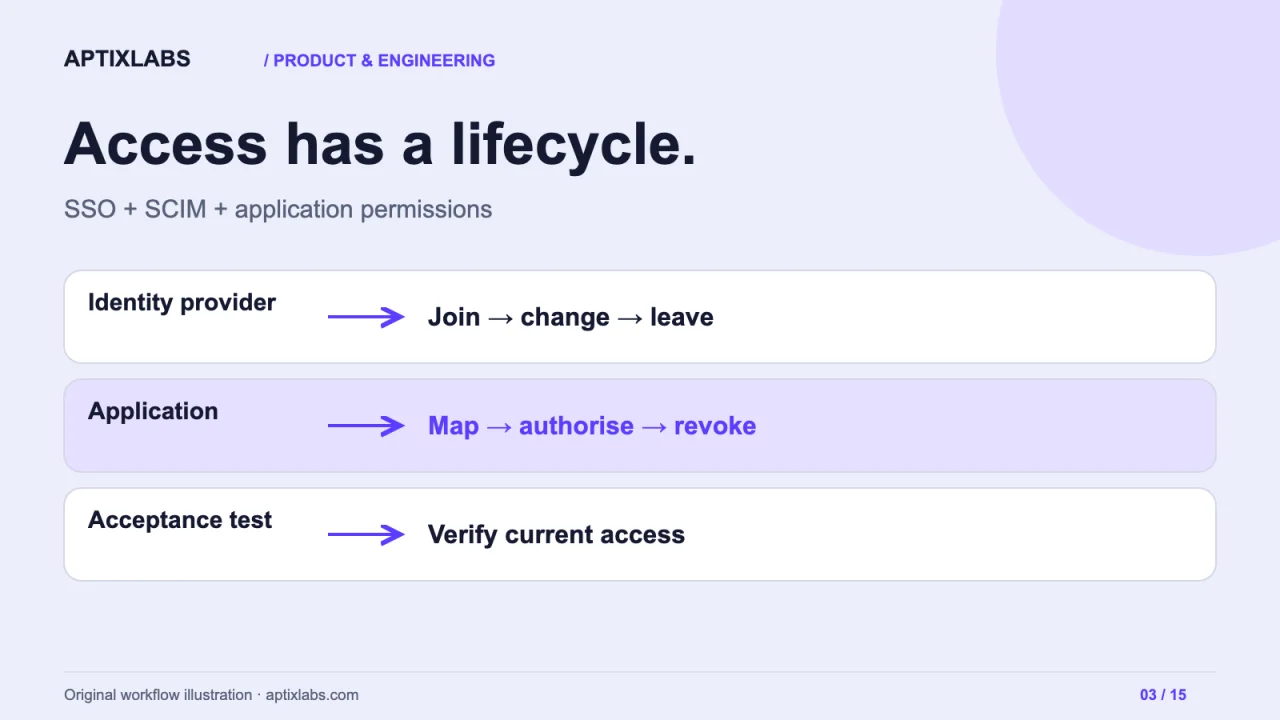
An enterprise buyer asking for SSO often needs more than a different login button. The practical question is whether their organisation can control who enters your product and what happens when a person changes role or leaves. SSO handles sign-in through an identity provider; SCIM is commonly used to provision and update directory identities. Your application must still enforce membership and permissions.
Separate identity from application access
Successful authentication answers who signed in. It does not automatically decide which customer workspace they may open. Model organisation membership separately from a global user identity, and check it at the API boundary. A person can belong to more than one workspace, so avoid treating an email domain as permission to read every account with that domain.
WorkOS's Directory Sync documentation describes receiving and processing directory changes. An integration vendor can simplify that transport. Your product still owns the mapping from directory membership to product roles, how conflicting changes are resolved and which operations become unavailable after removal.
Reference: WorkOS Directory Sync documentation
Map the full join, change and leave lifecycle
| Event | Product decision | Evidence to demonstrate |
|---|---|---|
| Employee joins | Workspace and initial role | No access to another organisation |
| Group changes | Updated role mapping | Removed privileges stop working |
| Employee leaves | Membership deactivation | Existing sessions cannot continue authorised work |
| Event repeats | Idempotent update | No duplicate membership or invitation |
| Delivery is delayed | Reconciliation policy | Directory and product differences are visible |
Define the promised delay for access changes rather than writing “instant” without an architecture to support it. Session lifetime, token caching and permission caching affect the result. Revoking an identity at the provider does not by itself guarantee an already issued application session stops working. Test the product's behaviour explicitly.
Resolve awkward account cases before launch
An existing password user may later join an SSO-managed workspace. Decide how identity linking is verified and whether that workspace requires SSO on subsequent access. Do not merge accounts solely because a browser submits a matching email address. Define administrator recovery and emergency access carefully enough that it does not become an undocumented bypass.
Test invitations created before provisioning, two organisations with different policies and a user removed from only one organisation. These scenarios expose designs that confuse a person with a membership. If a removed member owns scheduled work, decide whether the job is cancelled, reassigned or paused for an administrator.
Related: tenant isolation at the data boundary
Prepare a buyer-facing evidence pack
List supported protocols and providers only after verifying them. Include the role mapping, deprovisioning behaviour, audit events, recovery ownership and known limitations. Offer a demonstration using a test organisation rather than a screenshot of a successful login. Keep configuration instructions and incident responsibilities close to the integration.
AptixLabs' UltraFit360 work includes account and coach-organisation boundaries. That experience informs the questions above; this article does not claim UltraFit360 currently provides enterprise SSO or SCIM. For a new B2B product, we would scope the identity lifecycle, vendor dependency and acceptance tests as a distinct integration milestone.
Start with the buyer's actual identity requirement
Ask for the intended identity provider, number of organisations, provisioning expectations and role model. Some buyers require only federated login; others require directory-driven access removal and audit exports. Naming those differences lets you estimate the real work and avoid selling an “enterprise-ready” label that means something different to each side.
What is the difference between SSO and SCIM?
SSO supports authentication through an identity provider. SCIM commonly supports provisioning and updating directory identities. Application membership, authorisation and session handling remain product responsibilities.
Does removing someone from a directory immediately end application access?
Not necessarily. The result depends on delivery delay, session behaviour and permission caching. Define and test the product’s deprovisioning policy, including existing sessions and scheduled work.