
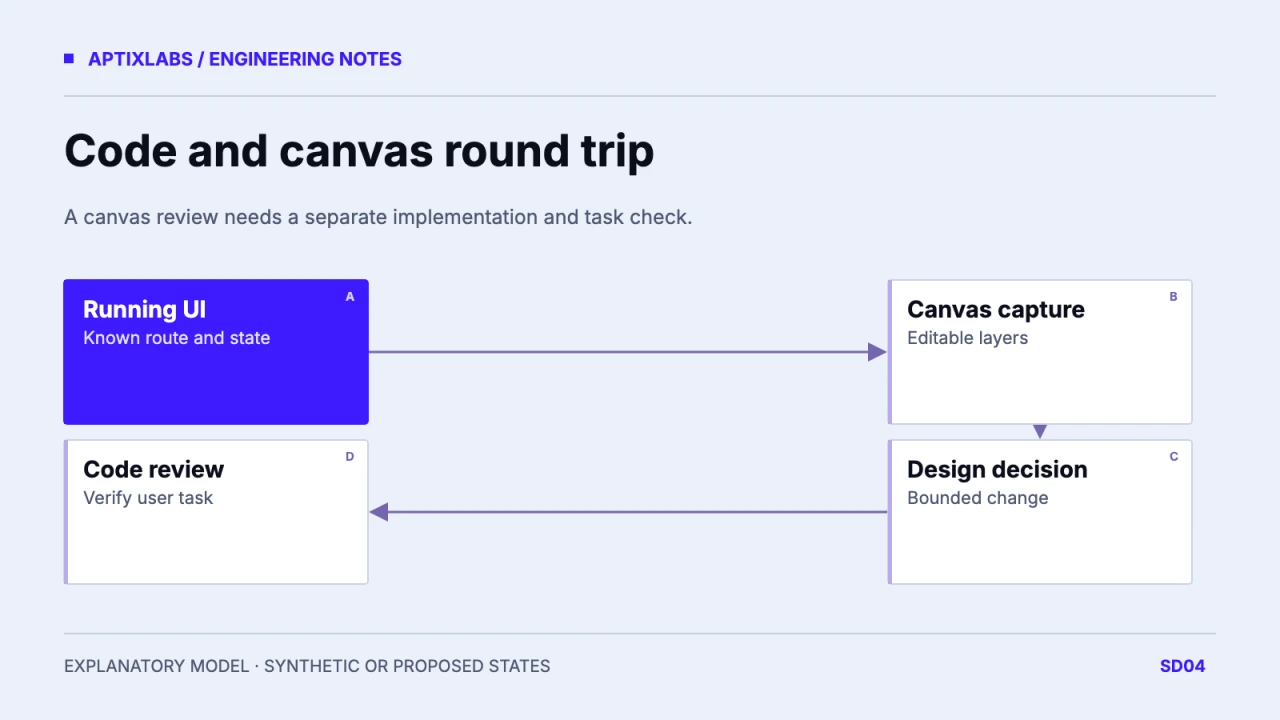
Choose the direction and artifact before calling a Figma round trip complete. Code to canvas captures a running UI as editable layers; design to code asks an agent to implement reviewed design context back in the repository.
Name the two directions and their artifacts
For code to canvas, the starting point is an implemented screen and the immediate result is a reviewable design capture. For design to code, the starting point is a design decision and the result is a proposed source change. Keeping those artifacts distinct prevents a polished canvas from being mistaken for an updated application. Record the route, state, viewport and source revision with each capture. A page captured before an error occurs cannot provide evidence about its recovery state. A round trip needs a new code review and acceptance check after the canvas discussion.
Distinguish captured layers from library-aware writing
Figma currently documents code to canvas on the remote MCP server through supported clients. Captures become standard editable design layers rather than connected library components. The same guide notes automatic binding of matching color, number and string variables when the target file has the relevant library. That variable behavior does not establish component-instance provenance. Writing to canvas is a separate contract that can build with existing components and variables. Review which tool produced the artifact and what it preserved, rather than assuming every editable layer belongs to the design system.
| Step | Result | Does not prove |
|---|---|---|
| Live UI capture | Editable design layers | Connected component instances |
| Variable match | Applicable variable binding | All design-system semantics |
| Canvas review | Recorded design decision | Application updated |
| Code implementation | Reviewable source change | Task acceptance passed |
Prepare a deterministic page or an explicit HTML snapshot
The repository’s export script visits known routes, waits for fonts, reveals content, forces a final animation state, inlines styles and removes scripts. That is an observed HTML preparation path. It does not prove a Figma import was completed. Its forced styles also intentionally change runtime behavior, so a snapshot must not be used to validate live motion or interaction. Figma separately documents html_to_figma for HTML without running the application. Choose that path deliberately when a static source artifact is sufficient, and keep the difference from live browser capture visible.
Review one proposed change and bring it back to code
Use a synthetic permission flow with a list, restricted record and retry state. Capture the relevant screens, then ask the designer to change one decision such as the order of explanation and action. Link the reviewed frame to a bounded implementation request naming the existing components and state behavior. The agent’s resulting code still needs inspection for semantics, permission handling and responsive layout. A copied label on the canvas has not changed the server response or the application bundle. Treat the repository diff as the return artifact and verify the actual user task.
Retain provenance through the handoff
Store a compact review record containing source revision, Figma file and frame, asset origins, intended component mapping and open decisions. Review the target library before capture when variable binding matters. Verify edit access for an existing destination file and confirm the remote tool is available in the selected client. The local HTML export described here was inspected, while the proposed Figma capture and reimplementation loop were not executed for this guide. That boundary allows the workflow to be useful without manufacturing a demonstration or implying automatic synchronization between code and design.
Figma to code: a handoff checklist that survives real product states
Figma Code Connect component mapping
Bring one implemented flow and the design decision to review, then scope the return path into code.
B2B SaaS development: scope and acceptance
Does code to canvas preserve connected components?
The current capture contract describes flat layers without library connections. Matching variables may bind automatically; that is different from connected component instances.
Has AptixLabs completed this Figma round trip here?
No. The repository HTML export path was inspected; the Figma capture and returned implementation are proposed verification steps.