
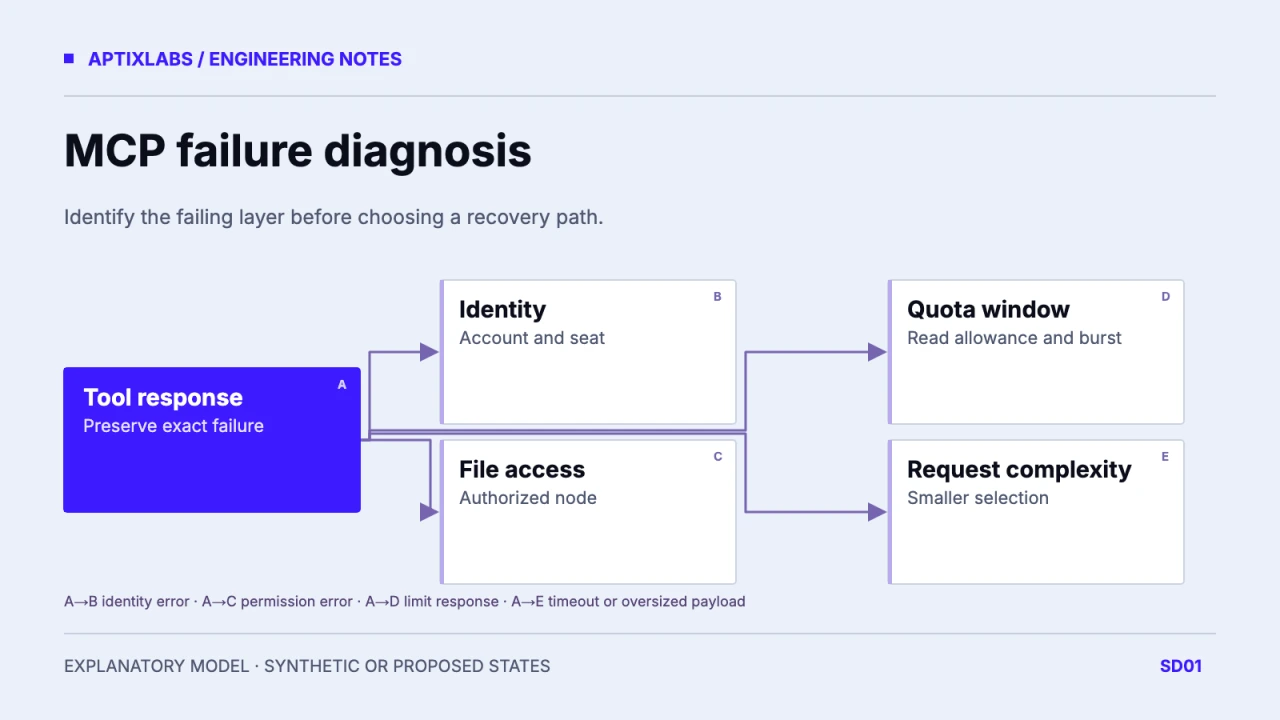
Diagnose a Figma MCP failure by tool, authenticated identity, file access and quota window before changing the implementation. A successful connection does not establish permission to every file or an unlimited allowance.
Capture the failing read before retrying
Write down the tool name, timestamp, selected node, client version and exact response category. Distinguish a tool that is absent from a tool that returns an access error. An agent repeatedly asking for the same large dashboard can obscure the original cause with later quota failures. Stop automatic retries while collecting a minimal trace. Keep file keys and account details in a restricted support record, and redact them from public examples. The diagnostic target is one read of one authorized node, with a known account and a repeatable result.
Check plan, seat and file access separately
Figma’s current access table distinguishes View or Collab seats from Full or Dev seats and applies per-minute limits alongside longer windows. Read-tool limits and AI-credit actions are separate accounting systems. Use whoami to verify the signed-in account and its plan or seat, then check that identity against the intended file. A file visible in a different browser profile is weak evidence for the agent’s access. Buying AI credits does not by itself repair a missing file permission or establish a higher read-tool allowance.
| Request | Observation | Recovery |
|---|---|---|
| whoami | Unexpected identity | Sign in to intended account |
| Read one permitted card | Access error | Verify file membership |
| Repeated dashboard reads | Limit response | Stop burst and inspect window |
| One small read | Timeout | Inspect client and payload |
Shrink the selection around the actual task
For a synthetic dashboard task, request a single client card and the relevant variables rather than repeatedly reading an entire page of cards, charts and hidden variants. Record whether the smaller request succeeds, fails with the same response, or cannot be attempted until the quota window changes. This comparison can isolate request complexity but cannot demonstrate a measured quota saving unless consumption evidence exists. Reuse already returned context within the task. Do not omit an error or restricted state just to make the request smaller; supply that state deliberately in a later bounded read.
Keep a request inventory that explains the decision
An inventory needs sequence, tool, purpose, result and next action. A row saying error is insufficient: authentication failure, missing resource, limit response and client timeout need different recovery paths. If the first request succeeds and a burst later fails, inspect the applicable short window before interpreting it as a daily exhaustion. If every authorized small request fails, investigate the account and client connection first. Retry only according to the documented response and current policy; do not invent a reset countdown from an unrelated API’s headers.
Make the supported recovery explicit
The handoff should name the failing layer and one next action: reauthenticate the intended account, obtain legitimate file access, wait for the applicable quota window, reduce unnecessary reads, or evaluate a seat change against the current table. Figma states that limits can change, so attach the review date rather than freezing an old allowance into an agent prompt. An implementation review resumes after design context is available. Its keyboard, responsive and persistence checks remain separate from proving that the MCP request worked.
Figma to code: a handoff checklist that survives real product states
Figma MCP acceptance tests: check the UI beyond the matching screenshot
Bring one failing tool response and a redacted request inventory to scope a focused Figma diagnostic.
B2B SaaS development: scope and acceptance
Do Figma AI credits increase MCP read limits?
They are separate mechanisms. Check the current plan and seat table for read limits and the AI-credit rules for credit-consuming actions.
Does reducing a frame bypass a quota?
No. A smaller selection can isolate complexity and reduce repeated context work; it does not grant additional allowance.