
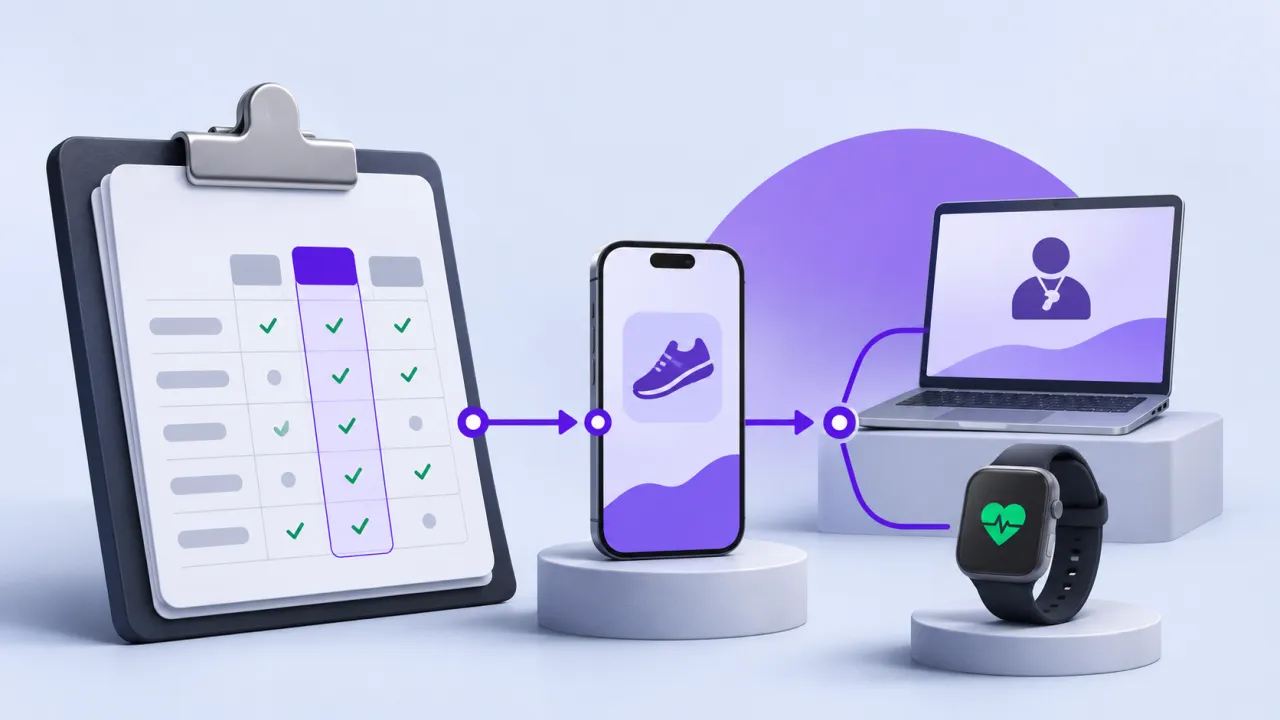
A fitness-app RFP should describe the coach and client tasks that matter rather than asking vendors to confirm a long generic feature list. Two products can both claim meal plans and messaging while supporting very different workflows. Ask for demonstrations and acceptance evidence tied to your operating model.
The contract to define first
Separate client app, coach portal, administration, payments and wearable integrations. For each, define roles, data ownership and important exceptions. Ask about support, handover and third-party access conditions. Make current capabilities distinguishable from custom work or roadmap items, and avoid treating a provider’s marketing checkbox as a verified fit.
A worked scenario
A hypothetical coaching business needs one owner to manage several coaches while clients see only their own plans. The RFP should include a live permission scenario and reassignment behavior, not just the phrase “multi-coach support.”
An implementation and review sequence
- Define the actual coach and client operating model
- Request evidence for priority lifecycle scenarios
- Separate existing features custom scope and unresolved dependencies
Failure cases worth testing
| Condition or input | Expected behavior |
|---|---|
| Vendor claims wearable support | Verify the required devices metrics and access conditions |
| A role changes | Demonstrate current permission behavior |
| A feature is planned | It is not scored as currently delivered |
Download the illustrative acceptance checklist (JSON)
Tradeoffs and limits
An excessively broad RFP can invite equally broad proposals. Prioritize must-have workflows and state which decisions can be deferred to a pilot or discovery phase.
Use the result to make a decision
The practical output is straightforward: build a requirements matrix covering coach client and wearable workflows. Keep the assumptions with the artifact so a product owner, implementer or prospective partner can review the same decision. A useful handoff states the supported scope, the evidence collected and the remaining dependency instead of treating a successful demonstration as proof of every operating condition.
Continue with related implementation detail
Related guide: White-label or custom fitness app? Choose around the coaching workflow
Software maintenance handover checklist
SaaS integration statement of work
References and current platform requirements
AWS: SaaS integration overview
Trainerize: integration use cases
The linked references provide platform or process context. The worked scenario and acceptance matrix are original examples; adapt them to the actual product, supported environment and documented responsibilities.
Discuss the workflow
Propose a bounded UltraFit360 collaboration with audience, scope, owners, and pilot acceptance criteria.
Explore the relevant AptixLabs service
Discuss a proposed partnership
What should a fitness-app RFP ask vendors to demonstrate?
A fitness-app RFP should describe the coach and client tasks that matter rather than asking vendors to confirm a long generic feature list. An excessively broad RFP can invite equally broad proposals.
Which failure cases should be included in the review?
Include these explicit cases: Vendor claims wearable support: verify the required devices metrics and access conditions; A role changes: demonstrate current permission behavior; A feature is planned: it is not scored as currently delivered.