
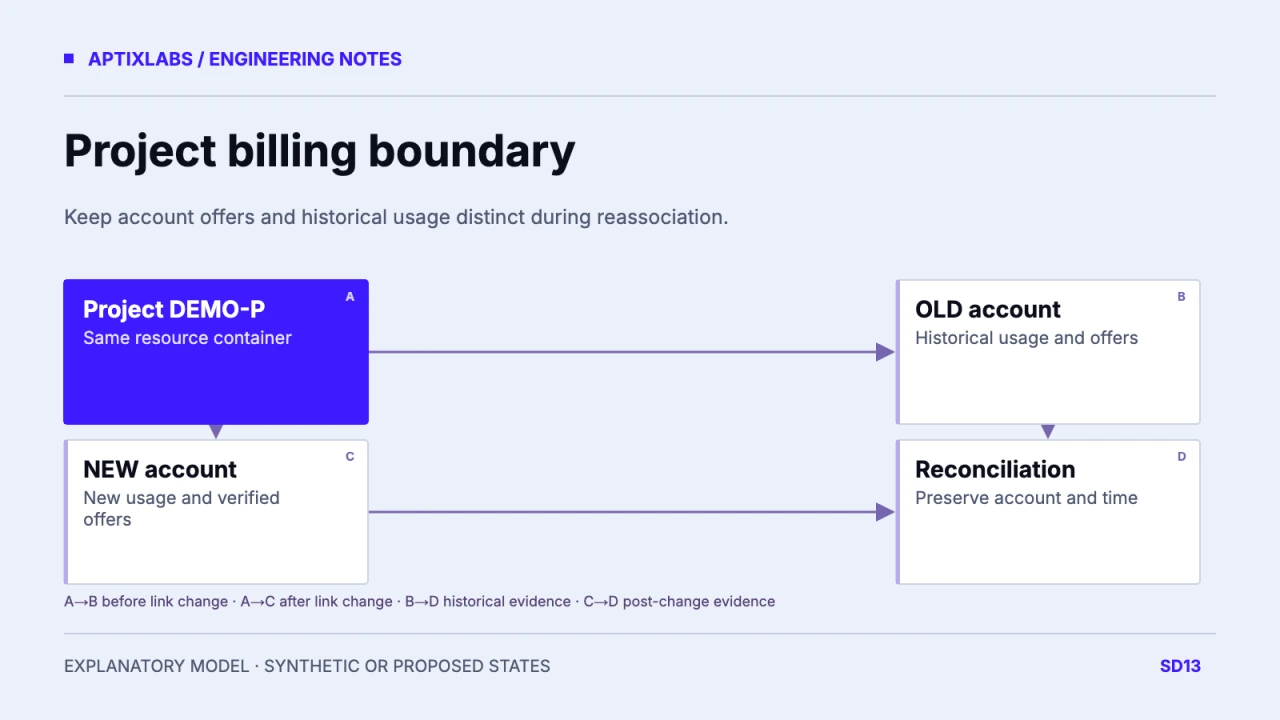
Changing the billing account linked to a Google Cloud project changes who pays for usage; it does not automatically move promotional credits or make historical charges part of the new account. Plan the boundary and verify both sides.
Distinguish billing reassociation from a project migration
A project can remain the same resource container while its Cloud Billing account changes. An organization move is another operation with different permissions and consequences. State which operation is actually proposed before scheduling work. Record project ID, old and new billing accounts, authorized operators and the intended change window. Google’s billing guide explains the project-to-account link and required change process. Do not disable billing as a shortcut during investigation: that can affect services. The purpose of the worksheet is to understand the planned reassociation without turning production into a test.
Inventory credits, commitments and payment state
List promotional offers on each billing account with their effective dates, coverage and expiry. Include commitments, subscriptions and account restrictions that may affect the move. A project’s existing resources do not establish that a promotion follows it to another payer. Verify the destination is billable and has the intended permissions before changing the link. Keep the credit forecast separate from the underlying gross usage forecast. If the migration case only works when a particular credit transfers, treat that as an unresolved prerequisite until the provider confirms the actual offer behavior.
| Artifact | OLD account | NEW account |
|---|---|---|
| Historical charges | Retain evidence | Do not relabel |
| Promotional balance | Verify existing offer | Verify destination offer |
| Exports | Historical continuity | Configure and confirm freshness |
| Post-change task | Before-window trace | After-window trace |
Define a timestamped before-and-after trace
Use a synthetic project DEMO-P and accounts OLD and NEW. Record the effective reassociation time and a known task executed before and after it. Preserve usage time, reported time and billing account in the ledger so delayed reporting can be investigated. Do not rewrite old records to make the project’s whole history appear under NEW. Late-arriving usage can complicate a simple calendar split, so reconcile the provider’s actual billing allocation rather than assigning lines solely from when an export row was received. No billing change was performed for this article.
Review reporting and access after the change
Inventory billing exports, budgets, alert recipients and report permissions for both accounts. Google’s guide notes billing exports are configured per billing account; verify the required destination export rather than assuming the project carries that configuration. Check whether operators can still inspect historical charges in OLD after the team changes access. Preserve read access or an authorized retained export as appropriate. Recheck the destination’s budget coverage and service-specific spend controls. Moving the payment link should not leave a resource operating without a responsible person receiving cost or enforcement notifications.
Close on observed post-change usage
A completion record should show the project linked to the intended account, one post-change task’s billing evidence, export freshness and alert ownership. Credit application may require a separate reconciliation window and should remain pending until evidence appears. Keep rollback permissions and service consequences understood, without promising that every commitment or promotion reverses cleanly. If the destination fails a prerequisite, defer the move rather than assuming a later account fix will be harmless. The handoff gives finance and engineering the same boundary: historical charges, future usage and promotional treatment remain distinguishable.
Google Cloud startup credits planning
Bring the old and new billing-account boundaries to scope a reporting and verification plan.
B2B SaaS development: scope and acceptance
Do Google Cloud credits automatically move with a project?
Do not assume they do. Verify the account-specific promotion and destination billing account before forecasting coverage.
Does the project carry its billing export configuration?
Billing exports are account-specific. Check the required configuration and first post-change data explicitly.