
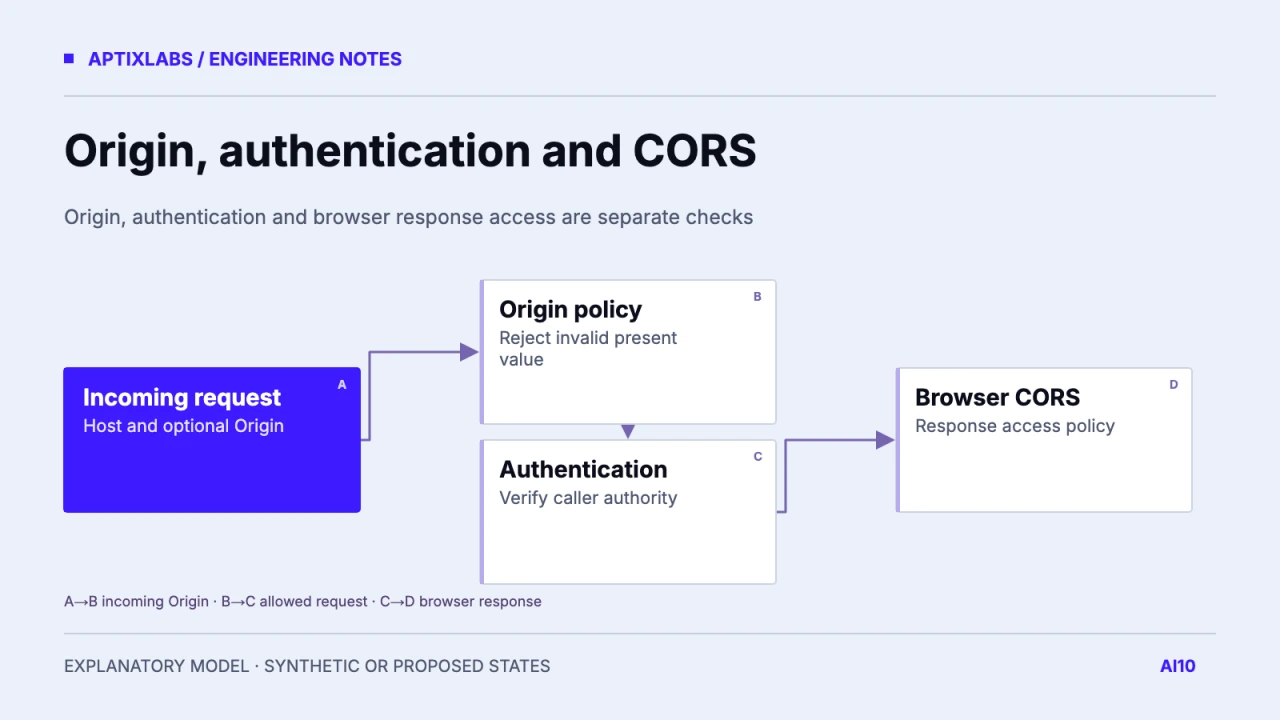
MCP Origin validation and CORS solve different problems. Validate an incoming Origin against the allowed deployment policy, preserve authentication, and configure browser access separately. Also distinguish the HTTP Host authority from Origin: they describe different ends of a request. A permissive or absent CORS response header is not evidence that an unapproved request was rejected by the server.
Name the three values before editing middleware
Host identifies the destination authority used for HTTP routing. Origin identifies the browser origin that initiated a request when that header is present. CORS response headers tell a browser whether frontend JavaScript may access a cross-origin response. A command-line client is not constrained by the browser's CORS enforcement, so server-side access decisions must not depend on the browser hiding a response.
For current Streamable HTTP, the MCP specification requires Origin validation and says a present invalid Origin must receive HTTP 403. It also recommends localhost binding for local servers and proper authentication. Missing Origin is a separate client condition; apply the chosen transport revision's requirements and a documented deployment policy rather than treating every native client as a browser.
MCP Streamable HTTP security and Origin requirements
A harmless three-request fixture
Use a local test endpoint with no customer data and an allowlist containing https://portal.example.test. Send an identical synthetic read request with an approved Origin, an unapproved Origin and no Origin. Keep credentials synthetic and the destination under your control. Inspect HTTP status and whether the handler executed; a CORS failure seen in browser developer tools does not establish that dispatch never happened.
| Origin condition | Server decision | Independent check |
|---|---|---|
| Approved value | Continue to authentication | Account and tool permissions |
| Unapproved present value | 403 under current MCP rule | Handler must not run |
| Absent value | Document client/revision policy | Authentication remains required |
The matrix is an illustrative design, not a live server test. Define how absent Origin is handled for supported non-browser clients, then test it explicitly. Authentication must still be required when the deployment contract calls for it. An approved Origin is not a credential, and a caller can supply that header outside a browser. Do not use it to identify a member or to select a tenant.
Match the allowlist to the deployment
Write exact allowed scheme, host and port values for browser integrations. Decide separately how development origins are enabled in a disposable environment. Avoid making a production exception just to unblock one local test. If an upstream proxy rewrites routing headers, inspect the trusted proxy configuration and the value your application actually validates. The intended public hostname in a diagram may differ from the authority presented to the backend.
Synthetic diagnostic fields
request_origin: https://portal.example.test
request_host: mcp-api.example.test
origin_policy: approved-portal
authentication: fixture credential accepted
dispatch: permitted synthetic read only
Use a correlation ID for the three test requests and compare sanitized access logs. Capture the rejection category without returning a full configuration dump. Rejected Origin values themselves can contain sensitive or untrusted material, so bound and sanitize any recorded value. The figure should show the origin check and authentication as independent gates, not a single browser permission switch.
Verify CORS after the server boundary
If a browser must call the endpoint, test its preflight and actual response with the intended methods and headers. Correct Origin rejection can coexist with a missing CORS response header on an error path, making the browser show only a generic network error. That is an observability and frontend integration issue to resolve without weakening the server's allowlist. Place middleware so approved clients can read the intended error contract while unapproved requests remain rejected.
Finally, run a normal authenticated read after each policy change and a denied account request from an approved Origin. Those two cases demonstrate why origin and account access are different checks. This guide does not identify a weakness in a particular deployment; it supplies a small, controlled acceptance matrix. Keep the protocol revision and host type in the result so future middleware changes do not accidentally alter a supported native or browser path.
MCP server authentication: trace the identity all the way to the record
Evaluate the tool action, not just the answer.
Bring one tool workflow, supported hosts and a sanitized failure trace for a scoped AI integration review.
AptixLabs ai agent development
How does MCP Origin validation differ from CORS?
Origin validation rejects disallowed incoming origins at the server. CORS controls browser access to responses and does not replace authentication or request rejection.
Does an approved Origin prove identity?
No. Authenticate the caller and authorize the requested record independently.
Must every non-browser client send Origin?
Check the supported transport revision and document the missing-Origin policy; native clients must not be treated as browsers by assumption.