
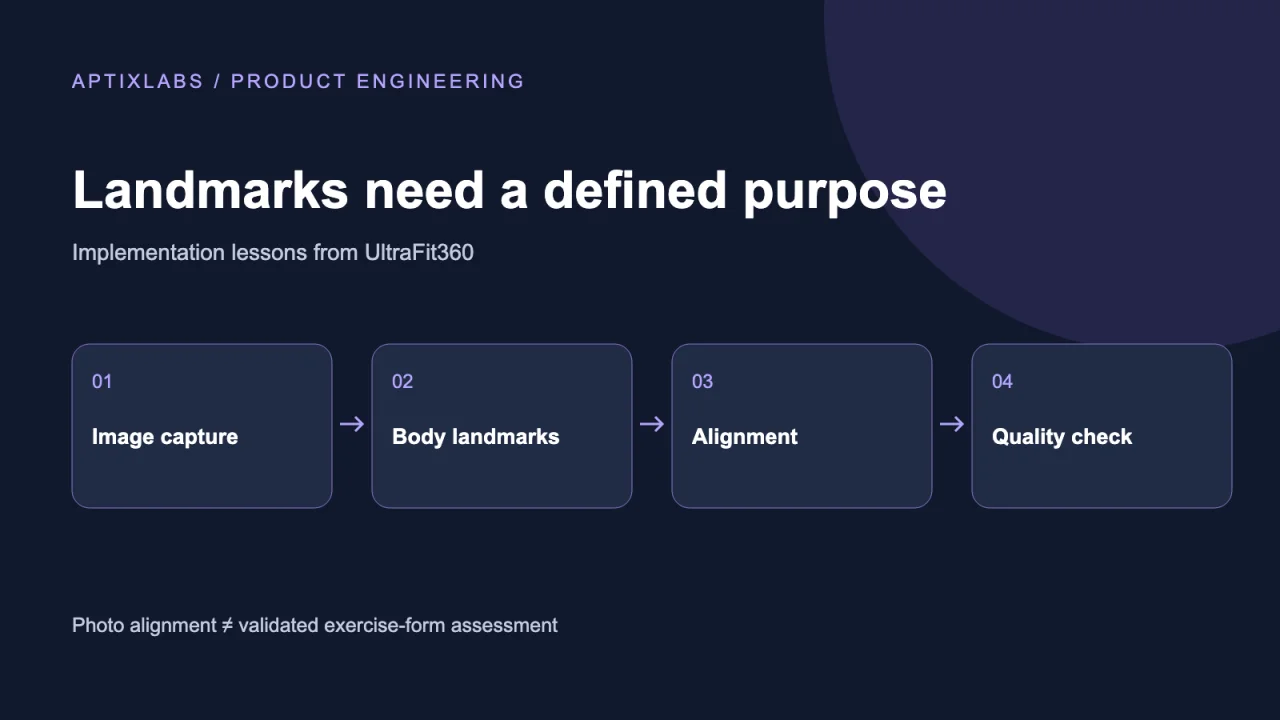
Pose estimation can locate body landmarks in an image, but that does not automatically make a fitness app capable of judging exercise technique. UltraFit360's reviewed implementation uses native person detection and body landmarks for progress-photo handling. This is a useful shipped-code story with a different scope from real-time repetition counting or exercise-form coaching.
Start with the actual user task
For a progress-photo comparison, inconsistent framing can make two otherwise useful photos difficult to compare. The engineering task is to identify a person, preserve a sensible crop and align comparable views. Success means more consistent presentation, not a claim about body composition, posture health or fitness improvement.
For exercise feedback, the task is harder. The app must interpret movement over time, know which exercise is being attempted and decide when the camera view is inadequate. A point on one frame cannot establish that a repetition is safe or correctly performed.
What we found in UltraFit360
The pose-detection service calls an iOS native Vision module and an Android ML Kit module. Its interfaces expose a person bounding box, image dimensions and landmarks such as shoulder and hip positions. Related progress-photo screens and local photo storage use those services. The code also contains fallback behaviour when native detection is unavailable or fails.
That is evidence for a photo-alignment workflow. It is not evidence that UltraFit360 currently provides a validated live exercise-form coach. We would treat that as a separate feature requiring its own implementation review and evaluation before advertising it.
What a live pose feature would add
Google's MediaPipe Pose Landmarker documentation illustrates another available approach: landmarks from images, video or live streams, including image and world-coordinate outputs. MediaPipe is a reference option here, not the engine identified in UltraFit360's reviewed photo workflow.
A live exercise feature needs a temporal model of the movement. For example, a squat-counter prototype would need to define a starting state, a descent, a return and the conditions for an incomplete repetition. That example is a proposed engineering approach, not a report of an UltraFit360 feature. The criteria must be tested across intended camera positions and users rather than copied from a single demonstration.
Camera placement also changes apparent joint geometry. Occlusion, loose clothing, equipment and motion blur can make a confident-looking overlay misleading. A useful product must be able to say that the view is insufficient instead of always returning a correction.
A practical evaluation plan
- For photo alignment, compare crops against manually reviewed examples and check that hands, feet or the head are not unintentionally removed.
- Include no-person and multiple-person inputs; specify whether the app rejects them or asks the user to choose.
- For a future exercise feature, evaluate repetition counting separately from technique feedback. One can work while the other fails.
- Track false feedback and rejected frames across the intended camera positions and capture conditions.
- Measure device latency, battery impact and privacy behaviour on representative phones, not only a development laptop.
Privacy and fallback behaviour belong in the design
Progress photos are personal. Decide whether processing stays on the device, whether an image is uploaded, how long it is retained and how deletion works. Native detection alone does not establish that every subsequent storage path is local. Trace the complete feature before making a privacy promise.
When detection fails, preserve the original image and offer a clear adjustment path. The useful implementation lesson is modest but transferable: start with a measurable visual task, preserve user control and avoid attaching a larger AI claim to a narrower capability.
Sources and next steps
Google: MediaPipe Pose Landmarker capabilities
Discuss a related implementation with AptixLabs
Does photo pose detection establish exercise-form coaching?
No. Detecting landmarks for photo alignment is a narrower task. Exercise feedback needs temporal analysis, capture-quality checks and its own validation.