
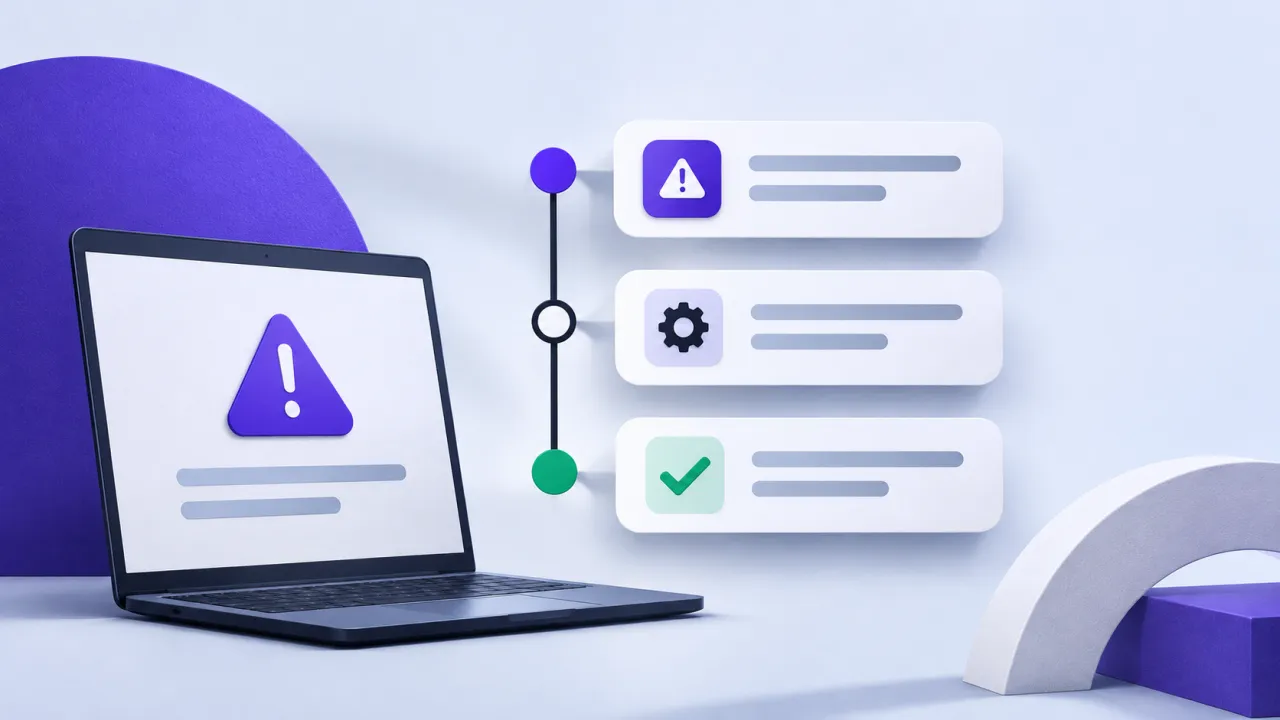
Incident communication should state what users can observe, what the team knows and when another update will arrive. A polished template is useful only when it is filled with verified facts. Avoid publishing a confident cause before investigation has established it, and distinguish recovery from confirmed resolution.
The contract to define first
Prepare templates for initial impact, investigation, partial recovery and follow-up. Assign an owner and a channel for updates. Keep internal hypotheses separate from customer-facing statements, and explain workarounds only when they have been tested. The final update should describe the restored behavior and any remaining follow-up without inventing a prevention guarantee.
A worked scenario
In a synthetic incident, some clients cannot submit check-ins while existing records remain readable. The first message should describe that specific impact rather than claiming the whole platform is down. If submissions begin recovering, report partial recovery until the affected path has been verified.
An implementation and review sequence
- Define incident stages and an accountable communicator
- Describe user impact before internal architecture
- Verify recovery before announcing resolution
Failure cases worth testing
| Condition or input | Expected behavior |
|---|---|
| Cause is still unknown | The message does not present a hypothesis as fact |
| Only some workflows recover | The update states partial recovery |
| A workaround is suggested | Its affected path has been tested |
Download the illustrative acceptance checklist (JSON)
Tradeoffs and limits
Frequent updates can become noisy if they repeat no useful information. A predictable update time and honest “still investigating” statement are often better than speculative detail.
Use the result to make a decision
The practical output is straightforward: build status update templates tied to verified impact and recovery. Keep the assumptions with the artifact so a product owner, implementer or prospective partner can review the same decision. A useful handoff states the supported scope, the evidence collected and the remaining dependency instead of treating a successful demonstration as proof of every operating condition.
Continue with related implementation detail
Related guide: Trace one user action across client, API and background work.
References and current platform requirements
Google Cloud: Cloud Run documentation
Firebase: test Firestore security rules
The linked references provide platform or process context. The worked scenario and acceptance matrix are original examples; adapt them to the actual product, supported environment and documented responsibilities.
Discuss the workflow
Discuss one reliability bottleneck, its impact, and a measurable acceptance task.
Explore the relevant AptixLabs service
What should an initial incident update say?
Incident communication should state what users can observe, what the team knows and when another update will arrive. Frequent updates can become noisy if they repeat no useful information.
Which failure cases should be included in the review?
Include these explicit cases: Cause is still unknown: the message does not present a hypothesis as fact; Only some workflows recover: the update states partial recovery; A workaround is suggested: its affected path has been tested.