
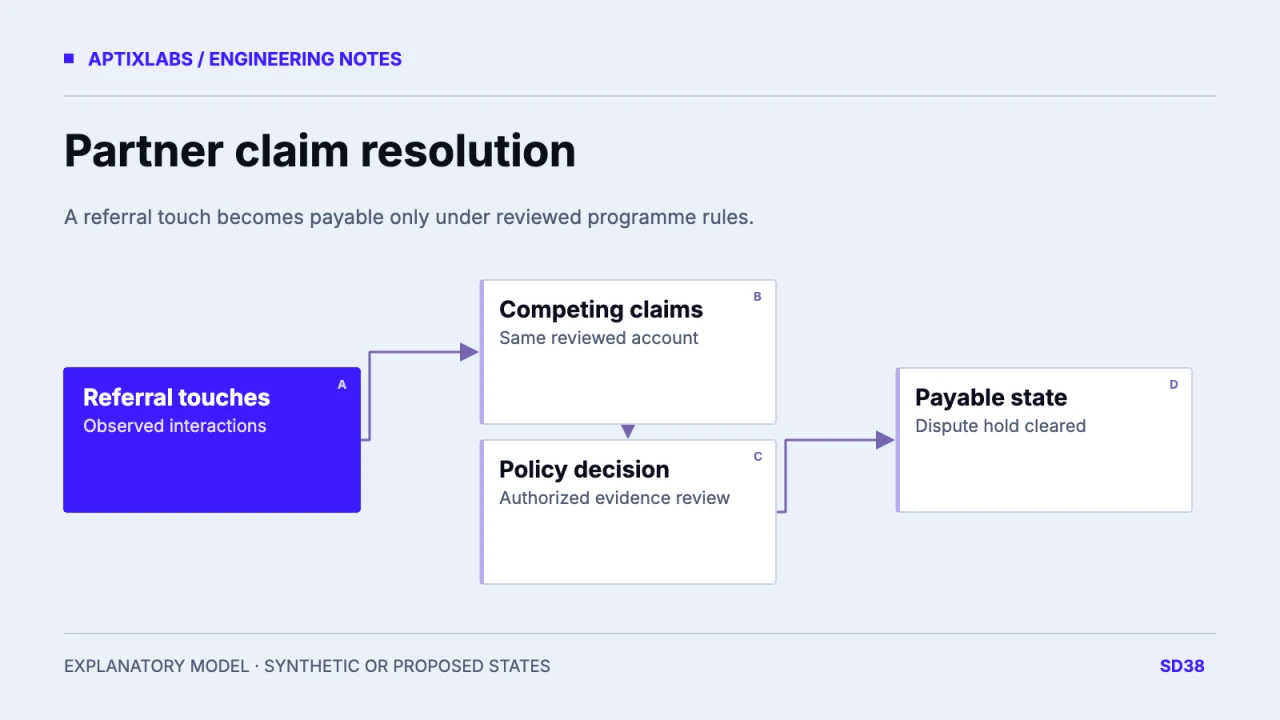
Store partner referral touches and accepted claims separately, resolve competing claims under an explicit policy and hold disputed cases before payout. An attribution timestamp alone does not establish contractual entitlement.
Define touch, claim, acceptance and payable state
A link click records a touch. A submitted account referral is a claim. Acceptance applies the programme’s eligibility rules, while payable status depends on the agreed commercial trigger and adjustments. Keep these stages distinct. Kisi’s published agreement is one primary example that defines registration, acceptance and a paying-customer condition; its rules are vendor-specific and the public page contains template placeholders. It is not evidence of an executed arrangement for either example partner. Do not adopt its referral window, revenue definition or payout conditions as universal terms. Identify your actual agreement, policy version and authorized decision-maker before translating any rule into software.
Choose a competing-claim policy before a dispute
Document how prior opportunities, existing customers, multiple partner types and late submissions are treated. First accepted claim, first touch, reviewed contribution and another agreed method can produce different outcomes. State the evidence needed and who can override a decision. Do not let the database’s default sort order become a commercial policy. Keep timestamps with timezone and provenance, including whether an entry was backfilled. A manual referral may be valid under the agreement even if it lacks the tracking cookie used by a web form.
| Claim | Evidence | Disposition |
|---|---|---|
| ALPHA → NORTH | Monday submission | Review eligibility |
| BETA → NORTH | Wednesday introduction | Competing evidence retained |
| Case NORTH | Two claims match one account | Disputed; payout held |
| Reviewed result | Policy version and reason | Accept, reject or request evidence |
Walk two synthetic policy outcomes
Partner ALPHA submits fictional company NORTH on Monday; BETA submits the same company on Wednesday and supplies a documented introduction. Under a first-accepted-registration policy, ALPHA may prevail if its claim was eligible and accepted. Under a reviewed-contribution policy, the owner may require additional evidence and could reach another result. These are illustrative policy alternatives, not a recommendation that either partner is owed money. Record both claims while the case is disputed, and prevent the payout job from choosing a winner automatically before the policy review is complete.
Match accounts without overcollecting personal data
Use a reviewed company or account identifier and preserve evidence of the match. Email domain alone can be ambiguous for consultants, subsidiaries and personal addresses. Provide a manual-review queue for uncertain merges rather than exposing full prospect messages to every partner. Keep each partner’s view limited to the information it is authorized to see. Retain the original claim and subsequent corrections so an accidental account merge can be reversed. Do not overwrite the losing claim; its history may explain the decision and support a later correction.
Gate financial actions on reviewed state
A proposed lifecycle can move from submitted to reviewing, accepted or rejected, then payable under the agreed trigger. Disputed status blocks payout. Add adjustment behavior for refunds, cancellations and corrected attribution, reviewed with the responsible commercial and financial owners. An append-only decision record should include actor, policy version, evidence reference and reason. No referral programme or payment was operated for this article. The technical deliverable is a claim-resolution contract that keeps uncertain attribution out of an automatic money movement and makes a reviewed decision explainable to the parties.
Fitness creator revenue share modeling
Bring the reviewed referral policy and a fictional competing-claim case to scope the resolution lifecycle.
B2B SaaS development: scope and acceptance
Is first-touch attribution always the correct payout rule?
No. Apply the actual reviewed partner agreement and policy; different programmes can use different criteria.
Should a disputed claim enter an automatic payout?
The proposed contract holds it until the authorized review resolves eligibility and entitlement.