
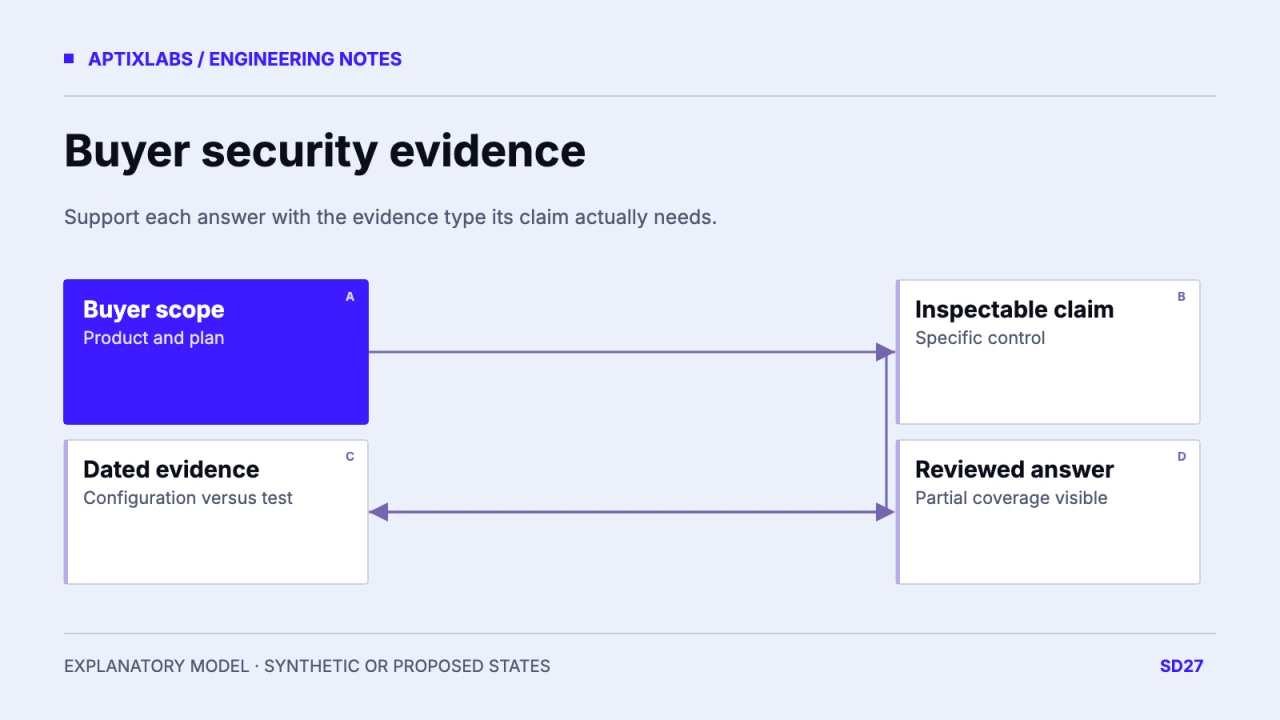
Answer a buyer’s security questionnaire with scoped, dated claims and traceable evidence. Separate a configured control from an executed test, and say when coverage is partial rather than forcing every answer to yes.
Identify the product the buyer is evaluating
Record the service, plan, hosting model, deployment region and release in scope. A company-level policy may not describe the specific product or optional enterprise feature the buyer intends to purchase. Confirm what evidence may be shared and through which authorized channel. CISA’s Secure by Demand guidance encourages buyers to ask about manufacturers’ security practices throughout procurement. That is a useful reason to prepare inspectable answers, not a certification scheme or approval of a vendor. Keep responses tied to the actual scope of the requested evaluation.
CISA: procurement questions and security practices
Translate a broad question into an inspectable claim
For a question such as whether access removal is tested, identify the account type, systems included, test frequency and expected denial outcome. Policy, code, configuration and execution records support different parts of that claim. A function named revokeAccess does not establish that a departed user was blocked across every service. Ask the buyer to clarify ambiguous wording rather than broadening the claim silently. If a control is available only under a specific plan or customer configuration, name that condition. Avoid answering on behalf of a third-party provider beyond the evidence your team can verify.
| Buyer question | Supporting artifact | Honest status |
|---|---|---|
| Access removal tested? | Procedure and execution record | Not verified until run |
| All integrations included? | Scope list | Partial if exclusions remain |
| Backups recoverable? | Dated restore evidence | Configuration alone insufficient |
| Certification held? | Current scoped certificate or report | No unsupported claim |
Use the synthetic access-removal evidence row
A fictional questionnaire asks whether departing members lose access. The proposed pack includes an access-removal procedure, a bounded test definition, a dated execution record if one exists and the remaining exclusions. If the test has not been run, state planned or not yet verified. If it covers the primary web session but not an external integration, mark partial coverage and identify the gap. No real access-removal test was executed for this article. The example demonstrates how a truthful answer can be useful without disclosing account identifiers or sensitive implementation paths.
CISA release: Secure by Demand procurement guidance
Share evidence proportionate to the question
A redacted test summary can show the tested scope, expected result and actual outcome without exposing tokens, raw user records or exploitable configuration detail. Keep detailed evidence behind controlled access when justified. Maintain a claim register with source artifact, owner, date and next review trigger. If an older answer no longer matches the service, withdraw or revise it rather than forwarding the same spreadsheet automatically. A buyer may need more depth, but that should be a deliberate review step with the responsible security and commercial owners.
Review the submission and its continuing commitments
Have the relevant control owners verify their claims and record unresolved questions before submission. Distinguish a technical answer from contractual commitments that require their own review. Keep the submitted version and supporting dates so later renewals can be compared accurately. Do not claim SOC 2, ISO certification or regulatory compliance from a questionnaire response. The practical deliverable remains a scoped evidence map, not a simulated audit opinion.
Health-product security claims need evidence.
B2B SaaS accessibility procurement
Bring the buyer’s actual scope and a redacted claim register to identify the evidence work required.
B2B SaaS development: scope and acceptance
Can source code prove a security control passed?
It can support implementation evidence, but a claim about successful execution needs the relevant test record and scope.
Should partial coverage be answered yes?
State the supported scope and exclusions explicitly, using the buyer’s response format where possible.