
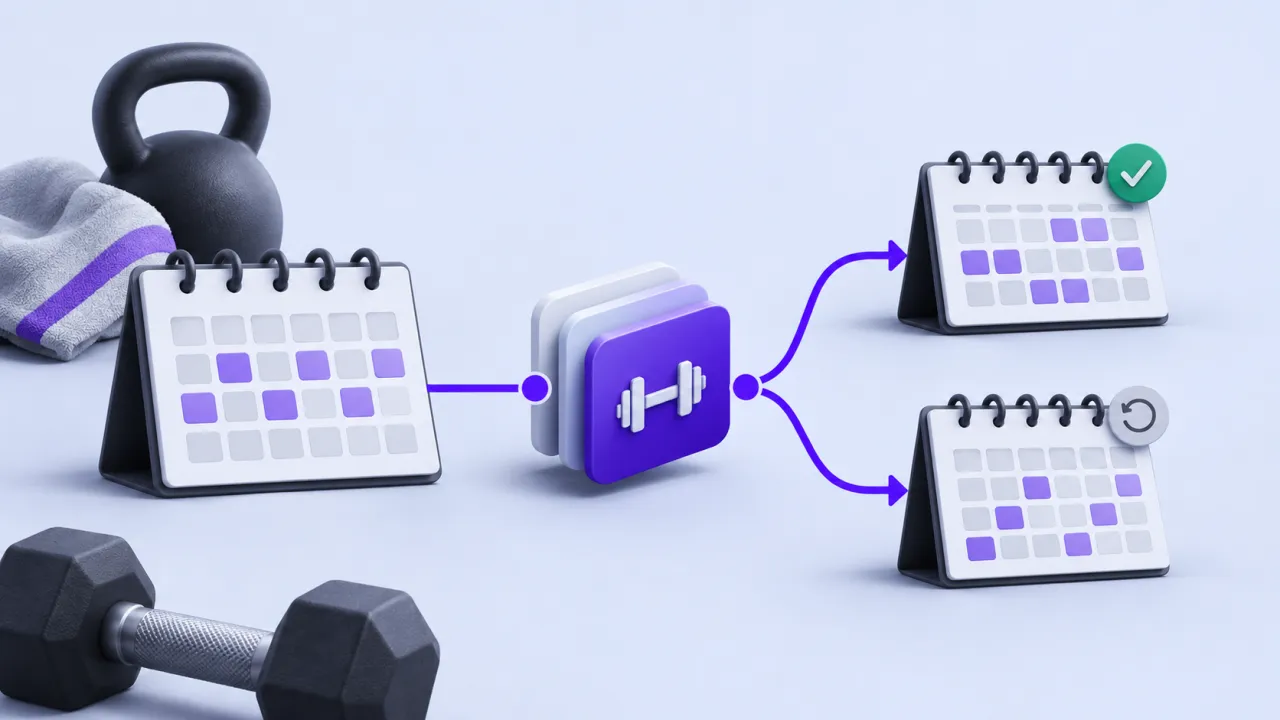
A training plan is editable, but a completed workout is historical evidence. If changing next week’s program rewrites the meaning of last week’s logged session, progress reports become unreliable. Program versioning should preserve the prescription that a client actually followed while allowing future work to evolve.
The contract to define first
Separate a reusable program template from the version assigned to a client and the snapshot associated with a performed session. Decide whether edits apply to future sessions, selected dates or a new assignment. Keep exercise identifiers and units stable enough to interpret older logs even when display names change.
A worked scenario
A synthetic coach replaces an exercise for the remaining weeks of a plan. Completed sessions should retain the original exercise and recorded loads. Future sessions should show the new prescription, with the change visible to the client rather than silently replacing their history.
An implementation and review sequence
- Define template assignment and session-history boundaries
- Choose which edits create a new version
- Show the effective date of future changes
Failure cases worth testing
| Condition or input | Expected behavior |
|---|---|
| A completed session is reopened | Its original prescription is recoverable |
| Coach edits a future week | Only the selected future scope changes |
| An exercise label is renamed | Historical logs remain interpretable |
Download the illustrative acceptance checklist (JSON)
Tradeoffs and limits
Full snapshots consume more storage than references, but references need strong version guarantees. Choose the smallest representation that can still reconstruct the historical prescription accurately.
Use the result to make a decision
The practical output is straightforward: keep completed sessions stable when a coach edits future plans. Keep the assumptions with the artifact so a product owner, implementer or prospective partner can review the same decision. A useful handoff states the supported scope, the evidence collected and the remaining dependency instead of treating a successful demonstration as proof of every operating condition.
Continue with related implementation detail
Related guide: Design a coach portal as an account-scoped product workspace.
Missed check-in escalation workflows
Coach client access after reassignment
References and current platform requirements
Android: health and fitness app design
The linked references provide platform or process context. The worked scenario and acceptance matrix are original examples; adapt them to the actual product, supported environment and documented responsibilities.
Discuss the workflow
Map one coach-to-client workflow with AptixLabs before expanding the feature list.
Explore the relevant AptixLabs service
Should program edits change completed workout history?
A training plan is editable, but a completed workout is historical evidence. Full snapshots consume more storage than references, but references need strong version guarantees.
Which failure cases should be included in the review?
Include these explicit cases: A completed session is reopened: its original prescription is recoverable; Coach edits a future week: only the selected future scope changes; An exercise label is renamed: historical logs remain interpretable.