

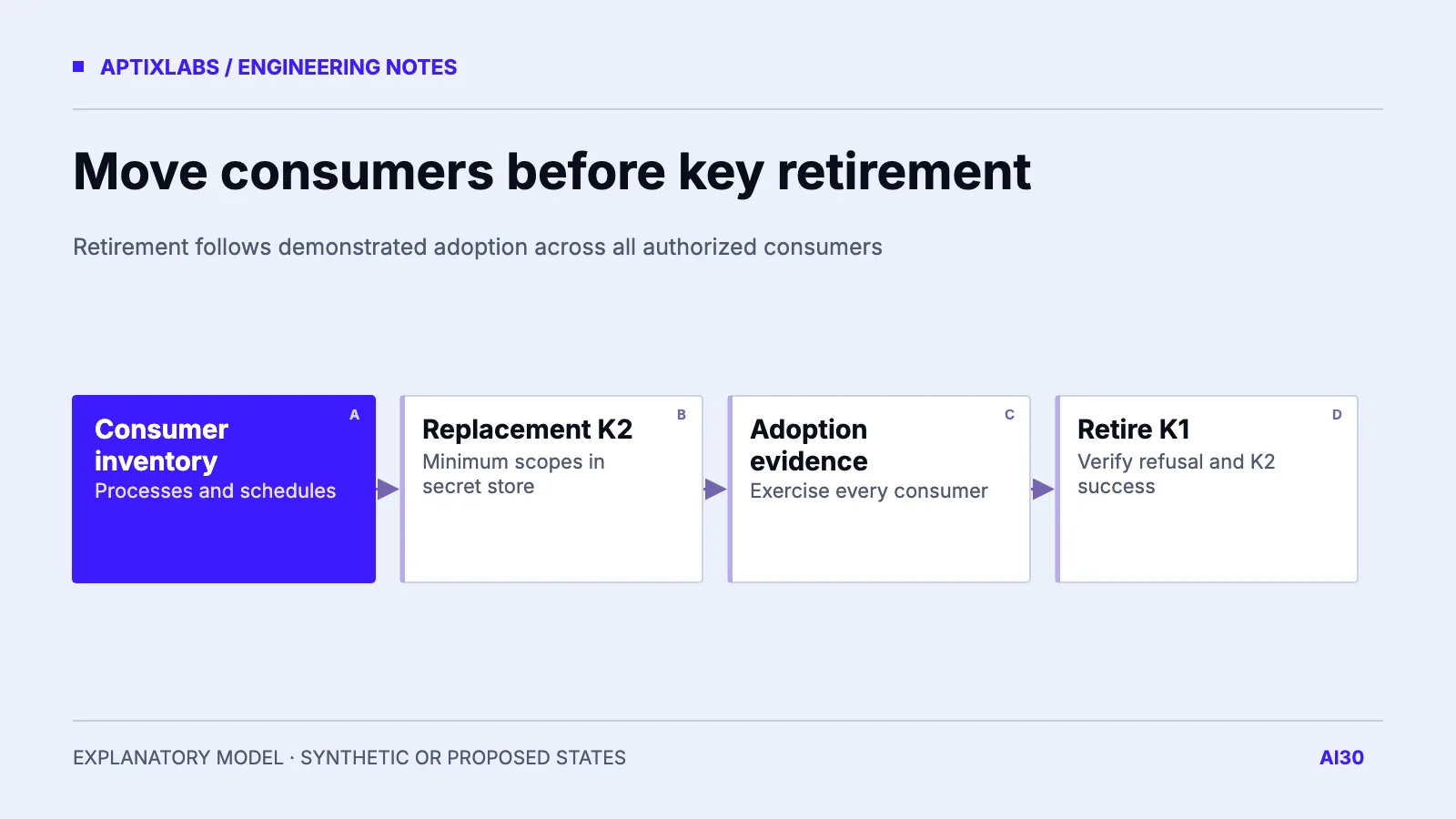
Rotate a SaaS integration API key by moving every consumer to a verified replacement before retiring the old credential, when the provider supports an overlap. Inventory workers, dashboards and scheduled jobs, distribute through approved secret storage, observe key-version adoption and test retirement. A deployment marked successful does not prove a rarely scheduled consumer has stopped using the previous key.
Inventory consumers and provider rules
List each process, schedule, environment, secret reference and required permission. Include manual support scripts and disaster-recovery jobs if they are authorized consumers. Determine whether the provider supports multiple active keys, which scopes can be narrowed and how revocation propagates. If it allows only one key, plan a coordinated cutover and explicit temporary-unavailability behavior rather than promising zero downtime.
Railway's credential-rotation guide describes an overlap-and-redeploy pattern in its platform context. Treat provider-specific guarantees and secret-reference behavior as inputs to verify for your integration. Refresh-token rotation is a different lifecycle from API-key replacement; inspecting one token helper does not establish an API provider's dual-key support or a shipped rotation pipeline.
Railway: credential overlap and consumer migration
A two-consumer synthetic rollout
Suppose a fictional integration has a dashboard API and a nightly worker. Issue replacement version K2 with the minimum required scope and store it under an approved versioned secret reference. Move the dashboard first and run a harmless authorized read. Move the worker next and trigger its disposable test workload rather than waiting for an unobserved overnight schedule. Keep K1 available only for the documented overlap interval.
| Stage | Dashboard | Nightly worker |
|---|---|---|
| Inventory | Secret reference and scope | Schedule and reference |
| Move to K2 | Redeploy or supported reload | Redeploy and test workload |
| Observe | Successful synthetic read | Successful synthetic job |
| Retire K1 | Monitor auth outcome | Monitor next scheduled execution |
The version labels are synthetic and never contain credential bytes. Record provider key IDs or secret-version references where safe, deployment revisions and the tested operation. Avoid logging a prefix of a secret as an informal identifier unless the security review explicitly permits it. A deterministic version reference is usually enough to track adoption without spreading credential material through dashboards and chat.
Observe adoption, not just secret updates
A process can retain K1 in memory after its secret store points to K2. Inspect startup and reload behavior for HTTP clients, workers and connection objects. Updating a secret reference may require a new process depending on the deployment platform. Also check retry queues: a queued task should load current authorized credentials at execution rather than carrying an old raw key in its payload.
Proposed migration ledger
consumer: nightly-report-worker
replacement_reference: integration-key/K2
application_revision: fixture-worker-v2
verified_operation: synthetic read
last_old_version_use: observed category only
retirement_owner: named operating role
Use a bounded observation window that covers the actual consumer schedules or deliberately exercise them in the test environment. Absence of old-key calls during five quiet minutes does not cover a weekly job. If the provider lacks per-key usage telemetry, record that limitation and use controlled consumer verification rather than inventing a last-used time. The retirement decision needs evidence appropriate to the available observability.
Retire and verify refusal
After adoption is confirmed, revoke K1 through the provider's documented process. Verify that an isolated request with the retired test key fails and that K2 still performs the intended operation. Monitor authentication failures by consumer identity without exposing headers. Keep recovery instructions specific: restoring a deployment does not restore a revoked key, and re-enabling a suspected compromised key may be inappropriate even if it is technically possible.
No provider API-key rotation was executed here. The ledger is a proposed rollout contract, not a claim about a private product's deployed integration. For an urgent compromise, a planned overlap may be the wrong choice; follow the incident policy and accept bounded disruption when required. For routine rotation, a small consumer-by-consumer evidence pack makes the final retirement decision concrete and prevents hidden jobs from becoming the first sign that a key was still in use.
SaaS partner integration sandbox
Observability for small teams: start with the failed customer task
Bring one API or data workflow and a sanitized failure example for a bounded implementation assessment.
How do you rotate an API key across SaaS consumers?
Verify provider overlap support, move and test every consumer using approved secret references, then retire the old key and confirm both refusal and replacement success.
Does updating the secret store update running processes?
Not always. Check whether each process reloads the secret or needs a new deployment.
Can rotation always avoid downtime?
No. Provider overlap, consumer behavior and urgent compromise can require a coordinated interruption.