
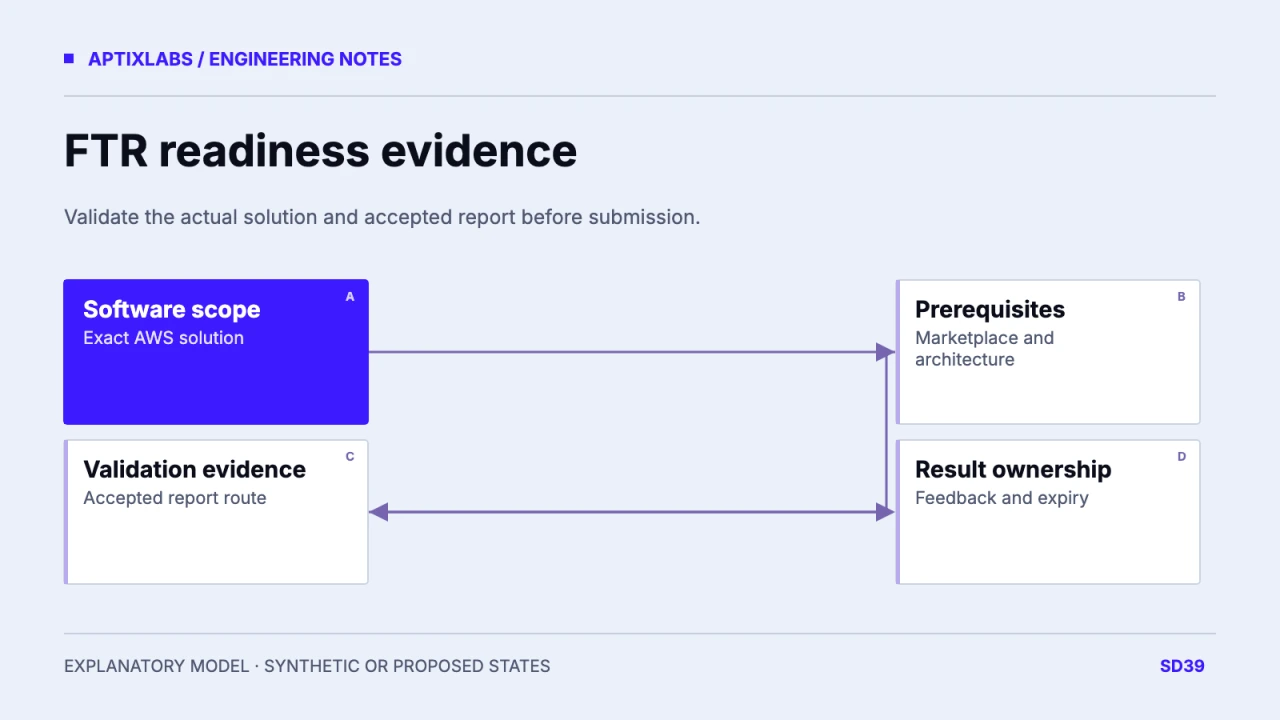
Prepare AWS FTR evidence for the exact software solution and current validation path. A credit award, another provider’s deployment or a general architecture slide does not establish AWS qualification or a passed technical review.
Identify the software and current Partner Central path
Record the solution, marketplace product, hosting scope and account owners. AWS currently describes FTR as a review of a subset of Well-Architected practices, with approval valid for two years. Its Partner Central validation guide addresses active software solutions linked to AWS Marketplace. Do not substitute a generic startup application checklist. The submission needs a product identity and a known architecture whose evidence can be reviewed. If the intended software is not actually deployed on AWS, record that boundary before preparing a report that implies otherwise.
Additional current primary reference
Read prerequisites before collecting a document pile
The current path checks one linked Marketplace software product, AWS-hosted architecture and Partner Revenue Measurement enablement, along with the documented product and account-linking conditions. Later checks can remain blocked until earlier ones pass. The guide accepts a scoped SOC 2 Type II report or AWS Well-Architected Framework Review report under stated freshness and quality conditions. Confirm the exact current checks before preparing a request. An infrastructure diagram is a prerequisite artifact, not a replacement for the accepted validation report or a finding that the workload satisfies the review.
| Item | Evidence state | Decision |
|---|---|---|
| Marketplace software link | Verify actual solution | Prerequisite gate |
| AWS-hosted architecture | Proposed in scenario | Do not imply deployed |
| Accepted report | Scope and freshness review | No substitute audit claim |
| Validation result | Not submitted | No qualification badge |
Build a fictional scope-to-evidence index
A hypothetical vendor has software DEMO-S and a proposed AWS architecture. Its index lists architecture scope, access management, recovery evidence, operations ownership and the accepted report route. Mark the architecture proposed until the deployment is real. If a report covers a different product or provider, mark it out of scope rather than renaming its title. Preserve report dates, solution identifiers and open gaps. The evidence pack should make it easy for the responsible owner to see what cannot yet be submitted, without manufacturing a badge or suggesting that documentation work alone creates qualification.
Validate the report’s scope before submitting
Inspect whether the chosen report names the actual solution and AWS-hosted workload, and whether the current conditions for that route are met. Follow the current upload format and size requirements at submission rather than hardcoding an old portal limit into a long-lived checklist. Keep sensitive reports restricted to the authorized process. Resolve a scope gap with the report owner or qualified reviewer; do not edit audit conclusions as an engineering cleanup. Source code, configuration and test summaries may support internal readiness but do not automatically substitute for the specific validation document.
Retain the result and continuing owner
After an authorized request, store the actual status, feedback, approval expiry and affected solution. If action is required, record the failed check and remediation owner, then resubmit through the supported path when ready. Do not describe pending as approved. No FTR request was submitted for this guide, and AptixLabs’ use of other providers establishes no AWS programme status. The handoff is a readiness index with explicit missing prerequisites and a post-review maintenance owner, separate from any startup promotional-credit planning.
AWS Activate credits readiness
Startup technical data room checklist
Bring the actual software scope and prerequisite gaps to organize technical readiness evidence.
B2B SaaS development: scope and acceptance
Do AWS Activate credits establish FTR approval?
No. Promotional credits and technical solution validation are different processes.
Can a report for another workload satisfy the scope automatically?
No. Verify the specific solution and AWS-hosted workload against the current validation requirements.