
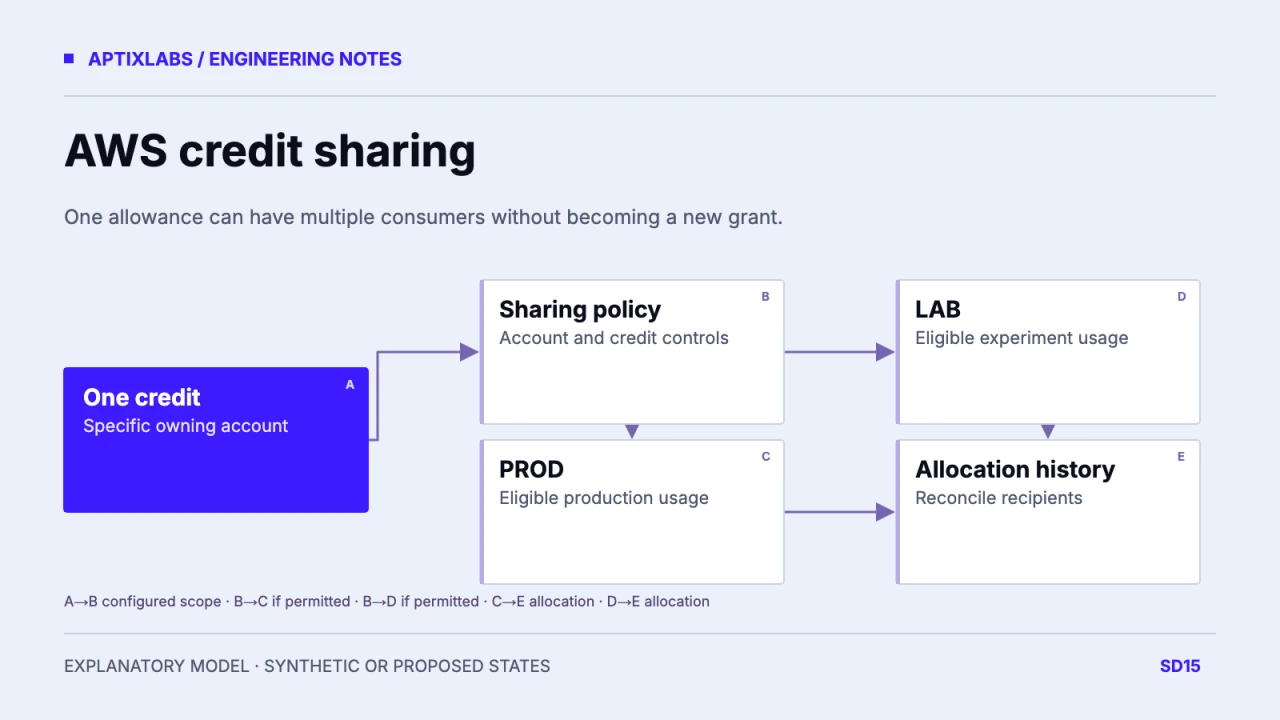
Model AWS promotional-credit consumption from the credit owner, eligible products and current organization sharing preferences. Moving workloads into multiple accounts can change who consumes a balance; it does not create additional credit.
Identify the credit and its owning account
Record credit ID, owning account, effective and expiry dates, applicable products and current status. AWS’s billing guide distinguishes active, paused, exhausted and expired credits and provides application history. Use the account’s current evidence rather than a remembered Activate award. Record whether the amount is a last-cycle balance or a current estimate. A credit that exists in a console may still be paused or restricted to products unrelated to the proposed workload. Keep these properties attached to the consumption model so an architecture decision is not based on one isolated balance number.
Read both sharing controls
AWS currently documents account-level credit-sharing activation and credit-level sharing preferences. Accounts need sharing activated to give or receive shared credits, while a specific credit’s preference can further scope consumption. Inspect the management-account configuration and the particular credit rather than treating AWS Organizations membership as sufficient. Do not change organization settings for a demonstration. Capture the effective period and authorized owner for any planned change. Monthly allocation rules and account membership changes can affect the billing result, so preserve the exact dates instead of extending one observed month into a universal rule.
| Setting | PROD | LAB |
|---|---|---|
| Credit ownership | Holds one allowance | No new grant inferred |
| Sharing permitted | Eligible usage may consume | Eligible usage may consume |
| Sharing not permitted | Verify local application | Budget separate exposure |
| Allocation review | Credit history | Recipient-account evidence |
Compare production and experiments using synthetic values
Suppose a fictional account PROD holds an eligible allowance and account LAB runs experiments. Build two scenarios with the same usage: sharing permitted under the actual configuration, and sharing not permitted. In the shared scenario, LAB may consume a portion of the same allowance if the credit and account rules permit it. In the isolated scenario, its charges need separate coverage or cash. Assign no new allowance to LAB merely because it is another account. Keep eligibility by service in both scenarios; sharing does not convert an excluded product into a covered one.
Monitor allocation and remaining exposure
Use application history and billing records to compare predicted recipient accounts and services with actual allocations. Separate allocation from responsibility: an experiment consuming a shared balance still needs an owner, shutdown condition and underlying usage budget. Review cash charges that remain after offsets. An account with no immediate invoice can still consume capacity and a finite shared promotion. If a credit is paused or a sharing setting changes, record the operational intent and next expected bill impact. Avoid using a temporary zero cash charge as evidence that the workload is free to operate indefinitely.
Review the next period before reorganizing accounts
Before adding, removing or moving an account, ask who owns the credit, who can receive it, which product lines are eligible and how the change date affects allocation. Keep the current AWS policy with the decision because billing controls evolve. The synthetic comparison is an operational worksheet and no organization changes were made here. Reconcile the first complete period after an authorized change. If actual allocation differs, retain the billing evidence and ask a precise support question. The result should be understandable to both the platform owner and the person forecasting post-credit costs.
AWS Activate credits readiness
Bring the credit configuration and account usage map to plan observable cost ownership.
B2B SaaS development: scope and acceptance
Does each AWS account get the same credit allowance?
No. Account separation does not create a grant. Model the actual credit owner and authorized sharing rules.
Is organization membership enough for credit sharing?
No. Inspect account sharing activation, the credit-specific preference and eligible service rules.