

Budget an Azure Marketplace purchase from the applicable offer and publisher evidence. A resource appearing in Azure does not mean startup sponsorship covers its third-party charge, and a Marketplace incentive programme is a separate entitlement.
Inventory the publisher and purchase route
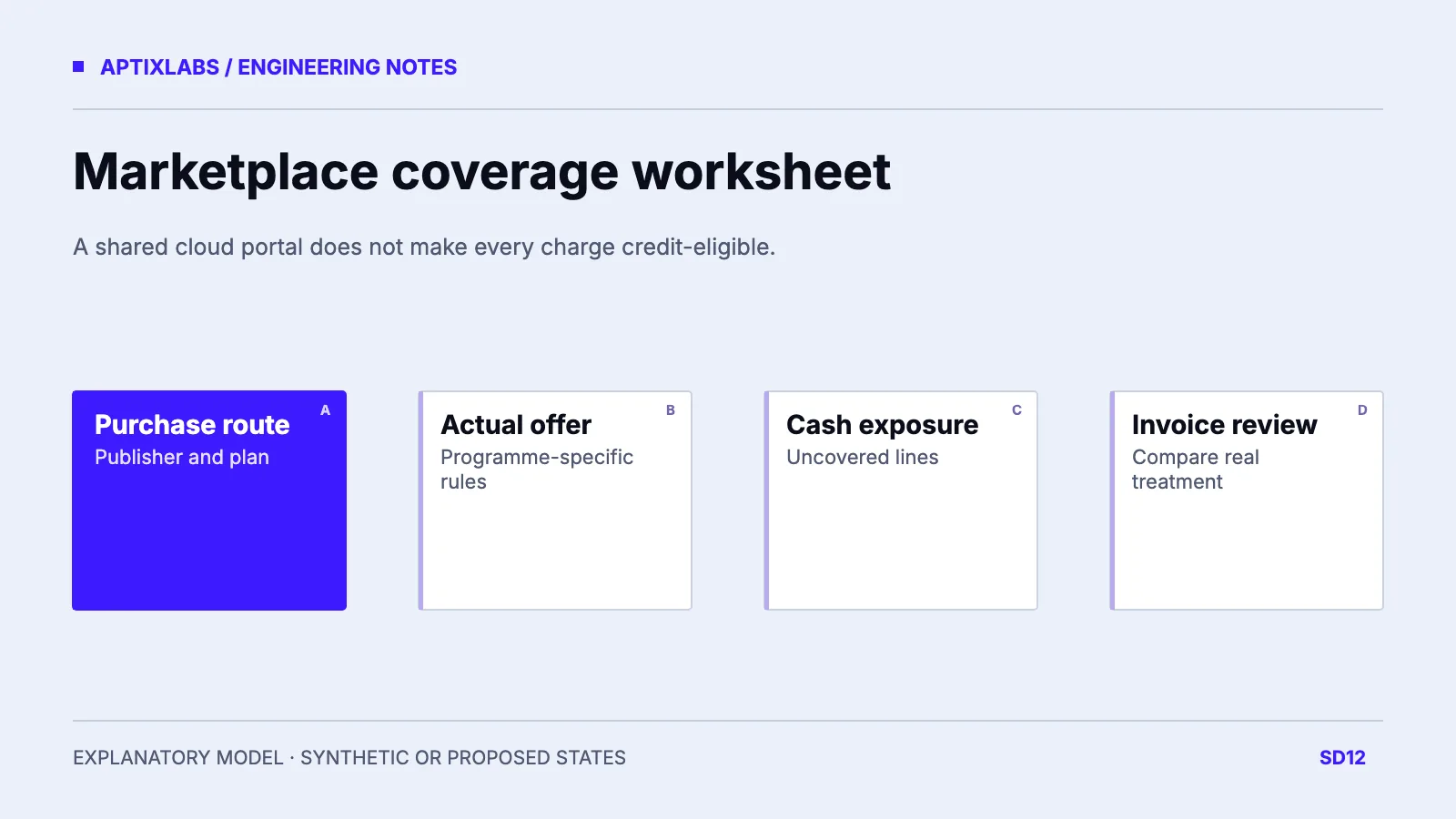
For each planned dependency, capture the publisher, product, plan, billing account and expected charge type. Separate infrastructure used to run a product from the product’s own subscription or license. A database appliance can create both Azure compute costs and a third-party software charge. Those lines may have different coverage. Keep an architecture sketch tied to a purchase worksheet so the procurement discussion sees every dependency. A generic line called database hides the distinction that determines whether cash is required while promotional credits remain.
Read the actual sponsorship terms
The Azure Sponsorship Offer details exclude several categories from special pricing, including third-party branded products and products sold through Azure Marketplace. Microsoft’s current startup technical-benefits page also distinguishes eligible Azure-billed models from third-party provider or Marketplace models. Confirm the approved startup offer before applying either statement to a purchase. The Grow Azure Sponsorship page in the research brief describes a Marketplace-performance incentive programme with specific use cases; it should not be treated as the startup grant’s terms. Name the programme in every row instead of combining benefits with similar branding.
| Cost line | Coverage evidence | Cash treatment |
|---|---|---|
| Azure compute | Verify startup offer | Conditional offset |
| External add-on license | Marketplace exclusion review | Budget without assumed offset |
| Grow sponsorship | Different programme | No startup entitlement inferred |
| Renewal | Plan and offer recheck | Separate commitment |
Keep infrastructure and license exposure in separate rows
Consider a synthetic deployment with first-party compute and an add-on sold by an external publisher. Assign no credit coverage to the add-on until its exact terms justify it. Model the infrastructure line separately even if the add-on’s listing bundles the user experience. Currency, taxes, minimum commitments and renewal terms can change the cash requirement. The worksheet should include a fallback purchase or a narrower trial that can be funded without assumed reimbursement. A maximum advertised credit amount is not a spending approval and should not be copied into the available cash column.
Azure Sponsorship Offer details
Microsoft startup technical benefits and model coverage
Review a purchase before making it
Ask the owner to supply the exact offer evidence, who can authorize the purchase and what happens at renewal. If coverage is uncertain, hold the commitment or use a clearly bounded alternative rather than treating pending support as approval. An accepted Marketplace order proves the order exists; it does not prove promotional credits will offset it. Keep the provider’s written clarification with the relevant line item. If the publisher, plan or model changes, reopen coverage review because a seemingly minor product substitution can change the billing route.
Reconcile the first bill against the worksheet
After an authorized purchase, compare actual line items with the predicted publisher, rate basis and offer treatment. Preserve unknowns rather than forcing totals to match by moving costs between covered and uncovered columns. The example here is a planning model and no Azure purchase was made. Use the resulting discrepancy to ask a focused billing question or correct the forecast. Revisit the post-credit scenario as well: even eligible infrastructure becomes an operating expense when the benefit ends. A useful decision record survives that transition and explains why the dependency remains worth operating.
Microsoft startup credits application checklist
Startup cloud credits comparison
Bring the planned purchase route and applicable offer evidence to review uncovered operating costs.
B2B SaaS development: scope and acceptance
Are all products purchased through Azure covered by startup credits?
No. Check publisher, billing route and the applicable offer; Marketplace and third-party exclusions can apply.
Is Grow Azure Sponsorship the same as a startup grant?
No. It is a distinct programme with its own use cases and conditions. Do not transfer its allowances to a startup offer.