
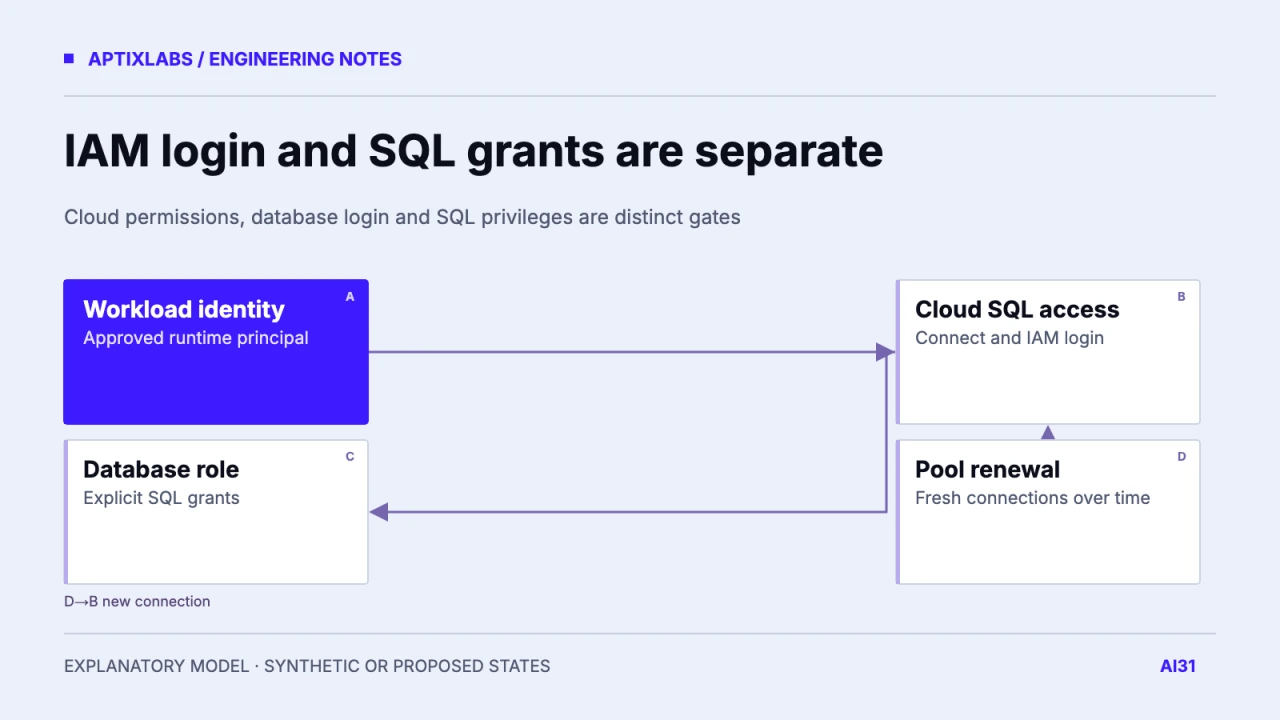
Scope Cloud SQL IAM database authentication as an isolated connector proof before changing a live connection pool. Separate permission to reach the Cloud SQL instance, permission to log in as an IAM database user and SQL privileges after login. Use a supported connector with a documented refresh strategy, and test new connections across credential renewal. A successful cloud API call is not a successful database authorization test.
Draw three independent permission boundaries
The workload first needs an approved identity in its runtime. It then needs the appropriate Cloud SQL connection and login permissions plus the instance's IAM authentication configuration and database user setup. After connecting, ordinary PostgreSQL grants determine which schemas, tables and functions it may use. A connector supplies a supported connection mechanism; it does not automatically grant every SQL privilege the application expects.
Google Cloud's IAM authentication documentation distinguishes automatic connector-managed authentication from manual token handling and describes user and service-account prerequisites. Check the supported connector, driver and account combination before choosing an implementation. Avoid embedding a short-lived login token into a long-lived static password setting without a renewal design.
Cloud SQL: IAM database authentication and prerequisites
Build a narrow disposable proof
Create an isolated database with fictional records and a dedicated test workload identity. Grant only the cloud and SQL permissions required for one read. Use the selected official connector's documented IAM mode and supported driver. Keep the connector and pool lifetime explicit in application startup and shutdown. A source-level lifespan hook is an integration boundary to inspect, not proof that IAM database authentication is already configured.
| Boundary | Passing evidence | Failure case |
|---|---|---|
| Cloud access | Instance connection allowed | Missing connection permission |
| Database login | Expected IAM principal | Unconfigured IAM user |
| SQL privileges | Permitted fixture view | Denied write or schema |
| Renewal | Fresh connection after refresh | Identity source unavailable |
Log connection attempt categories and safe identity references rather than tokens, connection strings or secret-bearing environment dumps. Verify the effective database user and role in the disposable session. Then attempt a denied write or unrelated-schema read to prove the intended SQL boundary. A passing SELECT from a publicly readable object is too weak to establish that the workload obtained the correct application role.
Test new connections after renewal
Keep an existing pooled connection open, then create fresh connections across the connector's documented credential-refresh period. Record which path handles refresh and what happens when the identity source is temporarily unavailable. Existing authenticated database sessions and new login attempts are distinct observations; do not infer one from the other. Use a controllable credential source or a bounded integration window appropriate to the connector rather than modifying a production identity.
Proposed connection proof
runtime identity -> Cloud SQL connection permission
IAM database login -> expected database principal
SQL SELECT -> fixture reporting view only
new pooled connection after refresh -> repeat login proof
revoked or missing SQL grant -> denied operation
Inspect pool creation callbacks and connection replacement. If the connector refreshes credentials for each new connection, ensure the pool invokes that path when replacing stale or failed connections. Do not close the shared connector after creating only the first connection. On shutdown, drain or close the pool before disposing of resources it still needs. The exact ordering must follow the selected connector's API contract.
Keep rollout and fallback bounded
Compare login failure, connection-network failure, SQL permission denial and pool exhaustion in the error taxonomy. They need different operator actions. Document the tested driver and connector versions and the workload identity configuration without exposing credentials. A fallback to another credential method, if approved, must preserve the same database role and isolation rules; it should not silently reconnect as an administrator.
No Cloud SQL IAM connection or credential-renewal experiment was executed for this article. The deliverable is a proposed proof worksheet, with database and cloud access intentionally left untouched. Run it in an approved disposable project, retain the actual permission and renewal trace, and only then plan a staged migration of the application pool. This keeps an authentication change reviewable without implying a deployed capability or an unmeasured availability improvement.
Database connection pooling on Cloud Run
Observability for small teams: start with the failed customer task
Bring one API or data workflow and a sanitized failure example for a bounded implementation assessment.
What should a Cloud SQL IAM authentication proof verify?
Verify runtime identity, connection permission, IAM database login, SQL grants and fresh pooled connections across credential renewal using a supported connector.
Does Cloud SQL IAM login grant table access?
No. PostgreSQL schema, table and function privileges remain separate authorization boundaries.
Does one successful pooled connection prove token renewal?
No. Exercise fresh connections after the documented renewal boundary and inspect connector lifecycle handling.