
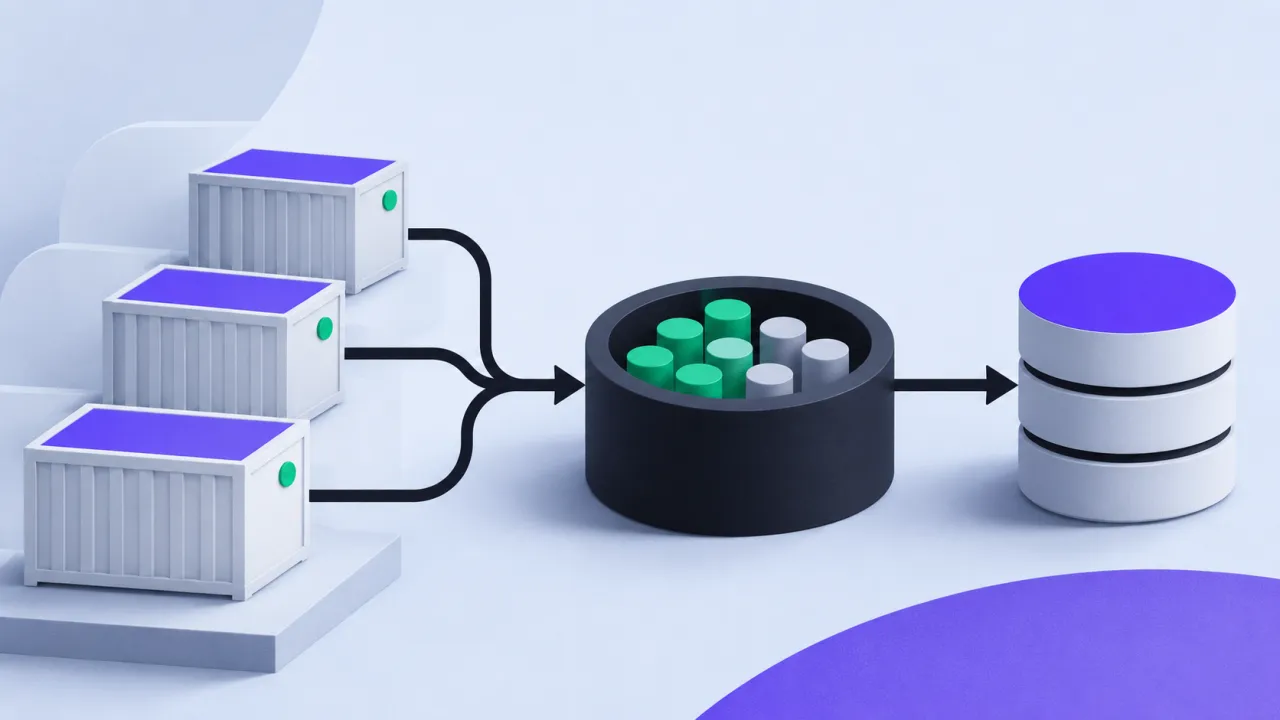
Autoscaling application instances can multiply database connections faster than expected. A modest per-instance pool becomes large when several instances each create their own pool. Plan the aggregate connection budget using concurrency, process count and database limits rather than tuning one local development process.
The contract to define first
Reuse connection pools appropriately within the application lifecycle and bound their size. Account for worker processes and other services using the same database. Queueing, timeouts and backpressure should make saturation observable. A managed pooling option may help, but its compatibility and transaction semantics must be checked against the application’s actual usage.
A worked scenario
In a hypothetical deployment, four instances with five connections each can reserve twenty connections before considering jobs or admin sessions. Those numbers are only a worksheet example. The real budget should include headroom and the maximum scaling behavior the team intends to allow.
An implementation and review sequence
- Calculate the aggregate pool budget across instances and workers
- Bound waiting and surface saturation metrics
- Test scale-out with representative transaction behavior
Failure cases worth testing
| Condition or input | Expected behavior |
|---|---|
| Instances scale out | Total connections remain within the planned budget |
| The pool is exhausted | Requests receive controlled waiting or failure |
| A transaction uses session-specific behavior | Pooling compatibility is explicitly tested |
Download the illustrative acceptance checklist (JSON)
Tradeoffs and limits
A larger pool can reduce local waiting while worsening shared-database saturation. Optimize end-to-end throughput and failure behavior instead of assuming more connections always improve latency.
Use the result to make a decision
The practical output is straightforward: estimate concurrent connections under autoscaling with explicit assumptions. Keep the assumptions with the artifact so a product owner, implementer or prospective partner can review the same decision. A useful handoff states the supported scope, the evidence collected and the remaining dependency instead of treating a successful demonstration as proof of every operating condition.
Continue with related implementation detail
Related guide: A startup stack with clear boundaries: React Native, FastAPI and PostgreSQL.
SaaS deletion propagation architecture
Cloud Run cold start measurement
References and current platform requirements
Google Cloud: managed connection pooling
The linked references provide platform or process context. The worked scenario and acceptance matrix are original examples; adapt them to the actual product, supported environment and documented responsibilities.
Discuss the workflow
Discuss one reliability bottleneck, its impact, and a measurable acceptance task.
Explore the relevant AptixLabs service
How does autoscaling affect the database connection budget?
Autoscaling application instances can multiply database connections faster than expected. A larger pool can reduce local waiting while worsening shared-database saturation.
Which failure cases should be included in the review?
Include these explicit cases: Instances scale out: total connections remain within the planned budget; The pool is exhausted: requests receive controlled waiting or failure; A transaction uses session-specific behavior: pooling compatibility is explicitly tested.