
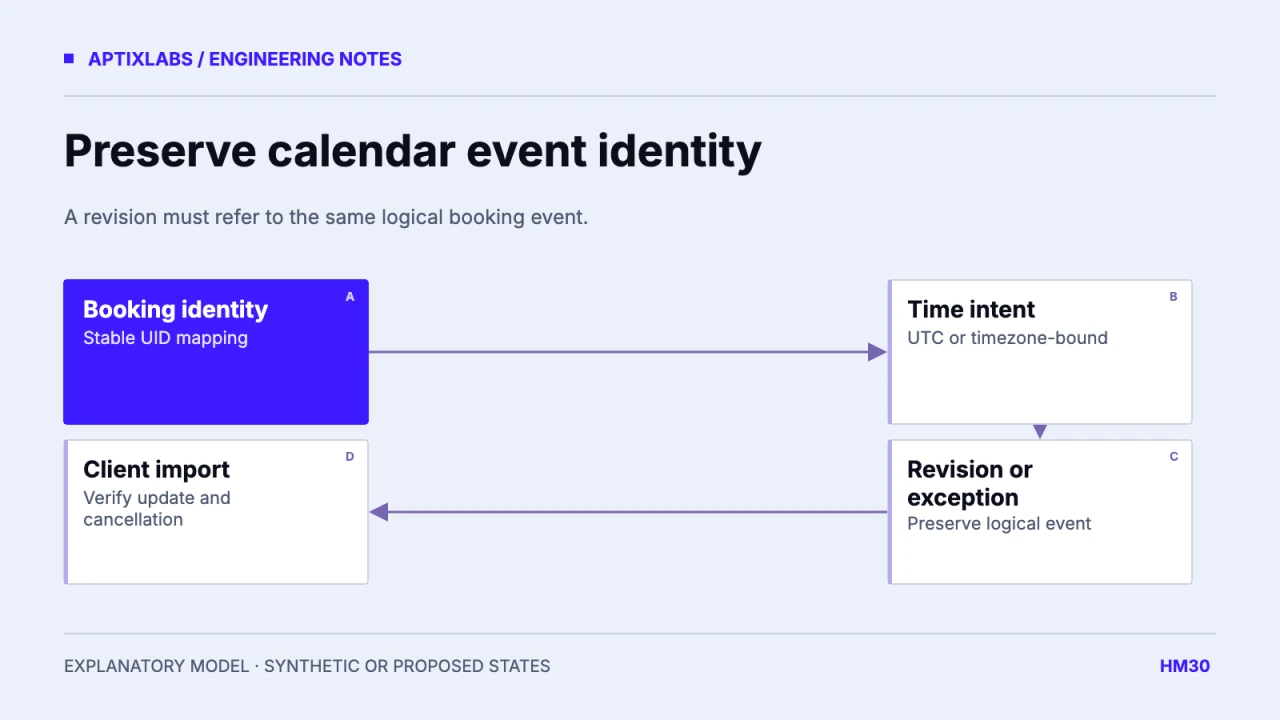
A calendar export needs stable event identity as well as correct time conversion. Re-exporting the same booking with a new UID can create another event instead of updating the old one. Decide whether the feature is a one-time file, a subscribed feed or a scheduling integration before promising automatic updates or cancellation.
Prerequisites are a stable booking ID, source-of-truth timezone, intended calendar clients and a delivery model. An .ics download is not equivalent to bidirectional calendar synchronization. Document what happens after a person imports the file and then the booking changes.
Choose the time intent before formatting DTSTART
A fixed appointment can be represented with UTC instants. A recurring local-time commitment may need a timezone-bound representation. A floating time has another meaning and should be deliberate. RFC 5545 defines these representations and event properties; inspect its current errata and the target client behavior before creating an exporter.
IETF: iCalendar event identity, time values and recurrence
For a synthetic weekly coaching call intended to remain at 09:00 in the coach’s timezone, do not generate future dates by adding a fixed UTC offset through daylight-saving changes. Preserve the zone intent and use timezone-aware recurrence handling. The client’s display zone can differ without changing the underlying appointment.
Retain event identity across revisions
Illustrative VEVENT fragment, not a complete calendar file:
UID:fictional-booking-42@example.invalid
DTSTAMP:20261105T060000Z
DTSTART:20261106T100000Z
DTEND:20261106T103000Z
SEQUENCE:1
SUMMARY:Coaching call
The same logical event should keep its UID when the accepted time changes. Update revision information consistently with the chosen protocol. For a recurring series, a single occurrence change needs a distinct recurrence-instance treatment rather than generating another whole series. Do not treat a new filename as the event’s identity.
| Action | Identity expectation | Client observation |
|---|---|---|
| Initial import | One UID | One event |
| Time correction | Same logical UID | Existing event updates under supported delivery |
| Single recurring exception | Series plus occurrence identity | Only intended occurrence changes |
| Cancellation | Same event reference | Client behavior verified explicitly |
The worksheet is proposed, not a passed import test. A manually imported file may not update an earlier import the way a subscribed feed or invitation workflow does. RFC 5545 supplies a data format; scheduling delivery semantics and client support need separate assessment.
Keep internal slots distinct from calendar integration
The reviewed UltraFit360 slot generator uses a configured timezone, availability windows, minimum notice and busy intervals to produce UTC slot starts. That source context helps define booking times. It does not establish an iCalendar exporter, subscribed feed or external-calendar connection. This article scopes a proposed addition.
Map booking cancellation, coach reassignment and timezone edits into the export policy. Restrict calendar descriptions to information appropriate for the chosen audience. A public feed URL and a downloaded file have different access and revocation properties; choose the sharing model deliberately.
Test the clients the feature will name
Use fictional events in isolated test calendars and retain client versions, import method and observed results. Include duplicate import, changed start time, cancelled event, recurring exception and a daylight-saving boundary. Remove test events afterwards under the fixture’s cleanup plan. No calendar import was executed for this guide.
If a target client does not update or cancel through the selected delivery model, explain that limitation or choose a different integration. The useful commissioning artifact is a lifecycle matrix with observed client behavior, not a blanket claim of compatibility based on generating syntactically plausible text.
Export filenames and download timestamps should not drive identity. A person can rename a file or import it twice, while the logical booking remains the same. Keep event identity derived from the application’s stable mapping and verify escaping, line folding and complete calendar structure with an appropriate parser. The sample fragment deliberately omits that envelope; it should not be copied into production as a complete .ics document. Syntax validation and client lifecycle tests answer different questions.
Propose a bounded UltraFit360-related integration pilot with the partner system, intended users, data rights, owners and acceptance criteria; availability must be verified.
Explore health fitness app development
What keeps coaching calendar exports from creating duplicate events?
Use stable event identity and explicit timezone intent, then represent revisions and cancellations under the chosen calendar delivery protocol.
Does downloading a new .ics file automatically update an earlier import?
Not reliably across delivery models and clients. Verify the chosen workflow rather than promising synchronization from file generation alone.