

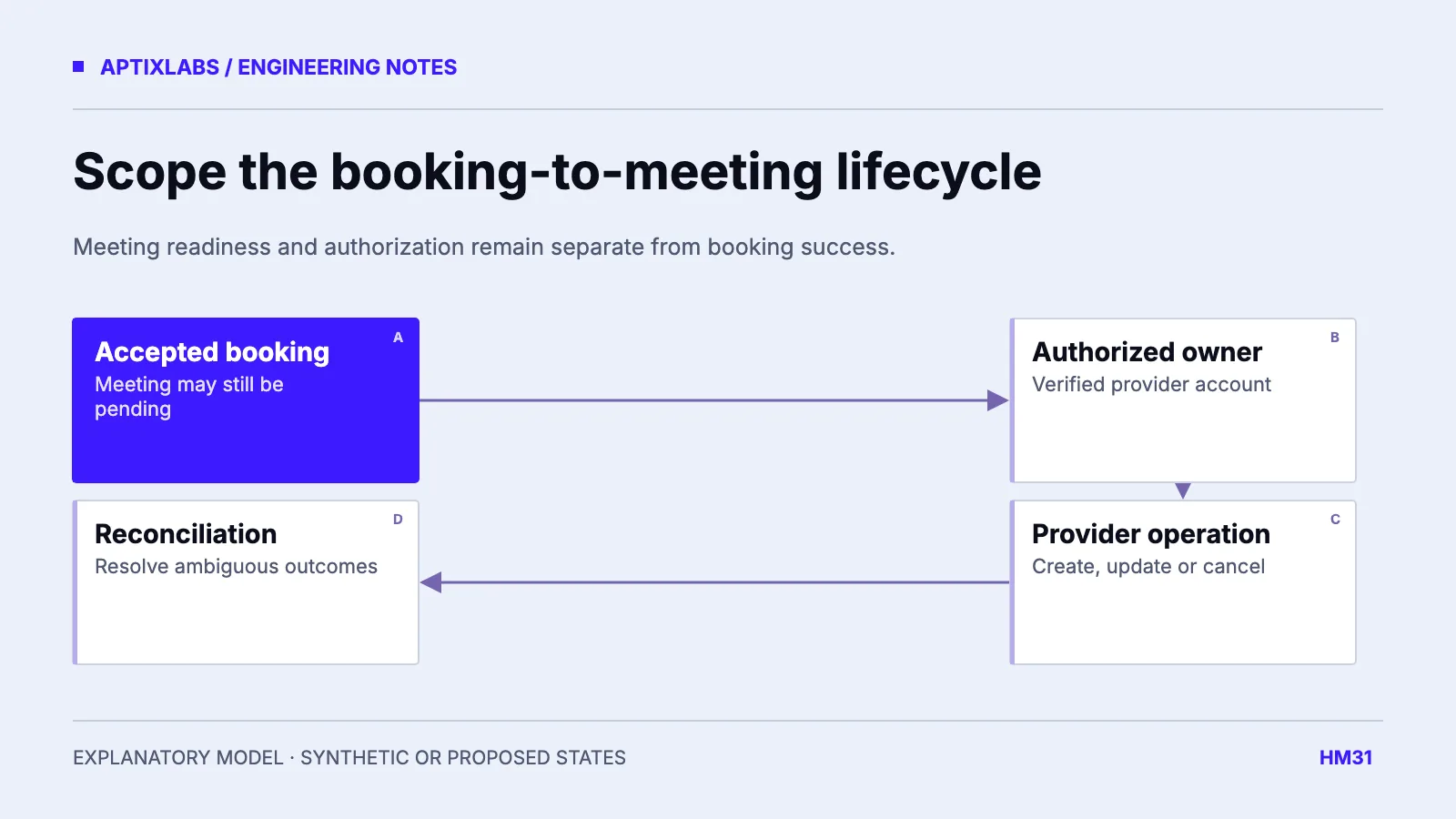
Adding video meetings to coaching bookings requires a resource lifecycle, not just a join-link field. Choose whose provider account owns the meeting, verify access and permissions, and define how booking creation, rescheduling and cancellation affect that resource. Keep an ambiguous provider response recoverable before issuing another create request.
This is a proposed integration scope. The reviewed booking route establishes an application booking flow; it does not establish Zoom connectivity, provider credentials or an available partnership. Bring the intended host model, supported account types and a fictional booking lifecycle to discovery.
Choose ownership before selecting OAuth scopes
A platform-owned host account and a coach-owned account have different onboarding, quota and offboarding questions. Decide who starts the meeting, who can manage it and what happens when a coach leaves. A client should receive an appropriate join action, not a host management credential.
Zoom documents OAuth flows for authorized access, token refresh and revocation according to the integration type. Use the provider’s current app and scope requirements for the chosen ownership model; possession of an application booking does not itself authorize creating a meeting in a coach’s account.
Zoom: OAuth authorization and token lifecycle
| Decision | Coach-owned model | Platform-owned model |
|---|---|---|
| Authorization | Coach connects an account | Operator authorizes host resources |
| Host identity | Coach’s supported provider user | Assigned platform host |
| Offboarding | Revoke connection and reconcile meetings | Reassign or cancel owned resources |
| Support | Connection and account eligibility | Resource capacity and operator ownership |
These are planning alternatives, not statements of provider plan eligibility. Verify current account and API conditions before selecting one. Do not promise recording, transcription or meeting capacity from a general OAuth page. Each additional capability has its own access and retention decisions.
Separate accepted booking from meeting readiness
A useful proposed model has booking confirmed and meeting pending as distinct states. If provider creation is temporarily unavailable, the product can retain the booking while showing link pending and assigning a reconciliation owner. Do not falsely display a meeting link or roll back a valid booking without a defined product policy.
Synthetic ambiguous-create sequence:
booking 42 confirmed → meeting create requested
provider response times out → outcome unknown
reconcile using retained operation context
known created → attach meeting identity
known not created → retry under bounded policy
The trace is illustrative and no provider API was called. A timeout can occur after the provider created the resource. Retain request context and any supported external identity so the worker can investigate before creating another meeting. Verify the provider’s actual idempotency and lookup capabilities instead of inventing a universal retry header.
Reconcile changes and revoked access
When the booking time changes, update the associated meeting under the chosen model and preserve its identity where appropriate. If cancellation succeeds locally but provider cancellation fails, mark cleanup pending and retry deliberately. A link copied earlier may still exist, so the product must explain what has actually been cancelled.
Test token expiry, revoked authorization, a coach account becoming ineligible, provider rate limiting and a callback arriving twice. Keep account ownership in queue keys so a job cannot run under a newly connected coach account by accident.
Commission the smallest complete lifecycle
A bounded milestone can cover one provider, one host model, one booking type and creation plus cancellation reconciliation. Use sandbox or authorized test accounts and fictional participants, with no real invitations sent during fixture development. Verify which join details may be shown and which management details must remain server-side.
No Zoom meeting, OAuth account or notification was created for this article. The deliverable is an ownership worksheet and failure-state trace. Once those are agreed and provider access is verified, the implementation can be assessed against a concrete lifecycle instead of an unsupported promise that every booking automatically includes video.
Separate provider meeting identity from a join URL. URLs can change or contain access material, while reconciliation needs an authorized stable resource reference. Store only the fields required by the lifecycle and restrict management data to the appropriate server-side path. A fictional test should replace a join link after an accepted update and inspect which clients receive it. The old link’s behavior is a provider question to observe, not something a database update alone can guarantee.
Propose a bounded UltraFit360-related integration pilot with the partner system, intended users, data rights, owners and acceptance criteria; availability must be verified.
Explore health fitness app development
What should be scoped before adding video meetings to coach bookings?
Choose the meeting owner, authorization and booking-to-meeting lifecycle, then define reconciliation for ambiguous creation and cancellation outcomes.
Should a timed-out meeting create be retried immediately?
First reconcile whether the provider created the resource. An ambiguous outcome can otherwise produce duplicate meetings.