
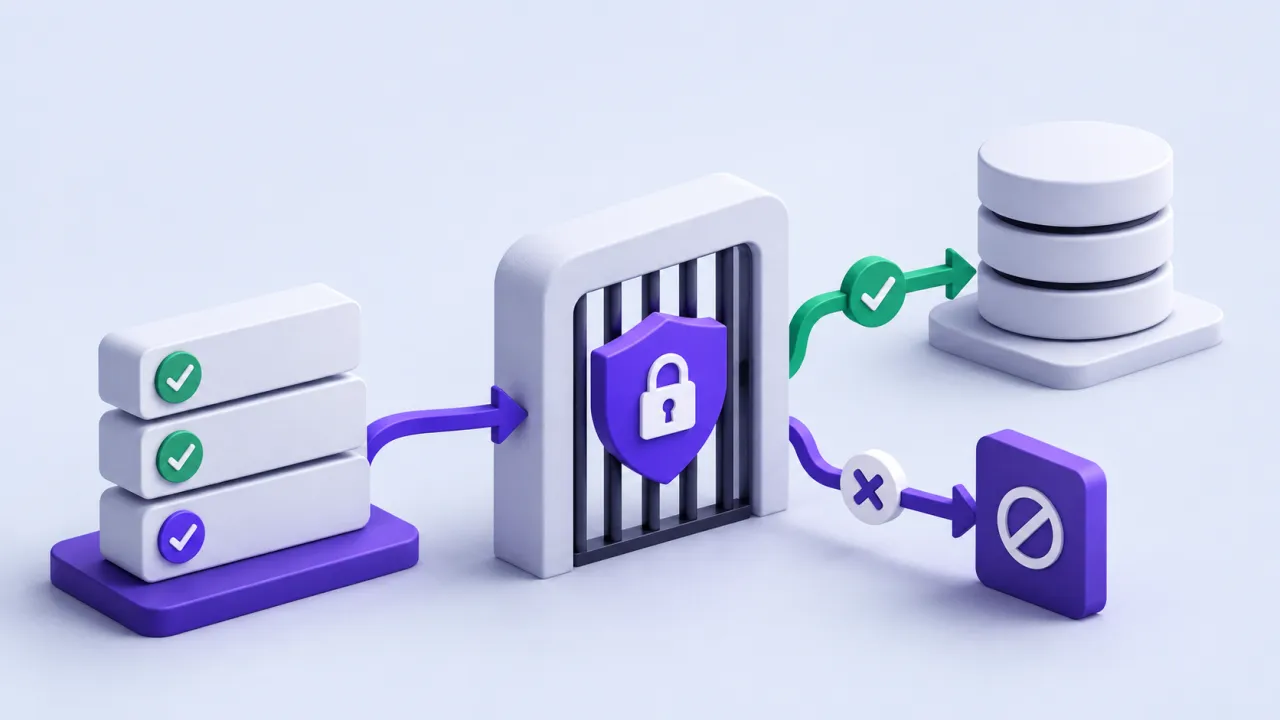
Security rules deserve regression fixtures because a small change can widen access to many records. Test the requests that must fail as carefully as the requests that should succeed. A green interface test does not prove that a direct unauthorized database request is denied.
The contract to define first
Use the supported emulator and testing tools to create explicit identities and record ownership states. Cover anonymous, owner, other-account and privileged paths. Test create, read, update and delete independently, including fields whose ownership cannot be changed by the caller. Keep administrative-server access assumptions separate from client security rules.
A worked scenario
A synthetic contact-submission collection may permit a constrained public create while denying public reads. A test should verify both operations and reject unexpected fields or ownership changes according to the intended contract. Passing a valid submission is only half the boundary.
An implementation and review sequence
- Write an allowed-and-denied operation matrix
- Use synthetic identities and records in emulator tests
- Test immutable ownership and unexpected field changes
Failure cases worth testing
| Condition or input | Expected behavior |
|---|---|
| A public user reads submitted enquiries | The request is denied |
| A valid constrained submission is created | The intended create succeeds |
| A caller changes an ownership field | The rule prevents unauthorized reassignment |
Download the illustrative acceptance checklist (JSON)
Tradeoffs and limits
Excessively clever rules can become difficult to review. Prefer small explicit invariants and fixtures that explain the intended product behavior, then expand coverage when the contract changes.
Use the result to make a decision
The practical output is straightforward: construct allowed and denied fixtures for contact and tenant records. Keep the assumptions with the artifact so a product owner, implementer or prospective partner can review the same decision. A useful handoff states the supported scope, the evidence collected and the remaining dependency instead of treating a successful demonstration as proof of every operating condition.
Continue with related implementation detail
Related guide: Multi-tenant SaaS data isolation with FastAPI and PostgreSQL
FastAPI background jobs versus task queues
References and current platform requirements
Firebase: test Firestore security rules
The linked references provide platform or process context. The worked scenario and acceptance matrix are original examples; adapt them to the actual product, supported environment and documented responsibilities.
Discuss the workflow
Discuss one reliability bottleneck, its impact, and a measurable acceptance task.
Explore the relevant AptixLabs service
Which denied requests belong in security-rule tests?
Security rules deserve regression fixtures because a small change can widen access to many records. Excessively clever rules can become difficult to review.
Which failure cases should be included in the review?
Include these explicit cases: A public user reads submitted enquiries: the request is denied; A valid constrained submission is created: the intended create succeeds; A caller changes an ownership field: the rule prevents unauthorized reassignment.