
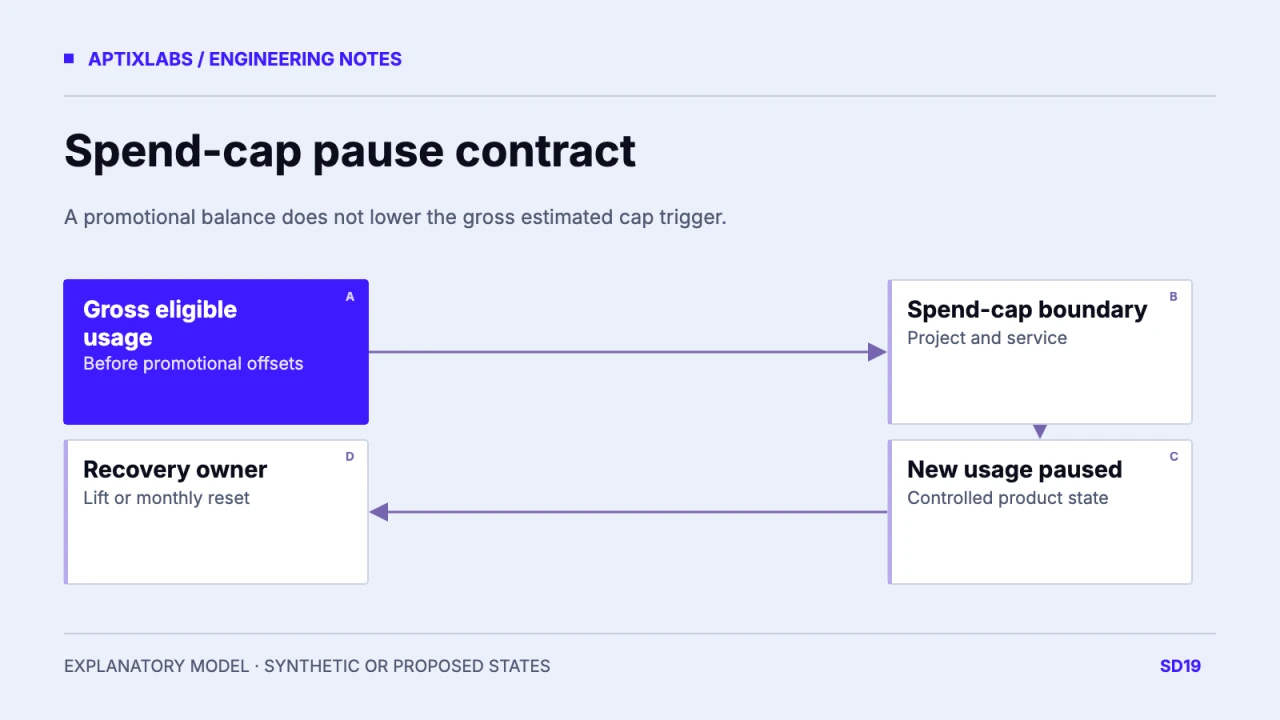
Google Cloud alerts-only budgets notify owners; eligible-service spend-cap budgets can pause new usage. Design the product for that pause, and model the cap from gross estimated usage rather than the cash bill after promotional credits.
Choose notification or enforcement explicitly
Google’s 30 October 2026 announcement describes generally available spend caps; older advice saying all Cloud Billing budgets are notifications alone is incomplete. Alerts-only remains a useful monitoring choice where interruption is unacceptable or coverage is unavailable. Before choosing enforcement, write down the dependency, user impact and recovery owner. A cap changes the failure model of the feature. It should be reviewed with the same care as a quota boundary, rather than added to a production project simply because a warning email was previously ignored.
Additional current primary reference
Verify scope and coverage in current documentation
Current spend caps are monthly, single-project and single-eligible-service controls for first-party customers. The documented service set includes Gemini API, Gemini Enterprise Agent Platform, Cloud Run and Cloud Run functions; verify the current table before rollout. They are not organization-wide cash caps. Gross list-price estimates exclude credits and savings. Enforcement is not instantaneous; in-flight requests finish, and fixed persistent-resource costs continue. The announcement also identifies Provisioned Throughput as unpaused. Separate those exposures in the operating worksheet instead of describing the control as an absolute ceiling on the invoice.
| State | Product behavior | Billing interpretation |
|---|---|---|
| Gross usage below cap | Normal task path | Monitor gross estimate |
| Cap enforced; credits remain | Controlled unavailable state | Credits do not lower trigger |
| In-flight work | Reconcile completed result | Charges may finish accruing |
| Fixed or provisioned resources | Separate monitoring | Not universally paused |
Model a pause while promotional balance remains
In a synthetic AI feature, the project’s gross estimated eligible usage rises to 101 units against a 100-unit cap while 1,000 units of promotional credit remain. The cap can still pause the dependency because the promotional balance is not subtracted from its trigger basis. Neither number is a customer measurement or provider rate. The application should distinguish the paused service from a missing user record or invalid prompt. Record the attempted task once, avoid an uncontrolled retry loop and explain the temporary limitation in language the user can act on. Preserve safe user input according to the product’s actual retention rules.
{"status":"unavailable","reason":"dependency_paused","retry":"operator_or_period_recovery"}
// Proposed application contract; verify provider-specific error mapping.
Specify a bounded degraded response
A proposed request contract can return a service-unavailable state with a stable internal reason such as dependency_paused, while leaving the provider’s exact error mapping to a real integration test. Do not invent a universal HTTP status that every eligible service emits. Offer a non-AI path or a later retry only if the product can support it. Avoid promising completion at the next minute or silently moving the request to an uncapped paid dependency. Test this state using a local mock before any controlled provider exercise; this guide’s pause contract is illustrative, not deployed.
Own lifting and the next-period restart
Assign a billing operator and product owner for each cap. Document who can approve renewed spending, how queued work is handled and how the first recovered task is verified. The current guide describes automatic next-period reset and manual lifting; a manual lift changes protection for the remainder of that period, so read the exact behavior before using it. Service recovery can take time. Review alerts, pause evidence and uncapped costs together. The runbook should keep a cost decision from becoming an unexplained outage and keep a recovery action from becoming unreviewed spending.
Startup credits expiration budget
Bring the dependency’s pause behavior and recovery owner to scope a controlled failure path.
B2B SaaS development: scope and acceptance
Do remaining startup credits prevent a Google Cloud spend-cap pause?
No. Spend caps use gross estimated eligible usage excluding credits and savings.
Does a cap stop every charge in the project?
No. Scope, eligible services, in-flight work, fixed resources and provisioned capacity create important boundaries.