
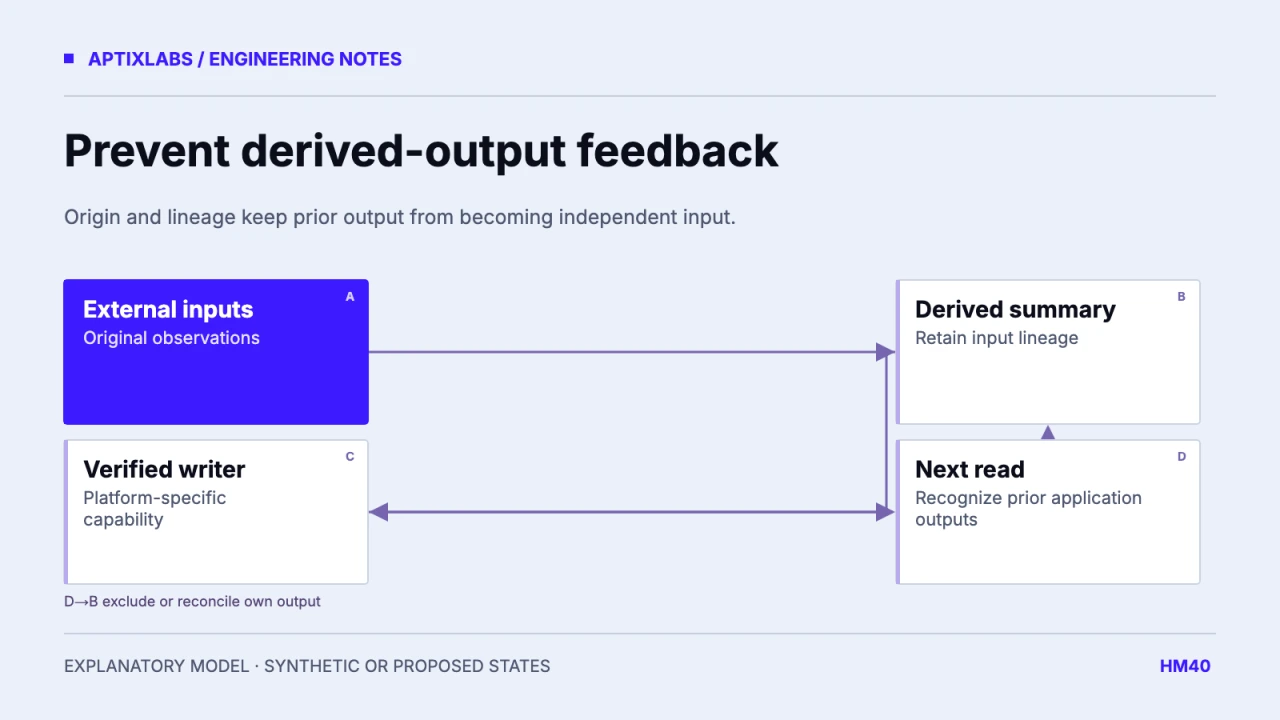
A health-data feedback loop occurs when an application imports observations, writes a derived output and then treats that output as another independent input. Stable import IDs alone do not solve the problem: the derived record may have a new valid identity while representing the same underlying activity. Map the topology and preserve origin and transformation meaning.
This guide proposes a bidirectional integration contract. It does not claim that UltraFit360 ships Apple Health write-back. The reviewed iOS authorization configuration has an empty write-permission array. A separate write-service file exists, but source presence does not establish enabled permissions, supported native behavior or a released feature.
Map every reader and writer before writing totals
For each metric, list external observations, manual entries, application estimates and derived summaries. Identify which paths may write to the platform and which paths later read those records. A field called dailySteps does not reveal whether it is an original interval count or a summary already calculated from other records.
| Record class | Read policy | Write policy |
|---|---|---|
| External observation | Apply metric-specific source policy | Do not rewrite as a new observation |
| Manual app entry | Retain authoring origin | Write only under verified capability |
| Derived daily summary | Keep input and version lineage | Avoid independent duplicate meaning |
| Prior app output | Recognize application origin | Update stable logical output if appropriate |
The table is conceptual. Source identity, provider metadata and application record references need to be designed for each platform. HealthKit and Health Connect expose different models; do not assume one origin filter or update mechanism works identically everywhere. Verify the exact metric and API contract.
Apple: HealthKit framework and data model
Inspect the feedback with a synthetic cycle
| Cycle | Naive append-and-sum | Origin-aware stable output |
|---|---|---|
| 1 | 1,000 steps | 1,000 steps |
| 2 | 2,000 steps | 1,000 steps |
| 3 | 4,000 steps | 1,000 steps |
The fixture begins with one fictional external observation of 1,000 steps. The naive branch appends each derived total and sums all records again. The guarded branch excludes its own derived outputs from the external-input calculation and replaces one stable logical output. It produced the values shown without any platform or production API calls.
Excluding app origin is only an illustrative guard. An app may legitimately author independent manual observations, and other apps may re-export a value. A production policy needs record purpose and lineage as well as package identity. Avoid claiming that one blanket filter deduplicates every cross-application topology.
Separate update identity from append identity
A repeat write of the same logical daily output should not create another independent contribution unless the platform and product explicitly require that model. Retain the mapping between application identity, provider identity, interval and transformation version. Handle corrections and deletion without leaving orphaned outputs that can re-enter the read path.
The reviewed write-service range checks provider connection and previous sync date. Those checks can limit when a workflow runs, but they do not by themselves prove loop prevention. A once-per-day feedback loop can still inflate totals over repeated days or replays.
Test permission and account boundaries independently
Verify supported write permissions and native calls separately for Android and iOS. For iOS, the current empty permission list is a concrete gate before any write acceptance claim. Test account switching, disconnect, source correction, repeated import and repeated write in an isolated environment with fictional records.
The useful deliverable is a reader-writer graph and a repeat-cycle fixture with expected logical records. Keep any future platform test distinct from this pure topology demonstration. Do not write imported totals back simply because a service method is available; first establish the record’s purpose, origin and update policy.
Include deletion in the topology fixture. Removing an external input should invalidate or revise any application-derived output that depended on it. Otherwise a stale output may survive as an apparent independent observation even after its source disappears. Retain the transformation’s input references at the level needed to find affected outputs. Test correction and deletion before adding another metric to the writer, because a successful initial import cannot establish that the bidirectional lifecycle will converge after later changes.
Bring the specific record types, device/OS targets and one failing or proposed data journey to scope a wearable integration review.
How can a health-data write-back loop inflate imported totals?
If an app writes a derived total as a new observation and later imports it alongside its inputs, the next total can count the same meaning again. Preserve provenance and update identity.
Does a separate health-write service prove iOS write-back is shipped?
No. The reviewed iOS setup requests no write permissions. Enabled native behavior and release acceptance must be verified separately.