
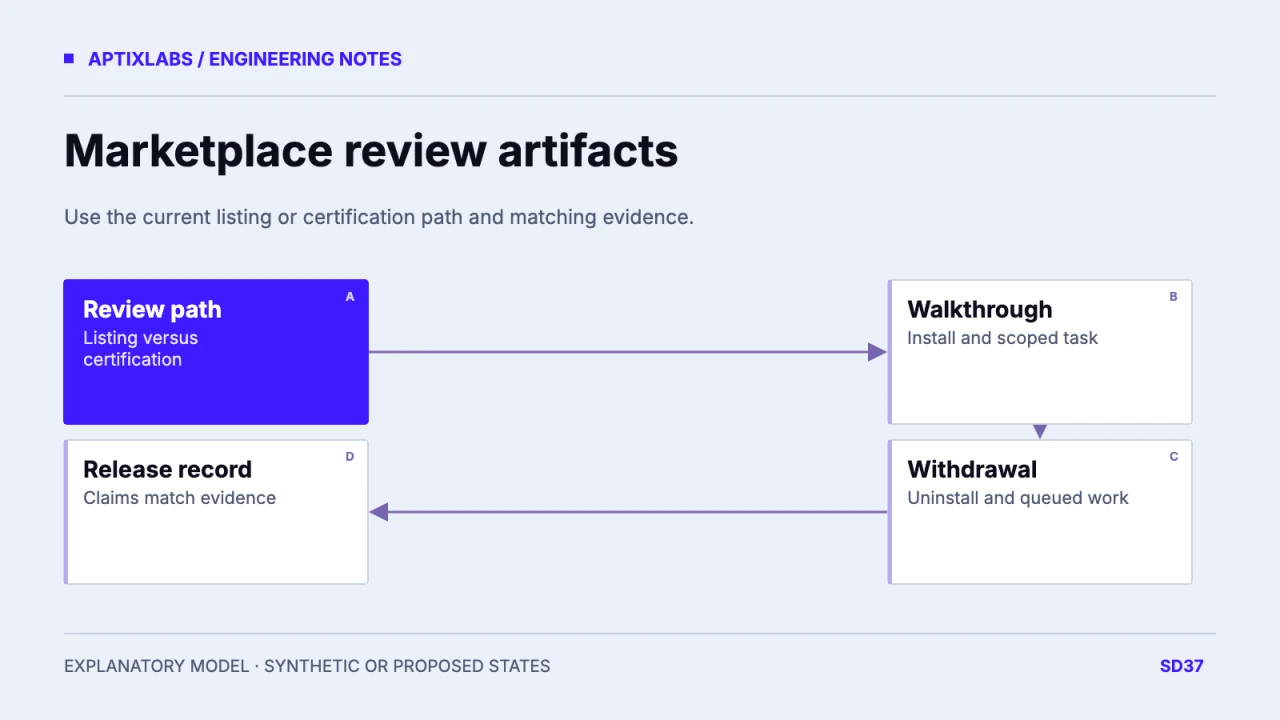
Prepare a marketplace submission around the current ecosystem review path and a reproducible install-to-uninstall task. For HubSpot, current listing guidance favors demo videos or guided walkthroughs rather than shared testing credentials.
Choose listing, certification or another review path
Name the ecosystem, distribution type, platform version, API versions and intended submission. Listing and certification can have different evidence requirements, so do not use one checklist for both. HubSpot’s March 2026 announcement adds confirmation for unlisted or unverified third-party installs, with stated exceptions. Its May update changes other listing and certification requirements. Review both the current requirements and release-specific notices immediately before submission. A private integration working in one account does not establish public distribution eligibility, marketplace approval or partner-program qualification.
Update the reviewer artifact contract
HubSpot’s May 2026 update says testing credentials are no longer required for app listing submissions from 31 March; demo videos or guided walkthroughs should show the core flow, configuration and permission usage. It also describes supported-platform enforcement from 2 November, OAuth endpoint changes and certification-specific uninstall requirements. Do not follow an older checklist that asks for a broadly privileged shared login. Keep any separate reviewer-access requirement scoped to the exact programme and current instructions. The artifact should let the reviewer understand the workflow without exposing customer data or permanent credentials.
| Artifact | Purpose | Boundary |
|---|---|---|
| Install walkthrough | Explain configuration and scopes | Synthetic records |
| Core task evidence | Show useful accepted sync | No customer outcome claim |
| Uninstall trace | Remote and local lifecycle | Path-specific requirement |
| Version register | Supported platform and APIs | Recheck at submission |
Explain every requested scope through the user task
For a fictional integration, map each requested permission to a supported action and the minimum required data. Show installation, an accepted sync task, a failed or restricted response and the resulting application state using synthetic records. A scope description should explain why the permission is needed rather than copying an API noun. Optional scopes need a useful unavailable state when not granted. If a sensitive scope requires separate approval, keep that gate visible. Do not claim the integration is approved simply because an OAuth consent screen allows an installer to continue.
HubSpot May 2026 listing and certification requirement updates
Demonstrate withdrawal and uninstall recovery
Include disconnection, token withdrawal, queued work and a later reconnect in the proposed acceptance plan. The relevant HubSpot certification path currently requires its Uninstall App API endpoint; follow the current endpoint and authorization contract instead of only deleting a local connection row. Review what happens to external records and retained data under the product’s stated policy. A successful local disconnect cannot prove the remote installation was removed. No install or uninstall was executed for this guide, and the lifecycle diagram is explanatory rather than a fabricated marketplace screenshot.
Tie listing claims to the reviewed release
Keep the walkthrough, scope matrix, support instructions, data behavior and version identifiers together. Remove unsupported claims of compatibility, certification or partner status from draft copy. If the reviewed release changes before submission, rerun the affected task and update the artifact. A rejection or requested correction should map to a specific evidence gap with an owner. Keep a safe demo environment available for reproducing the flow, even when credentials are not a submission requirement. The next step is a scoped integration readiness review, not a promise that a marketplace will accept the application.
SaaS integration landing page content
SaaS partner integration sandbox
Bring the ecosystem, release and proposed walkthrough to assess a bounded integration submission.
B2B SaaS development: scope and acceptance
Must HubSpot listing submissions include testing credentials?
The May 2026 update says they are no longer required from 31 March; provide the current requested walkthrough evidence and recheck the exact path.
Does a working private installation prove Marketplace approval?
No. Public distribution, listing and certification have separate review conditions.