
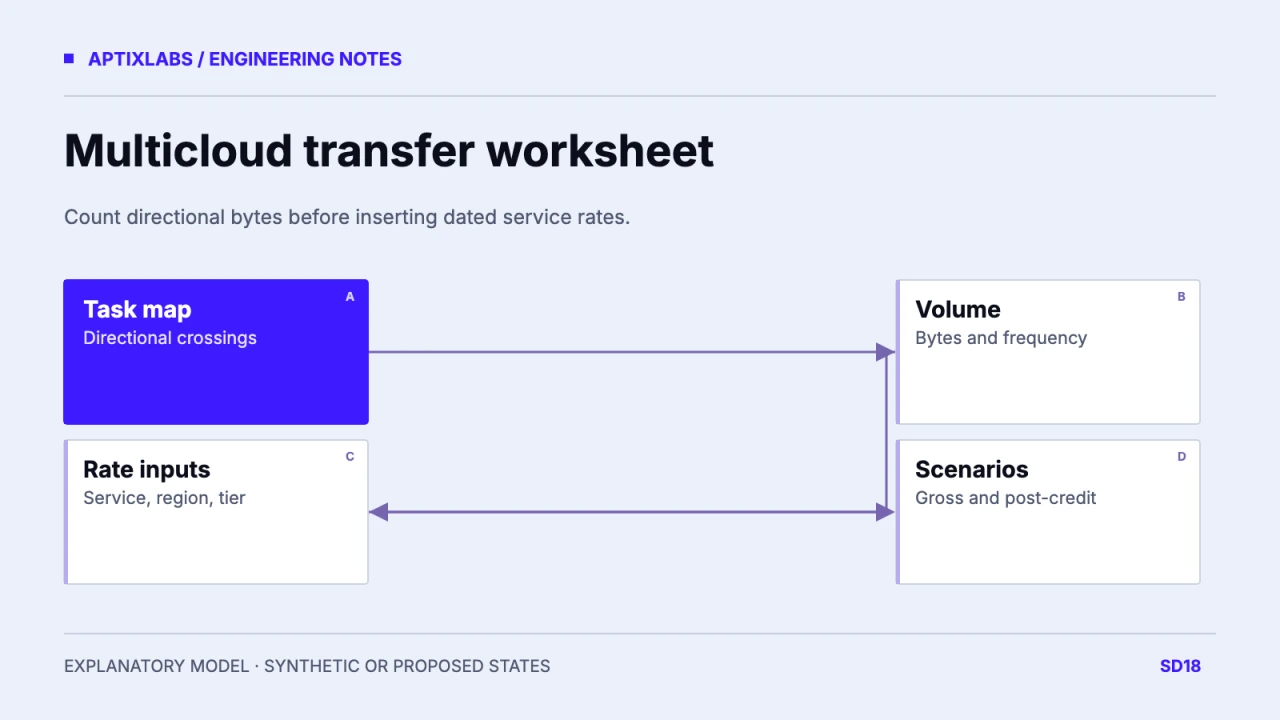
Draw both directions of data movement before using multicloud credits to justify an architecture. Estimate bytes, repetition and service-specific charges, then compare the same task with and without promotional offsets.
Trace one completed task across providers
Map the browser, application backend, record store, inference endpoint and returned output. Mark which provider sends each payload and where it terminates. Include background synchronization, failed attempts and retry loops rather than only the happy path. A model request may send a large context and return a small answer, while an image workflow can reverse that relationship. The relevant unit is one completed customer task, with every required crossing included. This task map also exposes data-location and integration dependencies that a cloud-credit comparison alone cannot resolve.
Calculate directional volume before inserting rates
Use synthetic decimal units consistently: 100,000 tasks each sending 2 MB and receiving 0.2 MB produce 200 GB outbound in one direction and 20 GB in the other before retries. If the first direction has an assumed 10% retry overhead, that illustrative volume becomes 220 GB. Do not label this as GiB or a measured workload. Replace the invented sizes with sampled, permitted payload measurements when planning a real product. Record compression, caching and repeated context policy, because those choices can change transferred bytes without changing the visible user action.
| Direction | Inputs | Volume |
|---|---|---|
| Records → inference | 100,000 × 2 MB | 200 GB |
| Inference → records | 100,000 × 0.2 MB | 20 GB |
| First direction with 10% assumed retry | 200 GB × 1.10 | 220 GB |
| Price | Exact dated service rate | Not supplied here |
Match rates to the actual network path
Google’s VPC pricing distinguishes internal transfers, internet data transfer and network tiers. Its guidance also notes that inbound transfer may be uncharged while a processing resource still incurs cost. Use the pricing page for the exact product, source region, destination and tier, with a dated rate citation. Do not apply one universal egress price to a managed database, storage export and VM path. This guide intentionally leaves rates as inputs rather than publishing an unverified blended dollar figure. A worksheet with honest rate gaps is more useful than a precise total built from the wrong service table.
transferCost = sum(directionGB * matchingRatePerGB)
netCashEstimate = eligibleGrossCost - verifiedOffset + uncoveredCost
# Keep NAT, processing and storage on separate rated rows.
Keep processing and network services visible
Add separate rows for NAT, load balancing, request processing, storage, replication and observability where relevant. Decide whether each cost occurs per byte, request, hour or stored amount. Do not multiply an hourly gateway rate by gigabytes. Credits may cover different rows under different account offers, so maintain gross costs before offsets. Include ongoing operational work such as synchronizing identities and investigating partial failures. Those requirements can make a nominally subsidized split harder to operate than a simpler deployment. The architecture choice needs both cash and engineering consequences on the same page.
Compare the post-credit task and a failure case
Build one-cloud and split-cloud scenarios using the same task volume, completion definition and retention requirements. Then remove promotional offsets and recalculate. Stress a failed dependency that causes retries or repeated downloads. Keep any lower-cost conclusion conditional on the measured volume, rate table and product behavior used. No network transfer or vendor pricing experiment was run here. The result is a reusable decision worksheet that shows which input changes the choice, rather than a recommendation to adopt multiple providers solely because grants are available.
Startup cloud credits comparison
Cloud credits versus cash runway
Bring one complete task’s data-flow sketch and volume assumptions to compare deployment options.
B2B SaaS development: scope and acceptance
Is inbound traffic always free to process?
No. A transfer charge and the resource processing the traffic are different cost lines.
Are the example volumes measured customer usage?
No. They use invented decimal-MB payloads and task counts to explain the calculation.