
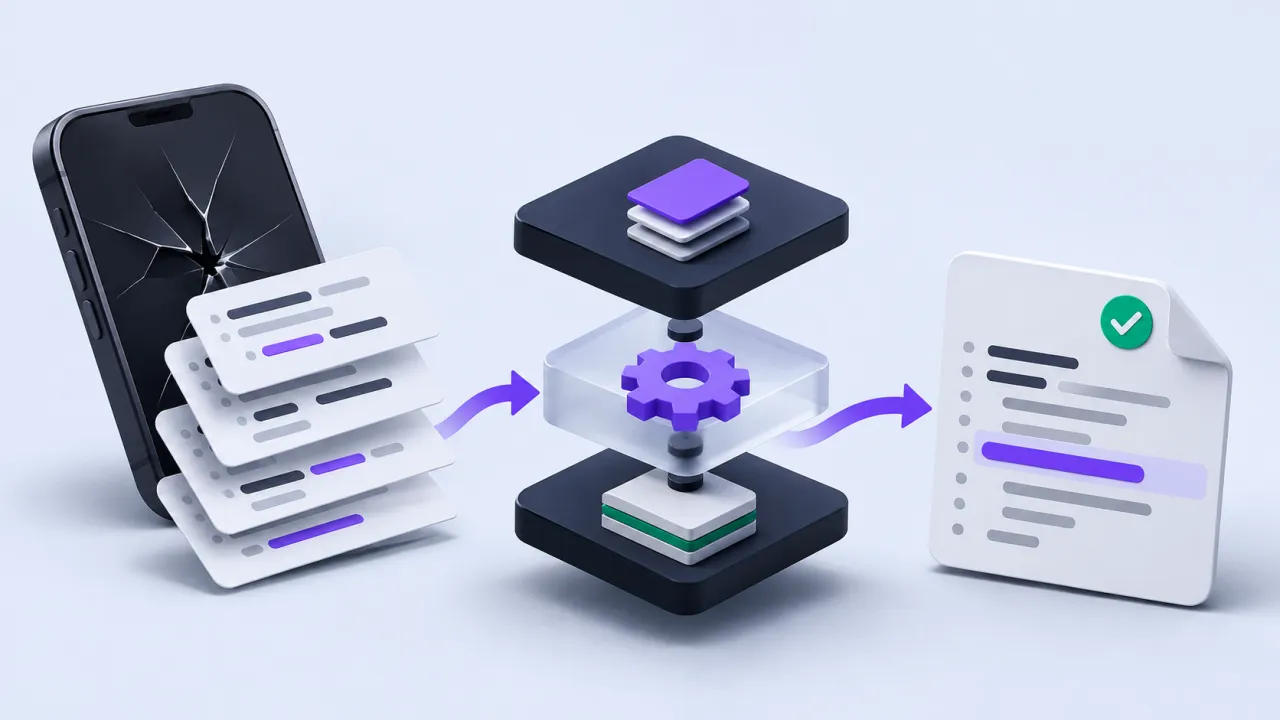
A crash report is actionable only when it can be connected to the exact code and native build that produced it. Minified JavaScript and stripped native symbols make that connection harder. Symbolication belongs in the release process so debugging does not depend on reconstructing artifacts after an incident.
The contract to define first
Record build identity, runtime, update identity and matching symbol artifacts where applicable. Keep source maps and native symbols aligned with the shipped artifact, and restrict their access. A readable stack trace still needs reproduction context: device, operating system, workflow and whether the problem began after a particular release.
A worked scenario
A synthetic crash appears only in one installed build after an over-the-air update. Using a source map from the latest branch can point to the wrong location. The investigation should resolve the matching artifact before drawing conclusions about the failing function.
An implementation and review sequence
- Attach immutable release identifiers to reports
- Retain matching JavaScript and native symbol artifacts
- Reproduce the failing workflow on the affected runtime
Failure cases worth testing
| Condition or input | Expected behavior |
|---|---|
| A source map belongs to another build | It is rejected as a match |
| An update changes JavaScript only | The report preserves both runtime and update identity |
| A diagnostic includes personal content | The collection policy prevents unnecessary disclosure |
Download the illustrative acceptance checklist (JSON)
Tradeoffs and limits
Collecting more diagnostics can improve reproduction but may expose user data. Capture only what is necessary and redact sensitive inputs before they enter a crash-reporting service.
Use the result to make a decision
The practical output is straightforward: trace a release crash to the matching build artifacts. Keep the assumptions with the artifact so a product owner, implementer or prospective partner can review the same decision. A useful handoff states the supported scope, the evidence collected and the remaining dependency instead of treating a successful demonstration as proof of every operating condition.
Continue with related implementation detail
Related guide: Trace one user action across client, API and background work.
Mobile app deletion and data export
References and current platform requirements
Apple: adding identifiable symbol names to a crash report
Platform capabilities, programme terms and access conditions can change. Check the linked primary references against the version and account you actually use; the patterns above do not establish a provider approval, certification or universal compatibility guarantee.
Discuss the workflow
Bring the affected device, release version, and a reproducible workflow for a scoped mobile discussion.
Explore the relevant AptixLabs service
Why must crash symbols match the shipped build?
A crash report is actionable only when it can be connected to the exact code and native build that produced it. Collecting more diagnostics can improve reproduction but may expose user data.
Which failure cases should be included in the review?
Include these explicit cases: A source map belongs to another build: it is rejected as a match; An update changes JavaScript only: the report preserves both runtime and update identity; A diagnostic includes personal content: the collection policy prevents unnecessary disclosure.