
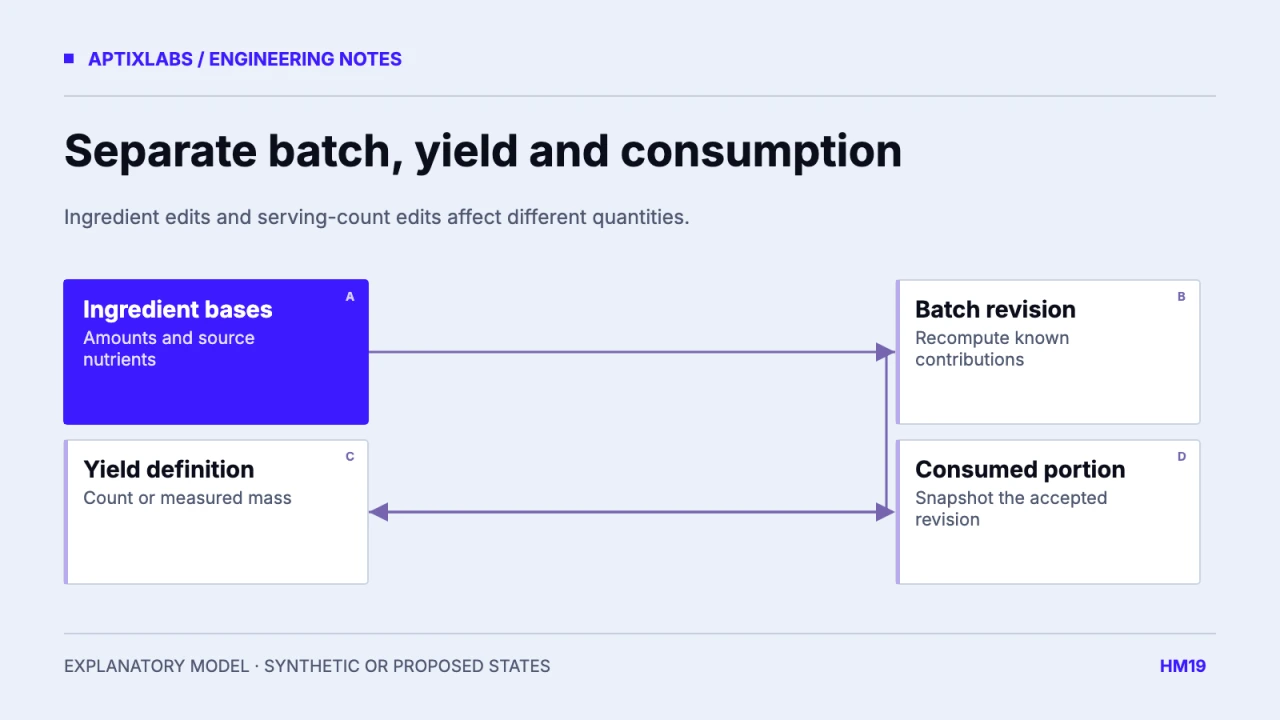
After an ingredient edit, recompute the recipe batch from its ingredient bases, then derive per-serving or per-portion values from the declared yield. Keep those three concepts separate. A batch total can increase while the amount per serving stays the same if the number of servings also increases.
Prerequisites are stable ingredient identities, amounts with units, nutrient bases and a definition of recipe yield. Distinguish a recipe template from a saved consumed meal. Editing tomorrow’s template should not silently rewrite a historical log unless the product explicitly supports that correction.
Build dependencies from ingredient to batch
Store each ingredient’s source basis and calculate its contribution from the committed amount. Then sum compatible nutrients into a batch result, retaining incomplete coverage. The reviewed UltraFit360 meal editor maps backend nutrient and quantity fields into an editing shape; that mapper is not evidence of a complete recipe dependency engine.
| State | Batch energy | Serving result |
|---|---|---|
| Ingredient A: 100 kcal; B: 200 kcal | 300 kcal | 2 servings: 150 kcal each |
| Double A; keep B | 400 kcal | 2 servings: 200 kcal each |
| Declare 4 servings | 400 kcal | 4 servings: 100 kcal each |
| Consume 1.5 declared servings | Unchanged batch | 150 kcal consumed |
The values are invented for arithmetic only. Changing serving count divides the batch; it does not change ingredient contributions. Changing ingredient quantity changes the batch. A consumed log should record which recipe revision and serving definition produced its value.
Name whether yield is count or mass
A yield of four portions is different from a cooked batch weighing 800 grams. If the product supports weighed portions, use the measured final batch mass and an explicitly compatible unit. Water loss during preparation means raw ingredient mass need not equal cooked yield. Do not infer cooked mass from a generic volume label.
A synthetic 400 kcal batch weighing 800 g contributes 100 kcal to a 200 g portion under that declared mass model. If final mass is unknown, that calculation is unavailable. Allow serving-count entry or a request for the required quantity rather than manufacturing a mass conversion.
Use provider analysis as a versioned input
Edamam documents a nutrition analysis interface for ingredient-based requests. Before choosing it, verify the current endpoint, accepted inputs, response units, access and terms for the intended feature. A provider’s recipe response should retain its request revision and basis so an edited ingredient cannot keep using a stale result.
Edamam: nutrition analysis API documentation
If analysis runs asynchronously, tag each request with the recipe revision. When a slower response for revision 3 arrives after revision 4, it must not replace the current batch. Keep pending, failed and accepted analysis states separate from the user’s editable ingredient draft.
Preserve corrections across save and reopen
A useful saved contract includes recipe revision, ingredient references or snapshot, batch totals with coverage, yield type, yield amount and the consumed portion. Retain the original provider data only to the extent needed for traceability and authorized operation. A display name alone cannot reconstruct what changed when an ingredient was replaced.
Test doubling one ingredient, changing serving count only, replacing an unknown nutrient, switching compatible units and an outdated provider response. Verify the ingredient list, recipe panel and daily meal summary against the same accepted revision. A cached daily total must not remain attached to the prior batch after an edit succeeds.
No recipe provider or product mutation was executed for this guide. The worksheet is a proposed calculation contract. Its purpose is to make a small representative recipe testable before commissioning a general recipe editor or promising that every household ingredient description can be analyzed automatically.
Decide whether ingredients are nested recipes. If they are, retain the referenced subrecipe revision and prevent cyclic dependencies. Otherwise an edit to a sauce can unpredictably change a parent meal, or a recipe can depend on itself. A first milestone may explicitly exclude nesting and still support a useful ingredient editor. State that boundary in the model and fixture set rather than accepting a text label that looks like another recipe but has no reproducible nutrient basis.
Bring one client-to-coach workflow, current data contract and acceptance constraint to discuss a bounded fitness product build or integration pilot.
Explore health fitness app development
How should recipe nutrition change after an ingredient edit?
Recompute the batch from ingredient bases, then apply the declared yield or serving count. Keep batch, serving and consumed portion as separate quantities.
Does changing serving count change the recipe batch total?
No. It changes how the batch is divided. Ingredient edits change the batch total.