

A recovery-score formula change should be a versioned data change, not an invisible replacement of yesterday’s number. Store which calculation produced a result and enough input references to explain it. Then choose whether historical results remain as originally shown or are recomputed under an explicit new version.
This is an engineering guide for application-defined wellness estimates. A reproducible formula is not proof of physiological accuracy, medical validity or training safety. Start with the product meaning of the score, required input coverage and the history policy before changing weights or colors.
A formula version belongs with each stored result
A result record should identify algorithm version, input observation references or snapshot, reporting interval, baseline version, coverage and calculated-at time. A code release number alone is insufficient when old and new workers can calculate concurrently or a later import changes one input. Separate implementation release from the calculation contract.
{
  "reportDate": "2026-11-04",
  "score": 64,
  "algorithmVersion": "synthetic-B",
  "baselineVersion": "baseline-3",
  "inputRevision": "fixture-7",
  "coverage": "complete"
}
This proposed JSON uses fictional values. It does not describe a measured person or an existing production API. Keep an unavailable result explicit when required inputs are missing; do not default to a numeric zero just to maintain a chart line.
Choose one historical policy deliberately
| Policy | What the user sees | Engineering requirement |
|---|---|---|
| Preserve A | Original A result remains | Retain version and original inputs |
| Recompute with B | History changes with explanation | Store old result or lineage |
| Parallel comparison | A and B shown as distinct series | Do not merge unlike versions |
| Missing input under B | Unavailable B result | Do not borrow A without a label |
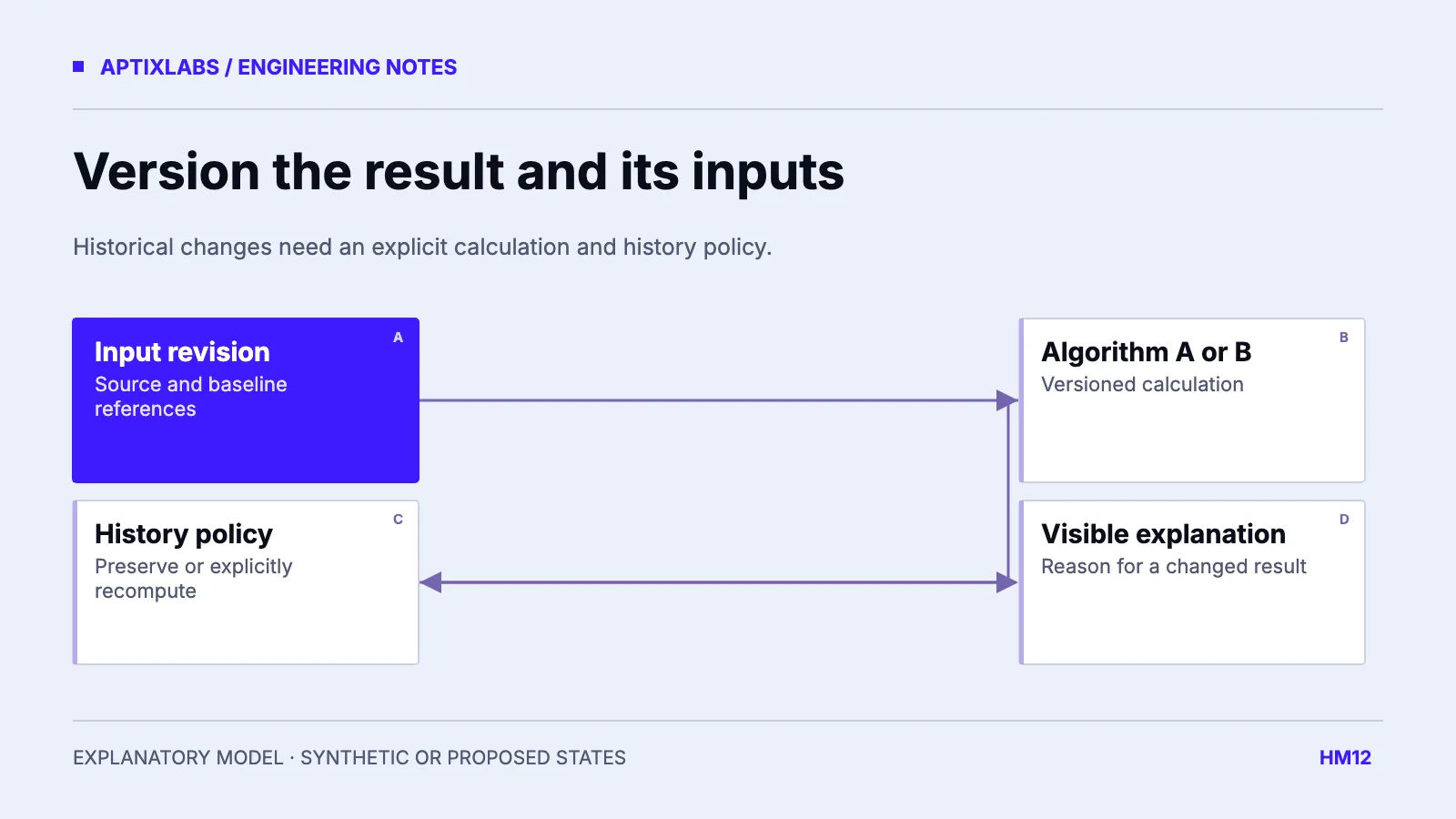
For an illustrative calculation, A weights two normalized inputs equally: 0.5 × 80 + 0.5 × 40 = 60. B uses 0.6 and 0.4: 64. The four-point difference is caused entirely by the chosen formula, not a change in the person. These invented inputs demonstrate version semantics and carry no health interpretation.
Explain transitions where the number appears
Google Health’s first-party readiness documentation describes an updated algorithm and notes that displayed scores may change while new results are calculated. That is evidence that a provider communicates a calculation transition, not validation of an AptixLabs formula or a requirement to copy the provider’s scoring model.
Google Health: readiness algorithm changes and recalculation state
If recomputing history, tell users which dates and version are affected. A chart should not join old and new values into an apparently continuous physiological trend without acknowledging the methodology change. Keep export fields and coach views consistent with the visible explanation.
Make rollout and late data independently repeatable
The reviewed UltraFit360 calculation function combines strain, stress and recovery results and returns insufficient-data and baseline-coverage fields. This shows useful source-level separation. The narrow range does not establish persisted algorithm versions, historical recomputation policy or validation of its weights. Assess those requirements separately.
Queue recomputation by account, reporting interval and target version. Applying the same target twice should converge on one logical result. A late source correction should produce a new input revision, while a formula-only change should retain the same input revision. This distinction allows support to explain why a number moved.
Acceptance should cover missing inputs, insufficient baseline, rollback to the previous formula, mixed-version workers and account switching. Compare calculation and presentation evidence separately. A successful rollout means the selected version and history policy are inspectable; it does not establish that the score predicts an individual’s recovery.
Define how caches identify a versioned result. A key containing only account and date can briefly display an A result while a B detail view is open. Include the requested calculation context or replace cached results through a documented accepted-version policy. Test an export created during rollout as well as the chart. Reviewers should be able to identify which version each number represents without reconstructing deployment timing from infrastructure logs or guessing from when the screen was opened.
Apple watch recovery score architecture
Bring one client-to-coach workflow, current data contract and acceptance constraint to discuss a bounded fitness product build or integration pilot.
Explore health fitness app development
Should a new recovery-score formula silently replace historical scores?
No. Store the calculation version and inputs, then explicitly choose whether history is preserved, recomputed or shown in comparable versioned views.
Does reproducing a recovery score validate it medically?
No. Reproducibility verifies calculation behavior. Physiological or clinical claims require separate appropriate evidence.