
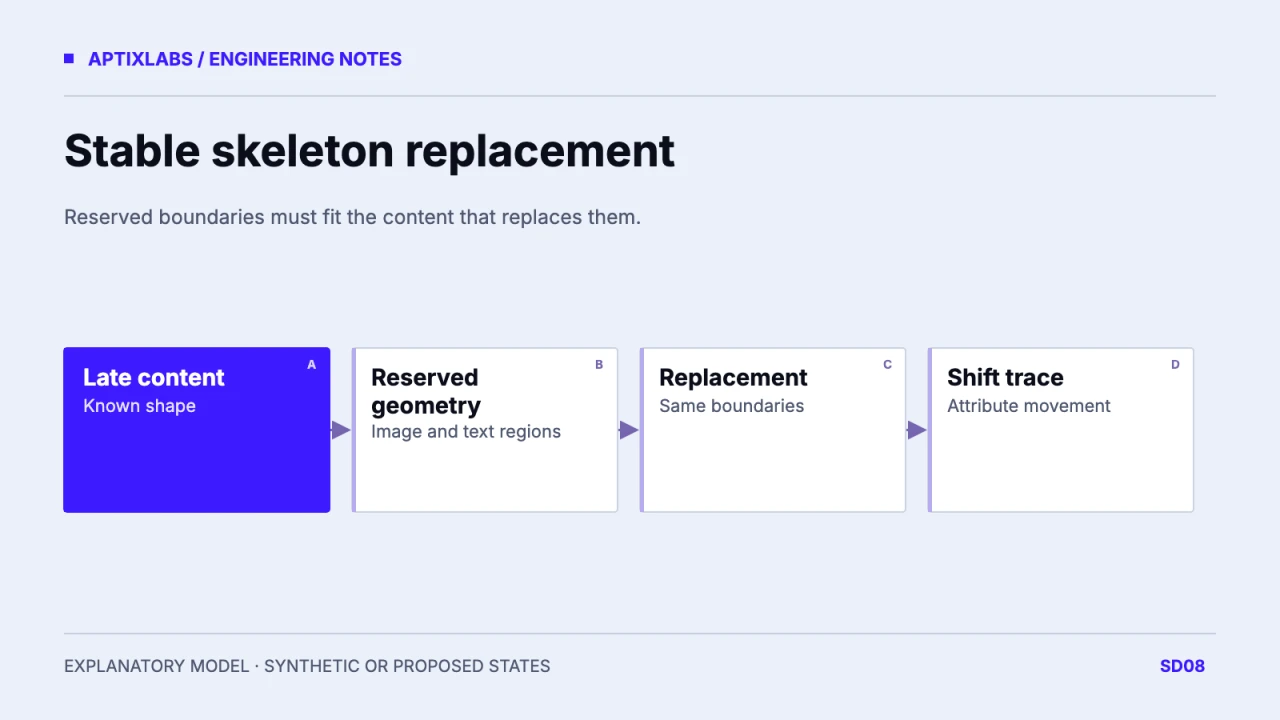
A skeleton prevents layout movement only when it reserves realistic space for the content that replaces it. Match image ratios and text regions, then measure the transition instead of treating a shimmer as proof of performance.
Identify which late content moves its neighbors
Start with one card or table region and list what arrives after initial rendering: image dimensions, title, status or a remote embed. Record the space each occupies before and after replacement. A centered spinner often reserves less height than the final card, moving everything below it. A skeleton can produce the same defect if its geometry is guessed. Keep loading duration and content stability separate: a stable placeholder may still wait too long, while fast content can shift noticeably. Choose one trace and explain what actually moved before applying a page-wide redesign.
Reserve an image ratio and plausible text area
Google’s CLS guidance identifies missing image dimensions, injected content and web fonts as common sources of shifts. Use intrinsic width and height or an intentional aspect ratio for the image region. Reserve text space based on the supported title length and line-height at each breakpoint. In a synthetic article card, a 16:9 image region plus two title lines provides a defined starting geometry. That is an illustrative design choice, not a guarantee that every title fits. If the final content may be much longer, the layout needs a truncation, expansion or variable-height policy rather than pretending the skeleton knows its exact size.
| Region | Reserved state | Review condition |
|---|---|---|
| Image | 16:9 boundary | Final crop uses same ratio |
| Title | Two-line minimum region | Long title policy explicit |
| Action | Stable row height | Enabled only with data |
| Failure | Useful recovery message | No endless skeleton |
Replace structure without changing the task
Keep the placeholder’s structure aligned with the eventual content hierarchy. A table-loading skeleton should preserve the meaningful columns and row density rather than suggest clickable data that does not exist. Avoid exposing every decorative placeholder to assistive technology. Announce a useful loading state and provide distinct empty, failed and partially loaded outcomes. Do not leave an endless skeleton after a failed request. For the card example, replacement should preserve the image boundary and title region while the action becomes available only when the actual record can support it.
.card__media { aspect-ratio: 16 / 9; }
.card__title { min-block-size: 2.8em; line-height: 1.4; }
@media (prefers-reduced-motion: reduce) {
  .skeleton { animation: none; }
}
Treat shimmer as optional motion
A moving highlight is a visual treatment, not the mechanism that reserves geometry. Provide a static equivalent when reduced motion is requested, and verify the treatment does not interfere with contrast or distract from usable content. Use the application’s established motion conventions. Avoid repeatedly remounting a placeholder when background data refreshes; preserving the current content with a bounded refresh indication may better support the task. The choice depends on whether existing data is safe to show. Keep those stale-data and permission rules explicit rather than using loading appearance to conceal an uncertain data state.
Measure the replacement under known conditions
Record viewport, content fixture, cache state and network conditions, then inspect layout-shift entries and a performance trace around replacement. Identify whether fonts, image decoding or another component caused the movement. A single local score is a lab observation, not field performance for all visitors. Compare the reserved card with a deliberately undersized region using the same fixture before interpreting the result. No CLS measurement was run for this article. The deliverable is a proposed measurement worksheet that links each observed shift to a changed boundary and a concrete correction.
AI-generated UI quality checklist
Bring a loading-to-content trace and the final card geometry to identify which boundary moves.
B2B SaaS development: scope and acceptance
Does a skeleton guarantee low CLS?
No. Its reserved geometry must fit the final content, and other elements such as fonts can still shift.
Is a faster loading spinner enough?
It can reduce waiting but does not reserve the height of the content that replaces it.