
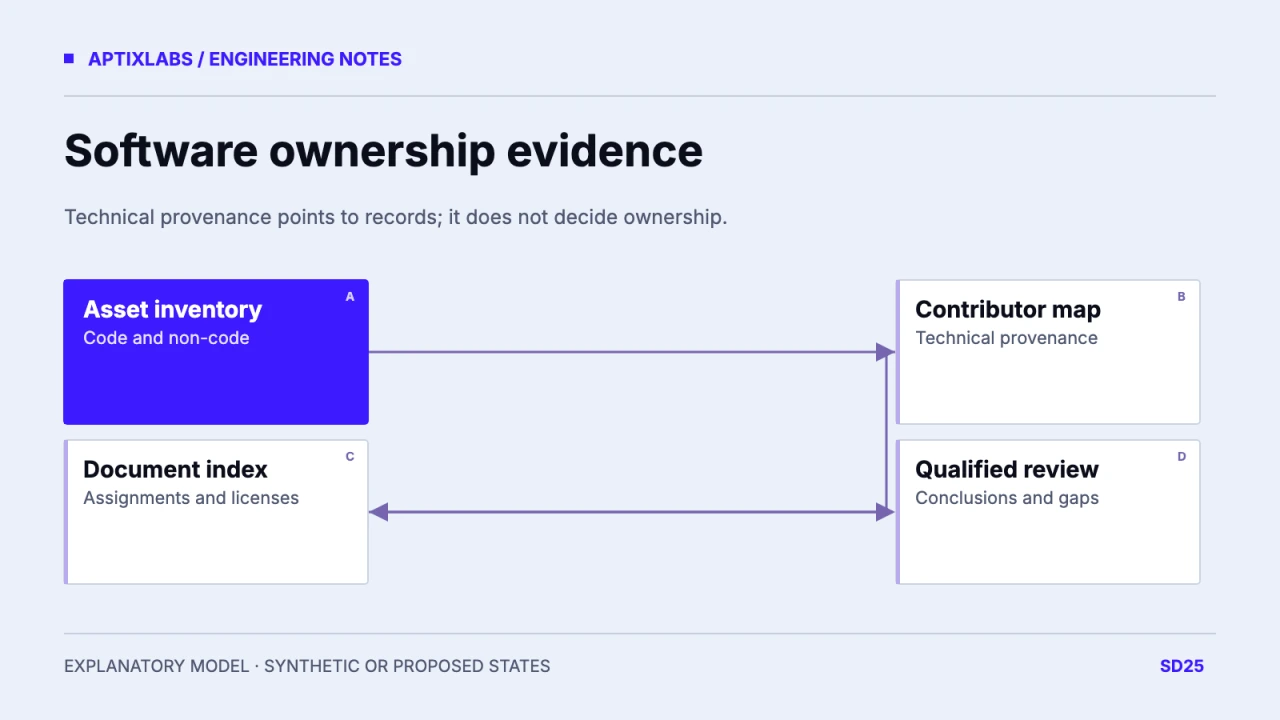
Prepare a software ownership evidence index linking repositories, contributors and third-party assets to the relevant documents. Git history helps trace technical contribution but does not by itself establish legal assignment or ownership.
Start with material assets and outputs
List repositories, deployed artifacts, domains, design files, datasets, illustrations and other inputs material to the product. Identify versions and where each asset appears in the delivered service. An ownership review limited to the main code repository can miss a build script owned elsewhere or an externally licensed image. Keep the inventory traceable with stable references and access controls. Kohler Law’s published diligence checklist describes records such as assignments, licenses and chain-of-title evidence; use it as an organizing reference while leaving legal conclusions to the qualified reviewer responsible for the transaction.
Map contributors without turning commits into assignments
A technical contribution register can identify founder, employee, contractor and agency contributions at a useful scope. Account aliases, pair work and imported histories can make commit attribution incomplete. Note that limitation rather than treating every line as a verified statement about authorship. Link a contributor to the corresponding executed agreement or missing-document status without publishing private contractual details. A contributor appearing in a repository proves neither that the company owns the work nor that it lacks rights. The engineering task is to expose the evidence path and unresolved questions for review.
| Asset | Technical trace | Document status |
|---|---|---|
| API | Employee contribution scope | Executed record reference needed |
| Interface | Contractor deliverable | Assignment review pending |
| Illustration | Source and build usage | License scope review |
| Unknown asset | Location and replacement path | Origin unresolved |
Include licensed and generated non-code inputs
Use a synthetic project with an employee-built API, a contractor interface and a licensed illustration. Record the employee and contractor document references separately, and attach the illustration’s license, source and permitted use evidence. If generated assets or code are included, preserve the applicable tool terms and available provenance rather than declaring that generation guarantees ownership. Do not invent a rights assignment retrospectively to fill an empty row. A missing agreement should remain a visible gap with an owner, so the reviewer can ask the right person for the actual record.
Distinguish technical gaps from legal findings
Use statuses such as located, incomplete, unavailable and pending review. Avoid a binary owned/not-owned column maintained by an engineer unless the qualified reviewer has established that conclusion for the stated scope. Keep disputed or sensitive material restricted and provide an index reference rather than copying entire documents into a broadly shared folder. If an artifact’s origin is unknown, identify where it is used and whether replacement is technically feasible. That gives the business options while the rights question is being resolved, without implying that replacing one file settles every legal issue.
Make the reviewer handoff reproducible
Deliver an asset index, contribution map, document references, known gaps and a contact for each question. Tie it to the release or transaction date and update it when new contractors, repositories or licensed assets enter the product. Record the reviewer’s conclusions in the proper controlled process rather than adding an unsupported badge to the public site. The example here is synthetic and no private agreements were inspected. The goal is an evidence pack that reduces searching and clarifies boundaries; it is not personal legal advice or a declaration of AptixLabs’ or another company’s ownership.
Startup technical data room checklist
Software maintenance handover checklist
Bring the asset index and missing evidence references to organize the technical side of reviewer preparation.
B2B SaaS development: scope and acceptance
Does a Git commit prove the company owns the code?
No. It is a contribution clue, not a substitute for the relevant agreements and legal review.
Should an engineer mark missing documents as lost ownership?
No. Record the evidence gap and route the question to the qualified reviewer.