
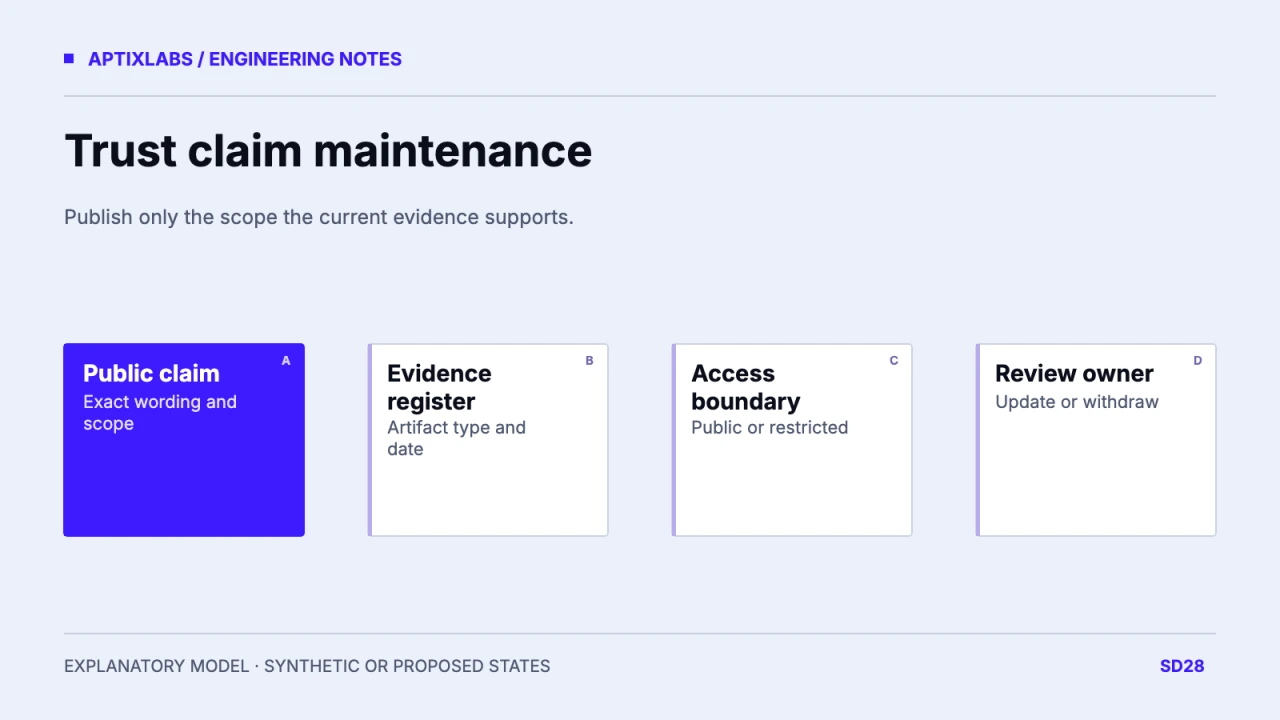
Build a trust center from claims the team can keep current. Separate public summaries from restricted evidence, connect each assurance to a dated artifact and remove certification language that the actual scope does not support.
Inventory promises already visible to buyers
Read the website, sales material, contracts and onboarding screens for security, privacy, uptime, backup and certification statements. Capture the exact claim and where it appears. A trust center that says less than a sales deck does not solve the inconsistency. Keep the scope attached to each statement: company practice, specific product, selected plan or configured customer environment. Atlassian’s trust center is a primary example of organizing trust topics and evidence access, not a template whose certifications or enterprise capabilities can be copied onto a startup site.
Map configured controls to demonstrated outcomes
For each claim, record its supporting policy, configuration or execution artifact and explain what that artifact establishes. A backup schedule supports a statement that backups are configured; it does not demonstrate that a restore succeeded. A restore exercise supports the tested recovery scope and date, not every future incident. Keep these distinctions in both public wording and the internal register. Avoid replacing a precise statement with vague language such as enterprise-grade security, which leaves a buyer unable to identify the actual control, product boundary or remaining uncertainty.
| Claim | Available evidence | Publication decision |
|---|---|---|
| Backups configured | Current schedule and scope | Describe verified configuration |
| Restore tested | No execution record in scenario | Keep pending |
| Certification held | No scoped report in scenario | Do not publish badge |
| Evidence available | Controlled access path | Explain request process |
Use the fictional backup claim to test wording
A synthetic startup wants to publish backups are tested. Its register contains a scheduled backup configuration but no completed restore record. The supported public statement should describe the configured backup practice if that configuration is verified, while the restore claim remains pending. Assign the planned exercise an owner and scope. After it is actually run, record the dataset, environment, result and exclusions before updating the summary. These fictional states are not a disclosure about AptixLabs’ backup practices. They show how the evidence type changes what a team can responsibly say.
Separate public explanation from restricted detail
Publish enough information for a buyer to understand the service boundary and request relevant evidence. Keep secrets, raw customer data and sensitive operational details out of public downloads. A controlled document room may hold a scoped report or redacted test summary, with access appropriate to the request. Do not use restricted access as a way to imply that a nonexistent certification is available on request. If no current report exists, state the actual status. Add a clear contact path and document review dates so buyers can ask questions without guessing what a badge represents.
Give every claim a maintenance trigger
Assign an owner, review date and change trigger such as a new hosting provider, feature, region or report expiry. Remove stale claims when evidence no longer applies. Keep the published revision and internal artifact references together so a reviewer can reconstruct what supported the page at a particular time. A trust center is a maintained product surface, not a one-time design deliverable. No trust page was published and no private assurance documents were inspected here. The useful output is a claim register and access model that can evolve with real evidence.
Health-product security claims need evidence.
B2B SaaS technical case study template
Bring the public claims and their current artifact references to scope a maintainable trust surface.
B2B SaaS development: scope and acceptance
Does a trust center establish certification?
No. Certification claims need the actual current scoped evidence and permission to describe it accurately.
Can backup configuration prove recovery?
No. A recovery claim needs an appropriately scoped restore exercise and its actual result.