
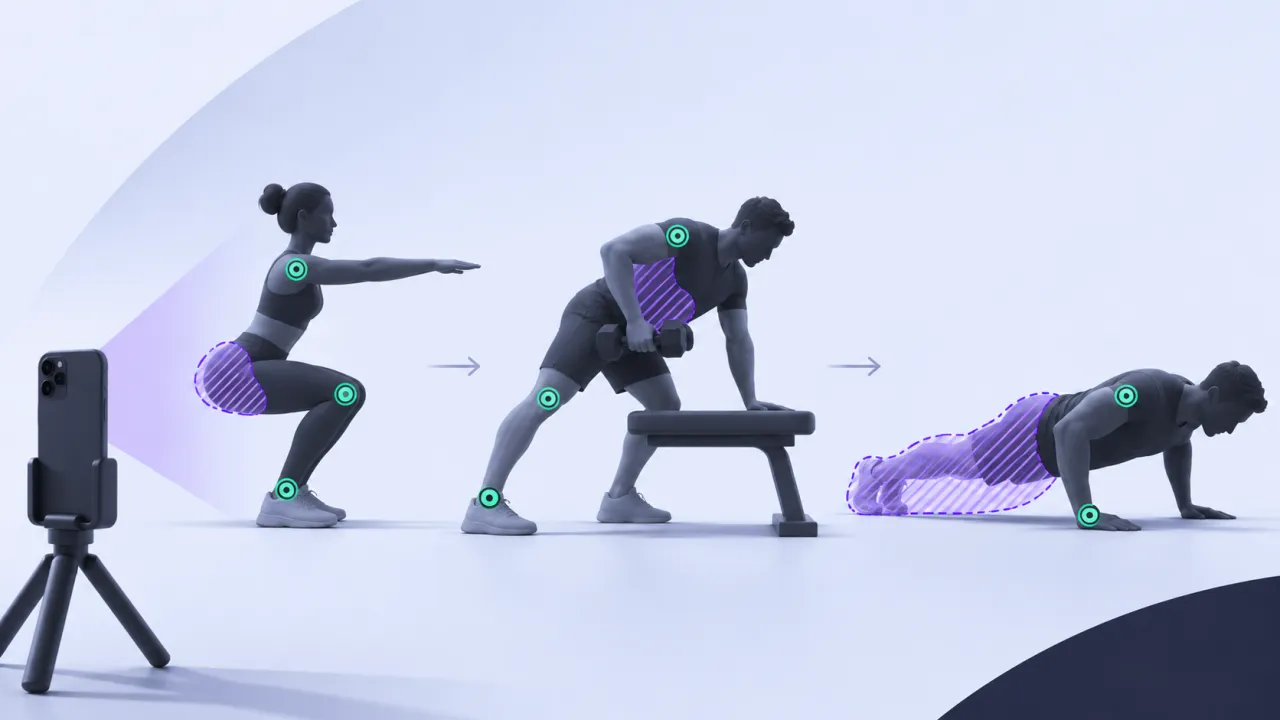
Camera-based exercise feedback depends on what the camera can actually observe. Lighting, angle, clothing, occlusion and exercise variation all affect the available landmarks. A useful product should define when it can offer a limited observation and when it must abstain instead of producing confident form advice.
The contract to define first
Separate person detection, pose landmarks, movement classification and coaching interpretation. Success at one stage does not validate the next. Build exercise-specific test sets with consented or synthetic material and document the capture conditions. A missing native module or low-confidence detection needs an explicit fallback, not a fabricated assessment.
A worked scenario
A synthetic squat recording hides the hips behind equipment. A landmark detector may still return a person box, but that does not establish enough information to assess the intended movement. The acceptance test should verify that the product recognizes the insufficient view and explains how to improve capture.
An implementation and review sequence
- Define the observable claim for each supported movement
- Test occlusion angle and unavailable-module states
- Provide an abstain state with useful capture guidance
Failure cases worth testing
| Condition or input | Expected behavior |
|---|---|
| Person box exists but key landmarks are absent | No unsupported form conclusion is shown |
| The camera angle is outside the tested setup | Explain the limitation |
| The native detector fails | Offer a transparent fallback |
Download the illustrative acceptance checklist (JSON)
Tradeoffs and limits
A narrower supported exercise and camera setup can be more useful than a broad promise of automatic correction. Independent validation is required before claims about accuracy, safety or injury prevention.
Where our product work provides context
The inspected UltraFit360 pose wrapper has explicit native-module and error fallbacks. It provides evidence of detection integration and failure handling, not independent validation of live exercise correction. A form-feedback product needs a separately tested movement interpretation layer before making broader claims.
Use the result to make a decision
The practical output is straightforward: build an evaluation plan for occlusion camera angle and missing landmarks. Keep the assumptions with the artifact so a product owner, implementer or prospective partner can review the same decision. A useful handoff states the supported scope, the evidence collected and the remaining dependency instead of treating a successful demonstration as proof of every operating condition.
Continue with related implementation detail
Related guide: Pose estimation in fitness apps: photo alignment versus form feedback
Fitness app accessibility during workouts
Nutrition logging uncertainty UX
References and current platform requirements
Android: health and fitness app design
The linked references provide platform or process context. The worked scenario and acceptance matrix are original examples; adapt them to the actual product, supported environment and documented responsibilities.
Discuss the workflow
Map one coach-to-client workflow with AptixLabs before expanding the feature list.
Explore the relevant AptixLabs service
When should camera-based form feedback abstain?
Camera-based exercise feedback depends on what the camera can actually observe. A narrower supported exercise and camera setup can be more useful than a broad promise of automatic correction.
Which failure cases should be included in the review?
Include these explicit cases: Person box exists but key landmarks are absent: no unsupported form conclusion is shown; The camera angle is outside the tested setup: explain the limitation; The native detector fails: offer a transparent fallback.