
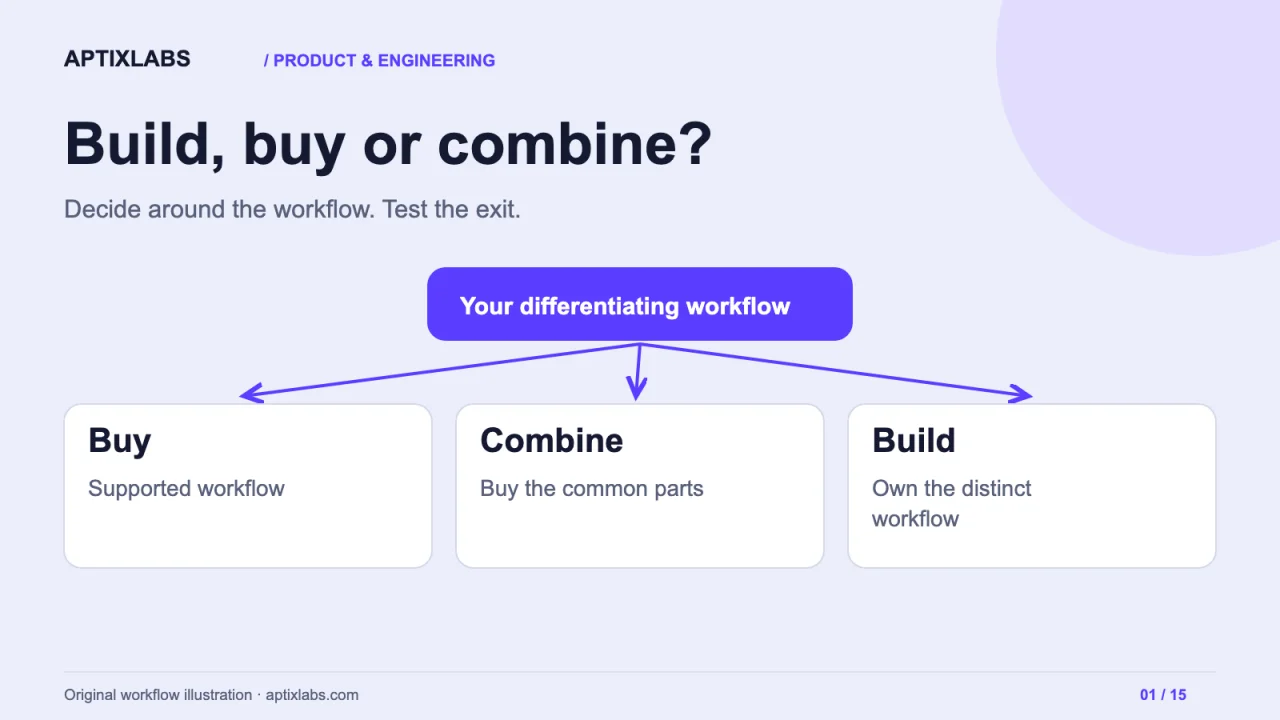
The build-versus-buy decision is easiest to get wrong when the demo becomes the requirements document. A vendor can demonstrate a polished workflow while your costly exception remains off screen. Start by identifying the task that makes your business different, then test whether a product can support it without a growing layer of manual work.
Run your exception through the demo
For a hypothetical coaching business, a standard plan assignment is easy to show. The revealing task is transferring a client between coaches while preserving history and removing the previous coach's access. Ask the vendor to demonstrate that exact journey with fictional records. Record what works, what requires configuration and what needs a custom integration.
Buying usually makes sense when the workflow is standard, the supported configuration is sufficient and the operating responsibilities fit your team. Building becomes more attractive when the differentiating behaviour cannot be represented safely, or when control over integration and data lifecycle is essential. Neither choice removes the need to operate the service.
| Requirement | Buying evidence | Building responsibility |
|---|---|---|
| Core workflow | Demonstration using your exception | Written acceptance journey |
| Data portability | Export sample with IDs and relationships | Export format and restoration test |
| Integrations | Supported API, limits and contract | Connector ownership and recovery |
| Availability | Vendor commitments and incident process | Monitoring and on-call ownership |
| Future changes | Published extension points | Roadmap and maintenance capacity |
Price the work around the subscription
A subscription fee is only one input. Include implementation, training, manual reconciliation, integration maintenance and the effect of usage limits. For a custom product, include discovery, delivery, support and infrastructure. Compare the same evaluation period and scenarios rather than an annual subscription against a one-time build estimate.
Do not manufacture a precise return-on-investment number from guesses. Write assumptions next to each quantity. If the main uncertainty is the time staff spend correcting imports, observe that task before modelling savings. A short measurement exercise can change the decision more than another vendor presentation.
Use a scoped development-cost worksheet
Test the exit before signing
Request a representative export. Can it reconstruct relationships, historical status and attachments? Are identifiers stable? Who can initiate an export, how long does it take, and what remains accessible when a subscription ends? A CSV containing names without the records those names connect to is not a complete migration plan.
Then test a small round trip into a neutral staging environment. Document fields that cannot be moved. For a custom system, run the same exercise: owning a repository does not guarantee usable backups, understood infrastructure or maintainable code. Exit readiness belongs in both options.
A combined approach needs a clear boundary
You can buy commodity capabilities and build the workflow around them. UltraFit360's implementation combines Firebase Auth with a separate application backend and mobile and web interfaces. That is an example of assigning responsibilities to different components, not evidence that every product needs the same stack.
Define which system owns each record and how failures are reconciled. Avoid a design where both the vendor and your application can independently decide the current subscription or account status without a conflict rule. An integration boundary should reduce work, not hide it.
Read the UltraFit360 implementation case study
Make a decision you can revisit
Write a short decision record: selected option, evidence, unresolved risks and a review trigger. A trigger might be an unsupported workflow becoming necessary, a changed commercial term or an integration reaching its agreed limit. This is more useful than declaring a platform permanently correct. AptixLabs can help test a difficult workflow and scope the custom portion before you commit to a full build.
When should a startup buy SaaS instead of building?
Buying is a strong option when the supported workflow, integration limits, data portability and operating commitments fit the business. Test difficult cases with representative data before deciding.
Does owning the source code eliminate vendor lock-in?
No. Operational knowledge, data formats, cloud dependencies and undocumented integrations can still make switching difficult. Test exports and restoration for custom systems too.