
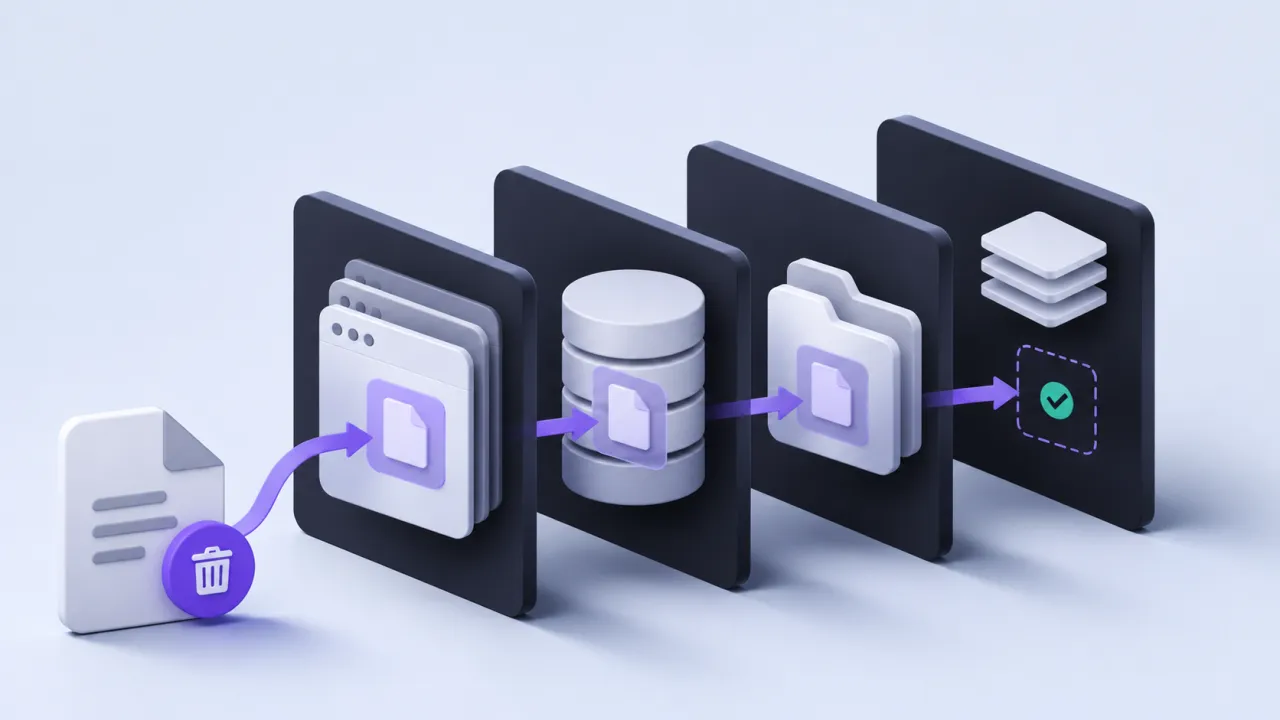
Deleting a customer record in the primary database may leave copies in caches, search indexes, exports and downstream integrations. A deletion-propagation design should identify every derived copy and define how the product knows removal has completed. Otherwise, deleted information can reappear through a secondary path.
The contract to define first
Maintain a dependency inventory and a deletion operation identity. Stop new derivations for records being removed, propagate tombstones or equivalent state, and retry failures in a controlled way. Search and cache access should respect current authorization and deletion state while asynchronous cleanup catches up. Backups need a separately documented lifecycle.
A worked scenario
A synthetic document is deleted while an indexing job is pending. If that job reads an old payload after deletion, it can recreate the search entry. The worker must check the current lifecycle state or use a versioned contract that prevents stale material from winning.
An implementation and review sequence
- Inventory primary derived and exported copies
- Prevent stale jobs from recreating removed material
- Track completion and exceptions by deletion operation
Failure cases worth testing
| Condition or input | Expected behavior |
|---|---|
| Indexing runs after removal begins | The document is not recreated |
| One dependency is unavailable | Cleanup remains visible and retryable |
| A stale cache entry exists | The access path respects current removal state |
Download the illustrative acceptance checklist (JSON)
Tradeoffs and limits
Synchronous deletion across every system can make the user request fragile. An explicit progress state and bounded asynchronous cleanup may be more robust, provided access is controlled immediately according to policy.
Use the result to make a decision
The practical output is straightforward: track removal across primary data cache search and exports. Keep the assumptions with the artifact so a product owner, implementer or prospective partner can review the same decision. A useful handoff states the supported scope, the evidence collected and the remaining dependency instead of treating a successful demonstration as proof of every operating condition.
Continue with related implementation detail
Related guide: Permission-aware RAG: keep private answers inside the right account
SaaS API rate limiting by tenant
Database connection pooling on Cloud Run
References and current platform requirements
Google Cloud: Cloud Run documentation
Firebase: test Firestore security rules
The linked references provide platform or process context. The worked scenario and acceptance matrix are original examples; adapt them to the actual product, supported environment and documented responsibilities.
Discuss the workflow
Discuss one reliability bottleneck, its impact, and a measurable acceptance task.
Explore the relevant AptixLabs service
How do you stop deleted data from reappearing?
Deleting a customer record in the primary database may leave copies in caches, search indexes, exports and downstream integrations. Synchronous deletion across every system can make the user request fragile.
Which failure cases should be included in the review?
Include these explicit cases: Indexing runs after removal begins: the document is not recreated; One dependency is unavailable: cleanup remains visible and retryable; A stale cache entry exists: the access path respects current removal state.