
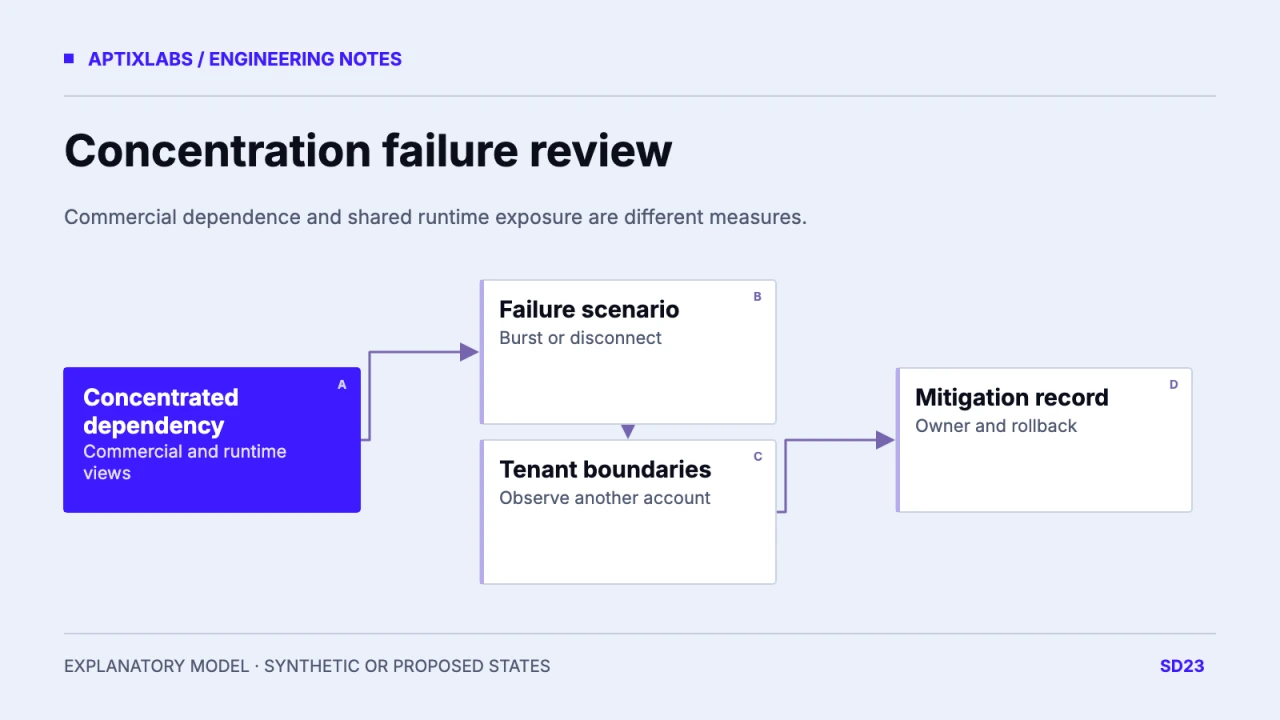
Translate customer concentration into engineering scenarios: tenant load, bespoke integrations, configuration and support dependency. A revenue share can signal a review need, but it does not describe which runtime boundary will fail.
Separate commercial concentration from runtime concentration
CFI’s customer-concentration reference describes dependence on a limited customer base. The engineering question is more specific: does one account dominate shared queues, storage, custom code or operational attention? A customer can have a large revenue share with isolated infrastructure, while a smaller free tenant can dominate expensive work. Keep those measures separate and do not assign a universal risk threshold. This article supports technical planning rather than an investment decision. Start with a fictional tenant and one product task whose dependencies can be traced without disclosing customer records.
Inventory customer-specific branches and integrations
List configuration flags, dedicated workers, data formats, external endpoints and manual support actions that exist for the large tenant. Record who understands each dependency and how it is tested. A shared component containing a tenant-specific conditional can create roadmap exposure even when the infrastructure is well isolated. Mark which exceptions are contractual, temporary or candidates for a general product capability. Do not remove special behavior solely because it is concentrated; understand the task and obligations first. The inventory should explain the cost of changing or disconnecting each dependency.
| Exposure | Experiment | Evidence to retain |
|---|---|---|
| Large job share | Burst NORTH workload | Other tenant task result |
| Custom endpoint | Mock provider outage | Bounded retries and recovery |
| Tenant-specific code | Exercise both configurations | No unintended shared branch |
| Single support owner | Receiver follows runbook | Missing knowledge recorded |
Model the isolated failure rather than forecasting a loss
In a synthetic case, tenant NORTH generates most background jobs and uses a custom scheduling endpoint. Two different failures matter: NORTH sends a burst, and the scheduling provider becomes unavailable. A burst should exercise admission control and fairness for other tenants. An unavailable endpoint should exercise bounded retries and recovery for NORTH’s work. Neither scenario proves the customer will churn or that revenue will fall by a predicted amount. Keep operational impact, commercial exposure and uncertainty in separate columns so the founder and platform lead can discuss the same evidence.
Observe the unaffected tenant as well
A test that only verifies NORTH receives a limit response can miss shared starvation. Include a second fictional tenant performing an ordinary task during the burst or dependency failure. Record queue age, completion result and any manual intervention under stated test conditions. Use a safe staging fixture and mocked third-party endpoint before considering a controlled production exercise. This guide specifies the experiment; no load test was run. Avoid inventing latency targets or claiming isolation from architecture diagrams alone. The acceptance threshold needs the actual product’s service expectations and operating budget.
Turn findings into bounded work and ownership
The decision worksheet should identify a specific failure path, evidence gap, mitigation owner and rollback. Potential work includes tenant-aware queues, configuration extraction, integration timeouts or reducing a single-person support dependency. Compare each change against its cost and business relevance rather than treating concentration as a reason for an automatic rewrite. Keep commercial decisions with the responsible leadership and advisers. The engineering handoff is successful when a reviewer can see what happens if the concentrated dependency becomes noisy, disconnected or unavailable, and which unaffected users were actually observed.
SaaS API rate limiting by tenant
AI startup technical due diligence: evidence beyond the demo
Bring one concentrated tenant dependency and its failure scenario to scope a bounded isolation review.
B2B SaaS development: scope and acceptance
Is there one safe customer-concentration percentage?
This guide establishes no universal threshold. Review the actual commercial and engineering dependencies separately.
Does a tenant rate limit prove isolation?
No. Observe shared queues and another tenant’s task during the relevant failure scenario.