
A health-sync battery budget begins with a freshness requirement and a representative workload. Increasing or reducing a polling interval alone does not establish energy impact. Measure equivalent device and build conditions, separate application work from wearable collection, and report the actual supported trigger behavior.
Prerequisites are a defined workflow, supported platforms, native dependency versions and a measurement method. “Always up to date” is not an engineering requirement. A coach reviewing yesterday’s summary and a person viewing a live exercise signal have different freshness needs and may require different data paths.
Inventory where work actually happens
| Trigger | Work to inspect | Freshness question |
|---|---|---|
| Foreground open | Local read, transform and upload | What must appear for this task? |
| Platform background event | Bounded reconciliation | What execution is actually supported? |
| Resume after interruption | Replay and catch-up | How much backlog is processed? |
| No new source data | No-op or repeated read | Can redundant work be avoided? |
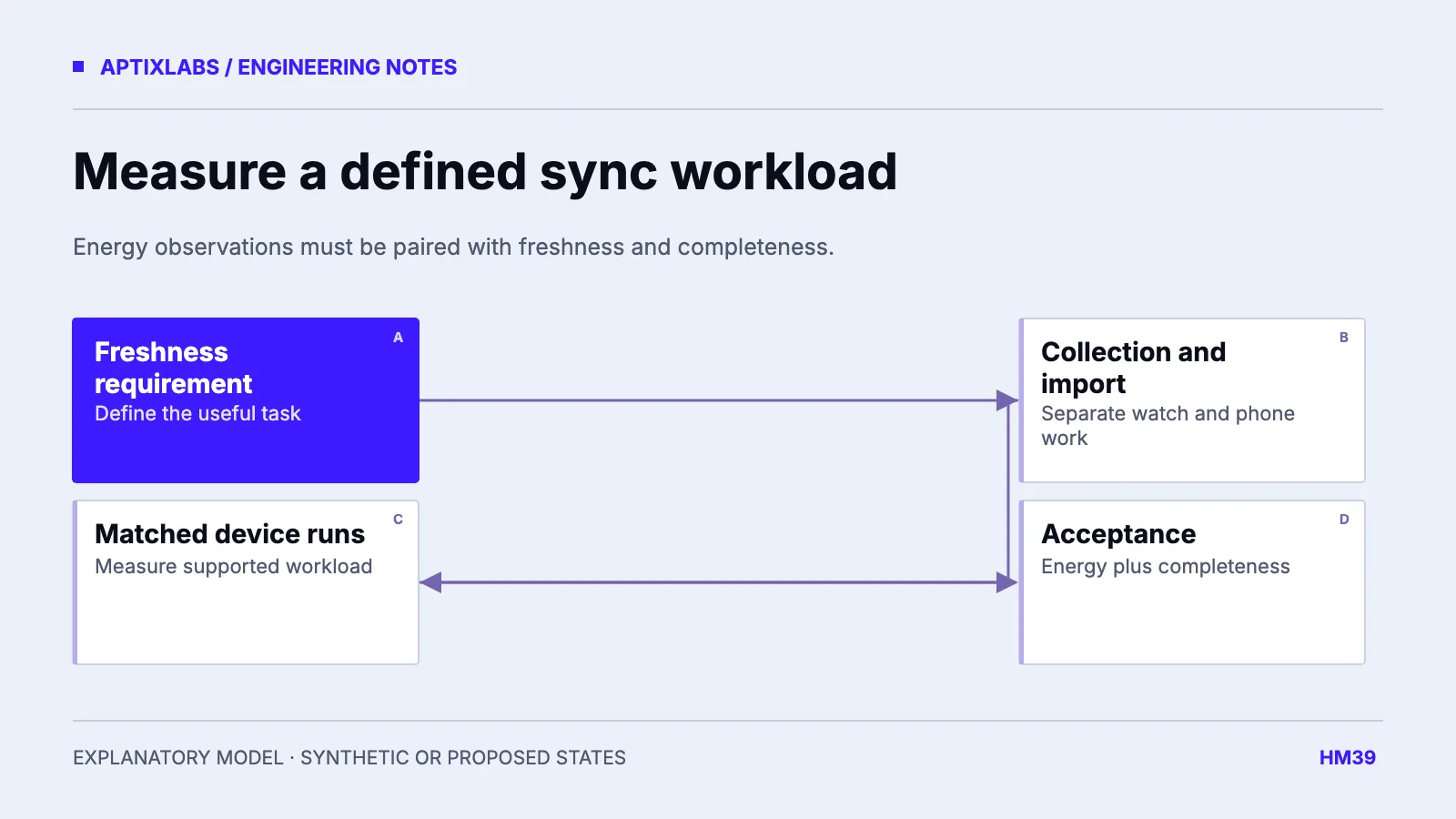
The worksheet is a measurement plan, not an energy result. Include database writes, serialization, cache invalidation and network upload as well as native reads. A low-cost provider query followed by an unnecessarily repeated backend upload can still be a costly application journey.
The reviewed UltraFit360 write service checks connection state and prior sync date before proceeding with a daily workflow. That source is useful for locating intended skip conditions. It does not establish a battery saving, background delivery frequency or released write-back capability on either platform.
Do not confuse Health Services with Health Connect
Android’s Health Services passive-monitoring guidance concerns Wear OS background collection over longer periods. It is relevant to a watch collection design, but it is not a scheduling guarantee for an arbitrary mobile Health Connect reader. Keep the watch sensor workload, phone import and backend synchronization as separate measurement subjects.
Android: passive background monitoring with Health Services
For phone imports, verify the current Health Connect background-read capabilities and permissions for the exact feature. On iOS, use the supported HealthKit lifecycle rather than promising a fixed polling cadence. A source timer or requested frequency does not prove how often a suspended application will execute.
Design an equivalent before-and-after comparison
Choose a release-like build, device models, OS versions, data volume and a fixed observation period. Record screen state, radio conditions, network quality, power mode and wearable connection. Compare idle baseline, a defined foreground import and a resumed backlog under matched conditions. Keep the number of successful useful syncs with the energy observation.
Repeat runs to expose variability and retain the trace or profiler output. A battery-percentage change on one short run is a coarse observation, not a universal power figure. If the optimization skips work, confirm that required records and corrections still arrive under the freshness contract.
Set acceptance around useful freshness
A proposed optimization can coalesce triggers, avoid uploads when nothing changed or bound replay batches. Each change should be assessed against completeness, correction propagation and time-to-useful-data. An apparent energy reduction that silently drops a page is not an acceptable sync improvement.
No device energy measurement was performed for this guide, and no synthetic saving percentage is supplied. Fill the worksheet with real observations before making claims. The conceptual figure should show collection, import and upload boundaries without an invented performance graph.
A scoped review should bring one target freshness requirement and a redacted workload trace. That allows the team to choose a supported trigger strategy and a measurement session that can confirm or reject an optimization, rather than increasing background frequency based on an unverified assumption.
Count retries and wake-ups along with successful imports. Two implementations can deliver the same final records while one repeatedly wakes to discover that nothing is readable. Retain failure and no-op counts in the workload trace, with redacted causes and observation conditions. This identifies avoidable work without assuming every skipped query is a saving. Recheck that coalescing does not delay a correction beyond the freshness requirement, especially after an offline period creates a larger than usual backlog.
Bring the specific record types, device/OS targets and one failing or proposed data journey to scope a wearable integration review.
Can a team claim lower health-sync battery use from a shorter interval alone?
No. Define the supported workload and freshness requirement, then measure equivalent device conditions before claiming an energy improvement.
Does Wear OS passive monitoring document phone Health Connect polling frequency?
No. They are different platform responsibilities and must be scoped and measured separately.