
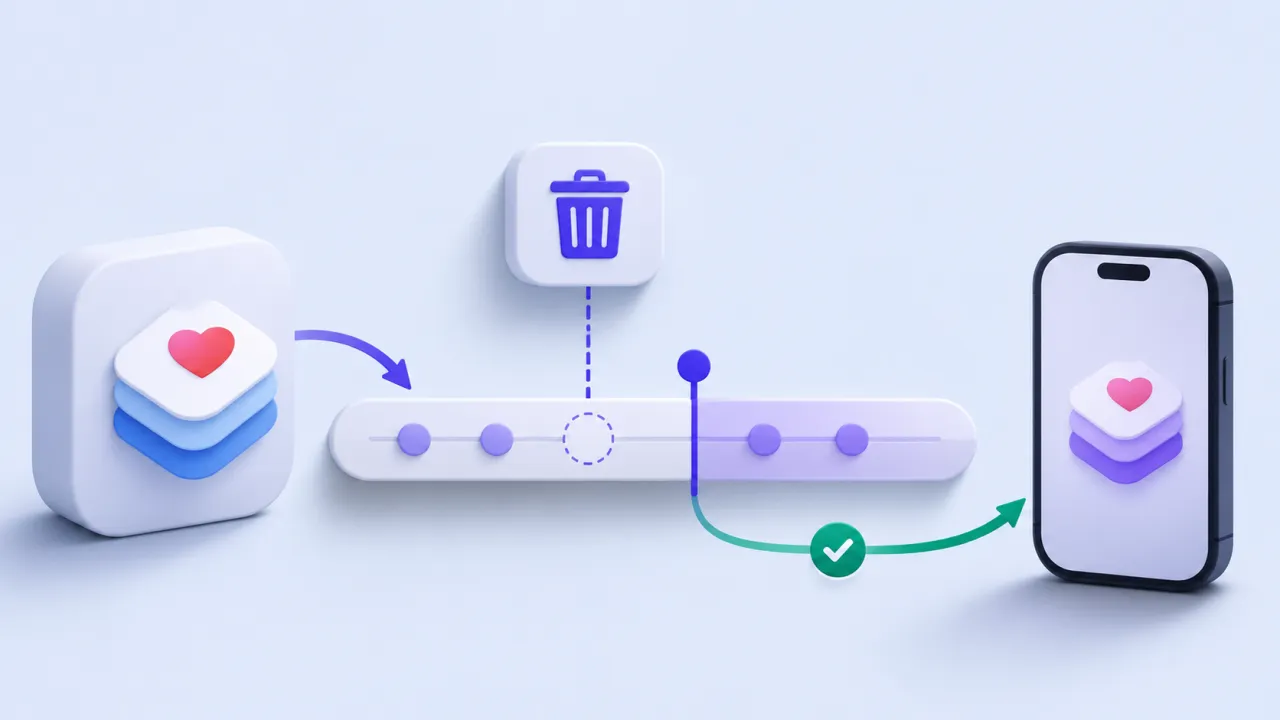
Health synchronization needs to handle records that disappear as well as records that arrive. A user may delete a sample or an originating app may correct its data. A local cache that only appends new observations can keep showing a value that no longer exists in HealthKit.
The contract to define first
Use the appropriate query lifecycle and persist a checkpoint only when the corresponding changes have been applied durably. Track the mapping between provider samples and local records so a deletion can remove the right copy and invalidate dependent summaries. Query state and permissions need separate handling: a lack of visible data is not automatically a deletion signal.
A worked scenario
A synthetic sleep sample contributes to yesterday’s total, then is removed at the source. The next successful synchronization must remove the mapped local contribution and refresh the summary. If the process crashes before checkpoint persistence, reapplying the change should not corrupt the result.
An implementation and review sequence
- Persist source-to-local record identity
- Apply changes before advancing the synchronization checkpoint
- Invalidate summaries affected by deletions
Failure cases worth testing
| Condition or input | Expected behavior |
|---|---|
| A deleted sample was previously imported | Its local contribution is removed |
| Sync crashes before checkpoint commit | Replaying changes remains safe |
| Read access is unavailable | Do not interpret an empty result as confirmed deletion |
Download the illustrative acceptance checklist (JSON)
Tradeoffs and limits
A full reconciliation can be simpler for a small bounded dataset, but it may cost more work than incremental changes. Choose the approach using data size and recovery requirements.
Use the result to make a decision
The practical output is straightforward: explain deletion propagation and anchored-query checkpoints. Keep the assumptions with the artifact so a product owner, implementer or prospective partner can review the same decision. A useful handoff states the supported scope, the evidence collected and the remaining dependency instead of treating a successful demonstration as proof of every operating condition.
Continue with related implementation detail
Related guide: HealthKit and Health Connect integration: what changes the quote
Health Connect duplicate records
References and current platform requirements
Apple: anchored HealthKit queries
Platform capabilities, programme terms and access conditions can change. Check the linked primary references against the version and account you actually use; the patterns above do not establish a provider approval, certification or universal compatibility guarantee.
Discuss the workflow
Bring the supported devices, required metrics, and your current sync failure examples.
Explore the relevant AptixLabs service
What happens when a HealthKit sample is deleted?
Health synchronization needs to handle records that disappear as well as records that arrive. A full reconciliation can be simpler for a small bounded dataset, but it may cost more work than incremental changes.
Which failure cases should be included in the review?
Include these explicit cases: A deleted sample was previously imported: its local contribution is removed; Sync crashes before checkpoint commit: replaying changes remains safe; Read access is unavailable: do not interpret an empty result as confirmed deletion.