
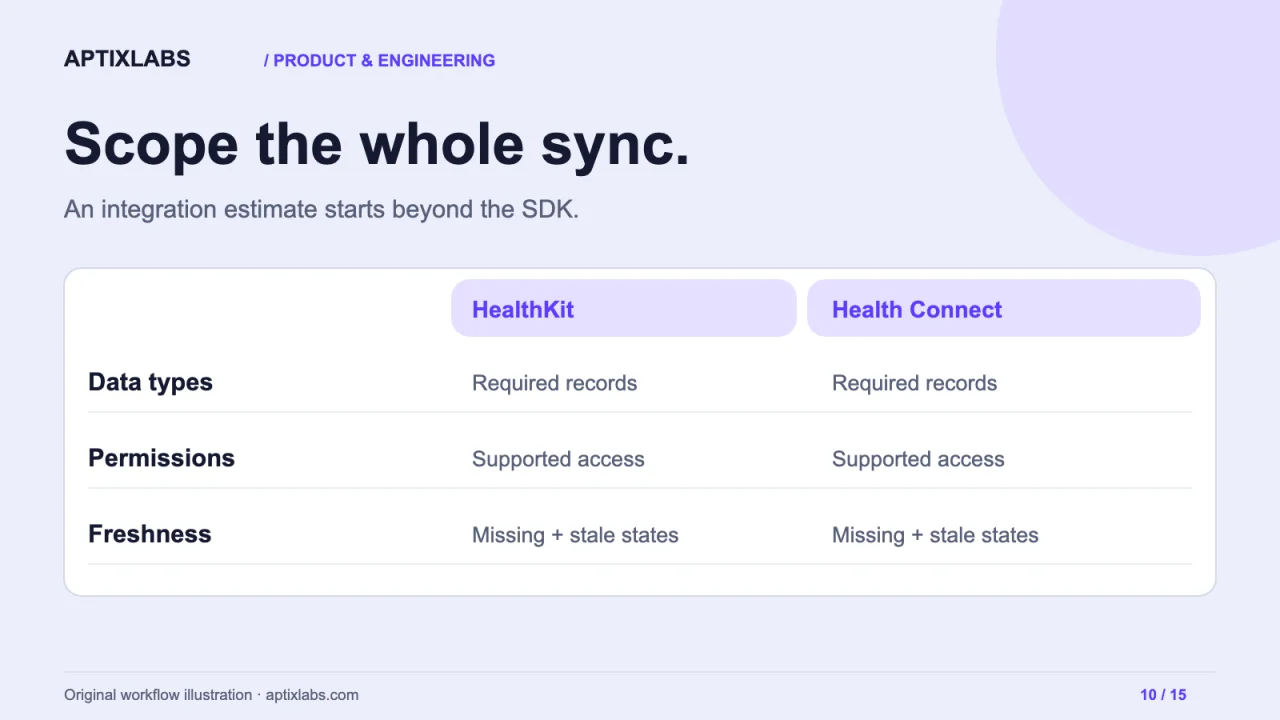
The cost of a health-platform integration depends less on the presence of an SDK than on the behaviour promised around the data. Reading one record in a development build is different from delivering a dependable experience across devices, permissions, time zones, missing inputs and account changes. Estimate the complete workflow.
Start with the product decision the data supports
Name the records required and explain how the product uses each one. A workout summary, daily activity view and recovery indicator have different needs. Specify whether data is read, written or both; whether historical records are needed; and what the interface shows when there is no usable input.
Avoid collecting every available signal simply because it may be useful later. Each additional type expands permission explanations, provenance handling and verification. A smaller, justified scope is easier to explain to users and easier to test.
| Scope item | Question for the estimate | Acceptance evidence |
|---|---|---|
| Data types | Exactly which records and fields? | Representative samples map correctly |
| Permissions | Read, write, history or background access? | Supported grant and withdrawal paths |
| Freshness | When should users expect an update? | Stale and pending states are visible |
| Provenance | How are overlapping sources handled? | No unexplained double counting |
| Time | Which day receives an overnight record? | Time-zone and boundary cases pass |
| Account lifecycle | What happens at sign-out or removal? | Old account data cannot appear in a new session |
Price platform differences explicitly
Apple documents fine-grained HealthKit authorisation and limits what an app can infer about read access. In particular, an absence of readable records should not be presented as certain proof that the user denied permission. Design a helpful missing-data state without claiming knowledge the platform intentionally withholds.
Reference: Apple HealthKit authorisation
Android's Health Connect documentation distinguishes ordinary reads from additional capabilities such as background access. Review current platform requirements and supported versions during scoping. Do not assume the iOS flow can be copied onto Android with only a different permission label.
Reference: Android Health Connect data reads
Include the tests that change the estimate
Test a device with no records, delayed synchronisation, overlapping sources and changed permissions. Add a user travelling across time zones and a record corrected after the first import. Establish stable identifiers or another justified reconciliation rule so repeated reads do not create duplicate application records.
Background work needs honest expectations: the operating system and source application can affect availability. A product should display the last usable update and distinguish missing inputs from a computed value. A dashboard that always displays a number can hide an integration failure.
How UltraFit360 informs the questions
UltraFit360's reviewed implementation includes health-related inputs and score calculation paths, with handling for unavailable inputs. That provides engineering context for freshness, calculation and presentation. It does not establish clinical validity or guarantee that another application's proposed data source is supported. A new device or partner integration still needs its own feasibility evidence.
Read the Apple Watch recovery architecture discussion
Request a phased quote
Separate a feasibility milestone from the full product integration when access or device behaviour is uncertain. The feasibility deliverable should include sample records, permission behaviour and unresolved constraints. The implementation milestone can then cover mapping, synchronisation, UI states and acceptance tests with fewer assumptions.
Bring AptixLabs the desired user outcome, target platforms, required records and any existing backend. We can discuss an integration scope and device-test matrix. A responsible estimate should say what has been verified and what still depends on external access or platform behaviour.
Why do HealthKit and Health Connect quotes vary so much?
Quotes may cover different data types, permissions, history, background behaviour, backend mapping and device tests. Compare the promised workflow and acceptance evidence rather than SDK installation alone.
Can an app always tell whether HealthKit read permission was denied?
No. HealthKit deliberately limits what applications can infer about read authorisation. Treat missing readable data carefully and avoid asserting that it proves a permission denial.